IUCN Red List Conservation Status


Least Concern

LC
NT
VU
EN
CR
EW
EX

Official assessment evaluated in accordance with the IUCN Red List of Threatened Species criteria: Least Concern.


Species Quick Facts

Scientific Name
Diaemus youngi

Average Lifespan
5-9 years in wild, 10-12 years in captivity

Average Weight
0.030-0.040 kg (0.066-0.088 lbs) – Males: 0.032 kg, Females: 0.038 kg

Average Length
7-9 cm (2.8-3.5 inches) – head-body length excluding tail

Overview & Identification

The whiteโ€‘winged vampire bat (Diaemus youngi) belongs to the order Chiroptera, family Phyllostomidae, and is one of only three true vampire bat species. It inhabits a broad swath of tropical Central and South America, ranging from southern Mexico through Guatemala, Honduras, Nicaragua, Costa Rica, Panama, and into northern South America including Colombia, Venezuela, Ecuador, Peru, Bolivia, and Brazil. The species prefers lowland evergreen and semiโ€‘evergreen forests, often roosting in caves, hollow trees, abandoned buildings, and under bridges near water sources. Its most distinctive feature is the striking white membrane that stretches across its wings, contrasting with the dark fur on its body. Specialized incisors and a reduced palate allow it to make precise, painless incisions in the skin of large mammals and birds, while its saliva contains a potent anticoagulant (draculin) that prevents clotting. Although classified as Least Concern by the IUCN, D. youngi faces localized pressures from habitat loss and human persecution, making continued monitoring essential for its longโ€‘term survival.

Behavior & Social Structure

Whiteโ€‘winged vampire bats are nocturnal and highly social, forming colonies that can number from a few dozen to several hundred individuals. Roosting sites are shared by both sexes and all age classes, fostering cooperative grooming and thermoregulation. Foraging begins shortly after sunset; bats use infrared-sensitive pits on their noses to locate blood vessels near the surface of potential hosts. They typically travel 5โ€“15 km from their roosts, often following river corridors where large mammals congregate. Communication relies on a repertoire of lowโ€‘frequency squeaks, chirps, and scent marks deposited on roost walls, which help maintain colony cohesion and delineate individual territories. While generally solitary during feeding, bats may aggregate at abundant food sources such as livestock corrals, where competition is mediated by brief aerial chases and vocal warnings.

Diet & Hunting Patterns

Diaemus youngi is an obligate sanguivore, feeding exclusively on the blood of warmโ€‘blooded vertebrates. Its diet includes the blood of large mammals such as cattle, horses, capybaras, and tapirs, as well as mediumโ€‘sized birds like ground doves and chickens. A single feeding event provides enough nourishment for several days, and individuals typically feed every 2โ€“3 days. Bats locate hosts by detecting heat signatures and carbonโ€‘dioxide plumes, then make a shallow incision with their razorโ€‘sharp incisors. The anticoagulant draculin in their saliva keeps the wound from clotting, allowing a steady flow of blood. On average, an adult consumes 15โ€“20 milliliters of blood per night, representing roughly 10% of its body mass. This specialized diet necessitates a high reliance on healthy livestock populations and undisturbed foraging habitats.

Reproduction & Life Cycle

Sexual maturity is reached at about 12 months for both males and females. Breeding in D. youngi is not strictly seasonal but peaks during the rainy season (Mayโ€“October) when prey availability is highest. Females typically give birth to a single pup after a gestation period of 4.5 months. The newborn weighs roughly 5 grams and clings to the motherโ€™s fur while she forages. Lactation lasts approximately 60 days, during which the pup gains weight rapidly, reaching 70% of adult mass by weaning. Maternal care continues for an additional 30 days as juveniles learn to locate hosts and develop the infrared sensory pits essential for feeding. Males do not participate in parental care but may assist in colony defense and grooming, indirectly supporting pup survival.

Threats & Conservation

The IUCN currently lists the whiteโ€‘winged vampire bat as Least Concern, estimating a stable global population of 50,000โ€“100,000 mature individuals. However, the species faces several localized threats. Deforestation for agriculture and cattle ranching reduces roosting sites and fragmentates foraging corridors. Human persecution, driven by misconceptions about disease transmission, leads to intentional roost destruction. Pesticide use can bioaccumulate in insects that bats inadvertently ingest, affecting reproductive success. Climate change may alter the distribution of suitable habitats and prey availability, especially in marginal northern ranges. Conservation actions include protecting cave roosts, promoting sustainable landโ€‘use practices, and public education campaigns to reduce unwarranted killings.

Interesting Facts

โ€ข The white wing membranes are among the most conspicuous features of any bat, providing camouflage against moonlit skies.
โ€ข D. youngi possesses infraredโ€‘sensing pits on its nose, allowing it to detect temperature differences as small as 0.1ยฐC.
โ€ข Unlike its relatives, the common vampire bat (Desmodus rotundus), the whiteโ€‘winged species prefers larger mammalian hosts and rarely feeds on birds.
โ€ข Its anticoagulant protein, draculin, has been studied for potential medical applications in treating bloodโ€‘clotting disorders.
โ€ข Whiteโ€‘winged vampire bats can live up to 12 years in captivity, considerably longer than most small bat species.

Description

The White-Winged Vampire Bat, Diaemus youngi, is a fascinating and unique species of bat belonging to the family Phyllostomidae. As the only member of the genus Diaemus, it stands out for its distinct characteristics and behaviors, particularly its feeding habits. This species is part of the New World leaf-nosed bats, known for their specialized noseleaves used in echolocation.

Appearance
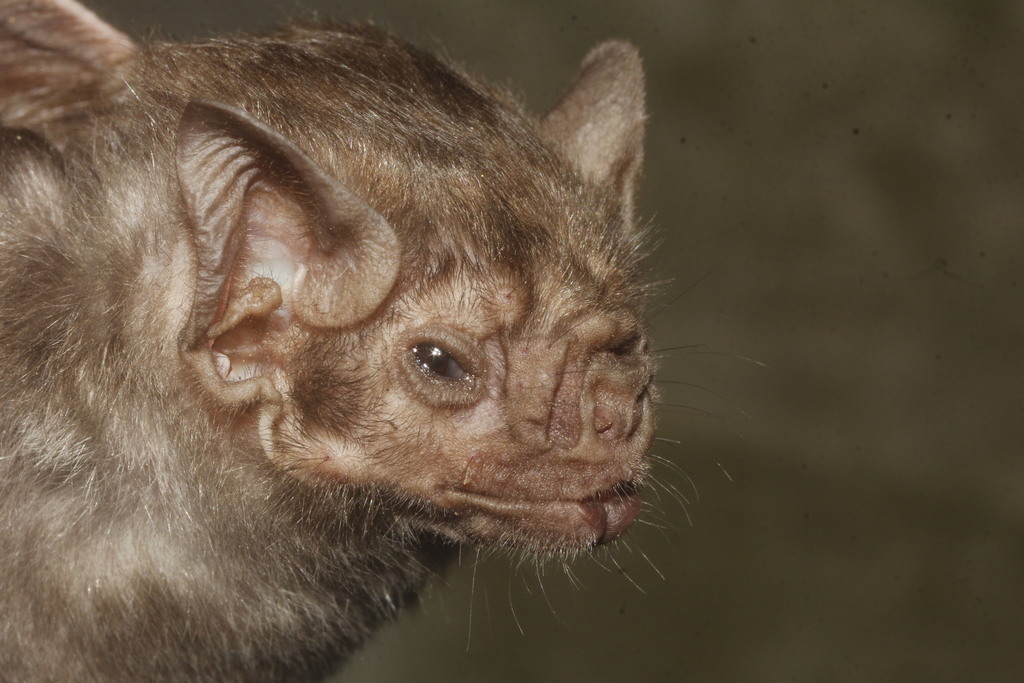
These bats are known for their striking appearance, characterized by short fur ranging in color from brown to reddish-orange, and long, pointed wings. One of the most distinguishing features of the White-Winged Vampire Bat is its dental structure, as it is the only bat species in the world with 22 teeth. Notably, the last upper molars are vestigial, and older individuals may lose them.

Distribution

The White-Winged Vampire Bat is found across a wide geographical range, spanning from Mexico to northern Argentina. Additionally, these bats are present on the islands of Trinidad and Margarita. Their distribution across these regions highlights their adaptability to diverse ecosystems and climates.

Habitat Preferences

White-Winged Vampire Bats thrive in a variety of habitats, including both wet and dry forests of South and Central America. They are well adapted to these environments and play a crucial role in their ecosystems. These bats are known to roost in hollow trees and caves, and they are particularly associated with tropical and subtropical regions.

This comprehensive species profile provides a detailed insight into the unique characteristics, distribution, and habitat preferences of the White-Winged Vampire Bat, shedding light on its importance within the ecosystems it inhabits.

Facts About White-Winged Vampire Bat

  • The white-winged vampire bat (Diaemus youngi) is the only member of the genus Diaemus.
  • They are found from Mexico to northern Argentina.
  • White-winged vampire bats have not been observed locomoting on the ground in the wild.
  • Contrary to previous reports, D. youngi has been maintained on a diet of defibrinated bovine blood supplemented weekly with fresh chicken blood.
  • In the Neotropical region, the white-winged vampire bat (Diaemus youngi) is the rarest of the three species of vampire bats.
  • Limited information on white-winged vampire bats indicates that their saliva (like Desmodus) possesses a plasminogen activator.
  • Its fur is short, ranging in color from brown to reddish-orange; its wings are long and pointed; and the first segments of the thumb are elongated.
  • White-winged vampire bats are found in The Neotropics and The Nearctic.
  • The virome of the white-winged vampire bat Diaemus youngi is rich.
  • They are a species of bats in the family New World leaf-nosed bats.


Scientific Provenance & Verified Sources

Biological taxonomy, conservation status, and physical traits are cross-referenced with authoritative global registers:


Peer-reviewed by Wildlife Science Editors โ€ข Updated for 2026

Explore Other Species Profiles