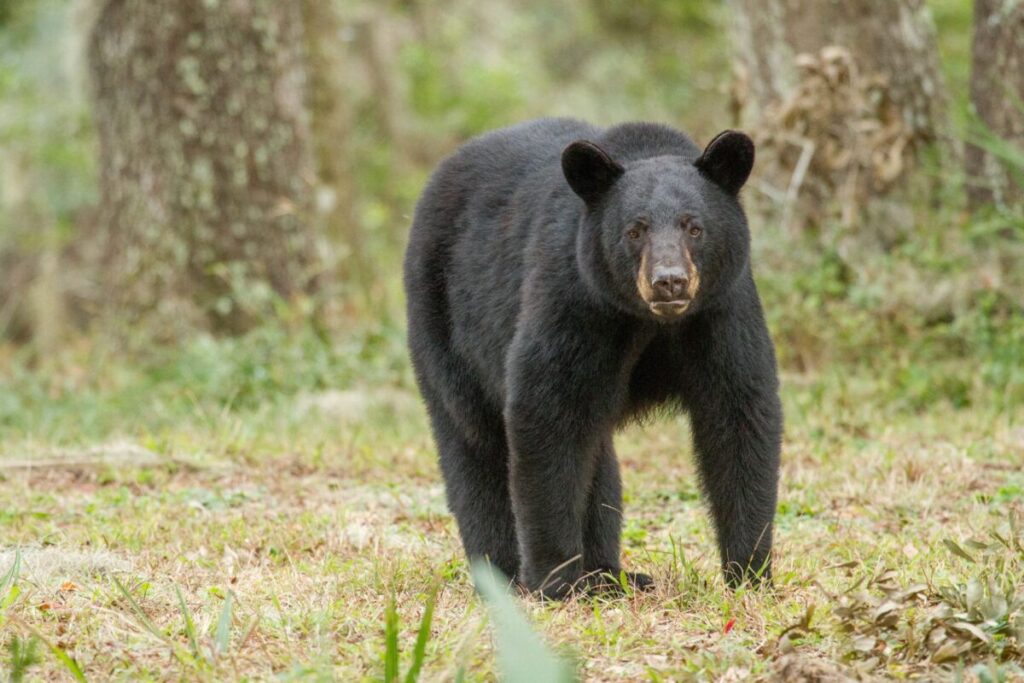
Florida black bear standing in a sunlit forest clearing

IUCN Red List Conservation Status


Least Concern

LC
NT
VU
EN
CR
EW
EX

Official assessment evaluated in accordance with the IUCN Red List of Threatened Species criteria: Least Concern.


Species Quick Facts

Scientific Name
Ursus americanus

Average Lifespan
15-20 years in wild

Average Weight
68-230 kg (150-500 lbs)

Average Length
up to ~180 cm (6 ft) head-body

Overview & Identification

Florida Black Bear (Ursus americanus floridanus)

Description

The Florida black bear, scientifically known as Ursus americanus floridanus, is a subspecies of the American black bear. These large mammals are characterized by their black fur and robust build, with adult males typically weighing between 250 to 450 pounds and measuring around 5 to 6 feet in length. They are known for their keen sense of smell and sharp claws, which aid in foraging for food and navigating their forested habitats.

Appearance
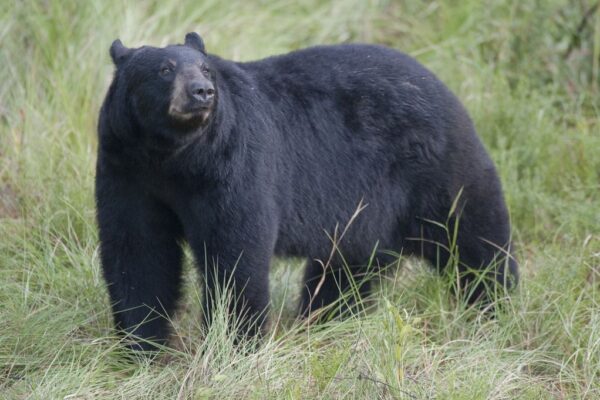
Florida black bears are visually similar to other American black bear subspecies, but they are distinguished by their slightly smaller size and a more slender skull. Their coat ranges from black to dark brown, and they may have a small white patch on their chest. These bears have a distinctive shoulder hump, a feature common to all black bear species, which aids in supporting their powerful forelimbs and gives them a distinctive silhouette.

Distribution

The historic range of the Florida black bear encompassed most of Florida and the southern portions of Georgia, Alabama, and Mississippi. However, due to habitat loss and fragmentation, their population has become fragmented, leading to isolated pockets of bears in specific regions. Notable efforts for conservation and management have focused on preserving and connecting these fragmented populations to ensure the long-term viability of the species.

Habitat Preferences</h

Behavior & Social Structure

The Florida black bear (Ursus americanus floridanus), a subspecies of the American black bear, is primarily crepuscular and nocturnal, though it can be active during daylight hours in undisturbed areas with low human presence. Activity peaks at dawn and dusk, particularly during the fall hyperphagia period when bears must consume large quantities of food to build fat reserves. Unlike bears in northern climates, Florida black bears typically do not undergo true hibernation due to the mild subtropical climate; instead, pregnant females enter a modified winter dormancy in dens for birthing, while other bears may remain active or reduce activity only marginally during cooler months.

Florida black bears are solitary animals except during the breeding season or when females are accompanied by cubs. Adult males maintain large, overlapping home ranges that can span 40 to 60 square miles, while females occupy smaller ranges of roughly 8 to 15 square miles, often influenced by resource availability and habitat fragmentation caused by Florida’s rapid urban development. Bears communicate through scent marking on trees (via clawing, rubbing, and biting), vocalizations such as huffs, jaw-popping, and woofs to signal stress or warning, and body language including head-lowering and ear-flattening in agonistic encounters.

Due to increasing habitat fragmentation from roads and suburban expansion, Florida black bears have adapted by traveling through wildlife corridors and occasionally foraging near human developments, leading to a rise in human-bear interactions. Their intelligence and strong spatial memory allow them to recall the locations of seasonal food sources across their expansive ranges year after year.

Diet & Hunting Patterns

As opportunistic omnivores, Florida black bears consume a highly varied diet that shifts seasonally based on availability. Roughly 80% of their diet consists of plant matter, including saw palmetto berries, acorns, blueberries, blackgum fruit, and various other mast-producing trees found throughout Florida’s forests, scrublands, and wetlands. Acorn and palmetto berry abundance in the fall is particularly critical, as bears enter hyperphagiaโ€”consuming up to 20,000 calories a dayโ€”to accumulate fat reserves ahead of winter dormancy or denning season.

The remainder of their diet includes insects (especially ants, termites, and beetle larvae), small vertebrates, carrion, and occasionally fawns of white-tailed deer. Florida black bears are also known to raid human food sources such as garbage cans, bird feeders, and agricultural crops when natural food is scarce, a growing issue linked to habitat loss. They obtain most of their water needs from the moisture-rich vegetation and fruit they consume, supplemented by direct drinking from Florida’s abundant rivers, swamps, and wetlands.

Reproduction & Life Cycle

Florida black bears are promiscuous breeders, with mating season occurring between June and August. Males compete for access to receptive females and may travel long distances to locate mates, but form no lasting pair bonds. Female black bears exhibit delayed implantation, meaning the fertilized egg does not begin developing until autumn, ensuring that cubs are born during winter denning (typically January to February) when the mother’s body condition and food reserves are optimal.

Litters typically consist of one to three cubs, born blind, hairless, and weighing under a pound. Cubs remain with their mother for approximately 16 to 18 months, nursing for the first several months and gradually transitioning to solid food. Female black bears provide extensive maternal care, teaching cubs foraging techniques and predator avoidance before family groups separate, usually just before the next mating season. Female Florida black bears typically reach sexual maturity around 3 to 4 years of age, while males mature slightly later, around 4 to 5 years.

Threats & Conservation

The primary threat to Florida black bears is habitat loss and fragmentation due to rapid urbanization, road construction, and agricultural expansion throughout Florida. This fragmentation isolates bear subpopulations into smaller genetic clusters, increasing the risk of inbreeding and reducing long-term genetic viability. Vehicle collisions represent one of the leading causes of bear mortality, particularly in high-traffic corridors that intersect fragmented forest habitats such as those near Ocala National Forest and the Big Cypress region.

Human-wildlife conflict is a growing concern as bears increasingly forage near residential areas due to diminished natural food sources, occasionally resulting in property damage or public safety concerns that can lead to conflict-related bear removals. Natural predators pose minimal threat to adult bears, though black bear cubs may occasionally fall prey to adult male bears or large predators such as Florida panthers. Conservation initiatives led by the Florida Fish and Wildlife Conservation Commission (FWC) include wildlife corridor projects, bear-proof waste management ordinances, and continued habitat protection efforts, contributing to a stable and recovering population that led to its removal from Florida’s state threatened species list in 2012.

Interesting Facts

  • State Comeback Story: Once reduced to fewer than 300 individuals in the 1970s due to habitat loss and unregulated hunting, the Florida black bear population has rebounded to an estimated 4,000+ individuals today, thanks to habitat protection and hunting regulations.
  • No True Hibernation: Unlike northern black bear populations, most Florida black bears do not fully hibernate due to the state’s mild winters; only pregnant females typically den for birthing purposes.
  • Exceptional Sense of Smell: Florida black bears possess an olfactory sense estimated to be up to seven times stronger than a bloodhound’s, allowing them to detect food sources from miles away.
  • Genetically Distinct Subspecies: Florida black bears are genetically distinguishable from other black bear populations in the southeastern United States, having evolved in geographic isolation within the Florida peninsula.
  • Wildlife Corridor Icon: The species has become a flagship symbol for the Florida Wildlife Corridor initiative, which aims to connect fragmented habitats across the state to preserve genetic diversity.
  • Impressive Climbers: Despite their bulk, Florida black bears are agile tree climbers, using this skill to escape threats, access food sources like fruit and honey, and allow cubs to evade predators.
  • Color Variation: While most Florida black bears have jet black fur, some individuals display brown or cinnamon coloration, a genetic trait more commonly seen in western black bear populations.

Description

The Florida black bear, scientifically known as Ursus americanus floridanus, is a subspecies of the American black bear. These large mammals are characterized by their black fur and robust build, with adult males typically weighing between 250 to 450 pounds and measuring around 5 to 6 feet in length. They are known for their keen sense of smell and sharp claws, which aid in foraging for food and navigating their forested habitats.

Appearance

Florida black bears are visually similar to other American black bear subspecies, but they are distinguished by their slightly smaller size and a more slender skull. Their coat ranges from black to dark brown, and they may have a small white patch on their chest. These bears have a distinctive shoulder hump, a feature common to all black bear species, which aids in supporting their powerful forelimbs and gives them a distinctive silhouette.

Distribution

The historic range of the Florida black bear encompassed most of Florida and the southern portions of Georgia, Alabama, and Mississippi. However, due to habitat loss and fragmentation, their population has become fragmented, leading to isolated pockets of bears in specific regions. Notable efforts for conservation and management have focused on preserving and connecting these fragmented populations to ensure the long-term viability of the species.

Habitat Preferences

Florida black bears thrive in a variety of habitats, including forested ecosystems such as sand-pine scrub, oak scrub, upland hardwood forests, and forested wetlands. These habitats provide the bears with ample food sources, shelter, and space to roam. They are primarily omnivorous, feeding on a diverse diet of plants, berries, insects, and occasionally small mammals, which are all readily available in their preferred habitats.

Overall, the preservation of these diverse habitats is crucial for the survival and well-being of the Florida black bear, as it directly impacts their ability to find food, establish dens, and maintain healthy populations.

Facts About Florida black bear

  • The Florida black bear (Ursus americanus floridanus) is a subspecies of the American black bear.
  • Adult Florida black bears typically weigh between 250 to 450 pounds.
  • Florida black bears can run up to 30 miles per hour for short distances.
  • Their diet primarily consists of berries, nuts, insects, and small mammals.
  • Female Florida black bears give birth to 1-3 cubs every other year.
  • They have a keen sense of smell and can detect food from miles away.
  • Florida black bears are typically solitary animals, except during the mating season or when a female is with her cubs.
  • Their population in Florida is estimated to be around 4,000 individuals.
  • Florida black bears are excellent climbers and swimmers.
  • The species is listed as threatened in Florida due to habitat loss and human-wildlife conflicts.


Scientific Provenance & Verified Sources

Biological taxonomy, conservation status, and physical traits are cross-referenced with authoritative global registers:


Peer-reviewed by Wildlife Science Editors โ€ข Updated for 2026

Explore Other Species Profiles