White-tailed jackrabbit sitting on a pine-covered forest floor

IUCN Red List Conservation Status


Least Concern

LC
NT
VU
EN
CR
EW
EX

Official assessment evaluated in accordance with the IUCN Red List of Threatened Species criteria: Least Concern.


Species Quick Facts

Scientific Name
Lepus townsendii

Average Lifespan
2-4 years in wild, 5-7 years in captivity

Average Weight
2.5-4.5 kg (5.5-9.9 lbs) – Males: 3.0 kg, Females: 2.8 kg

Average Length
50-70 cm (20-28 inches) – head-body length excluding tail

Overview & Identification

The whiteโ€‘tailed jackrabbit (Lepus townsendii) is a mediumโ€‘sized lagomorph belonging to the family Leporidae. Classified within the order Lagomorpha, it is native to western North America, ranging from southern Canada through the United States to northern Mexico. It occupies a variety of open habitats, including shortgrass prairies, sagebrush steppe, desert scrub, and agricultural fields, where its cryptic coloration blends with the ground. Distinctive features include exceptionally long hind limbs, ears up to 15โ€ฏcm that aid thermoregulation, and a characteristic white patch on the tail that flashes when the animal runs. Primarily nocturnal, it relies on speed and keen senses to evade predators such as coyotes, hawks, and bobcats. The species is listed as Least Concern by the IUCN due to its broad distribution and stable population trends, although localized declines have been noted where intensive agriculture or urban development fragment its habitat. Conservation efforts focus on preserving native grasslands and monitoring disease outbreaks that can affect hare populations.

Behavior & Social Structure

Whiteโ€‘tailed jackrabbits are largely solitary, with individuals maintaining overlapping home ranges that are defended through scent marking and occasional footโ€‘thumping displays. They are crepuscular to nocturnal, emerging at dusk to forage and retreating to shallow depressions or dense cover during daylight. Territory size varies with habitat quality, ranging from 0.5 to 2โ€ฏkmยฒ. Communication relies on a repertoire of vocalizations, including highโ€‘pitched squeals when alarmed, and visual signals such as the flashing white tail tip. Footโ€‘thumping serves both as a predator alert to conspecifics and a warning to the threat itself. Seasonal movements are modest; during winter they may shift to lower elevations where forage remains accessible.

Diet & Hunting Patterns

The whiteโ€‘tailed jackrabbit is a strict herbivore, consuming a diet dominated by grasses, forbs, and lowโ€‘lying shrubs. In spring and summer, it prefers tender grasses such as bluebunch wheatgrass (Pseudoroegneria spicata) and forbs like lupine (Lupinus spp.). During autumn and winter, browse shifts toward woody vegetation, including sagebrush (Artemisia tridentata) and rabbitbrush (Ericameria nauseosa). An adult requires approximately 150โ€‘250โ€ฏg of dry matter per day, supplemented by water obtained from succulent plants and dew. Feeding is primarily selective grazing; the rabbit uses its large incisors to clip vegetation close to the ground, and its keen sense of smell to locate nutrientโ€‘rich patches. Seasonal dietary flexibility allows it to maintain body condition despite fluctuating resource availability.

Reproduction & Life Cycle

Sexual maturity is reached at about 10โ€‘12โ€ฏmonths for both sexes. Breeding commences in early spring (Marchโ€‘April) and can continue through late summer, with peak activity in May and June. After a gestation period of roughly 42โ€ฏdays, females give birth to litters of 2โ€‘5 leverets, typically twice per year. Newborns are precocial, born fully furred with eyes open within 10โ€‘12โ€ฏdays, and are capable of rapid growth. The mother nurses the young for 3โ€‘4โ€ฏweeks before they are weaned and become independent. Leverets achieve full adult size by 8โ€‘10โ€ฏmonths. Parental care is limited to the mother, who provides shelter in shallow depressions and protects the young through aggressive displays if threatened.

Threats & Conservation

The IUCN classifies the whiteโ€‘tailed jackrabbit as Least Concern, with an estimated global population exceeding 10โ€ฏmillion individuals and a stable trend overall. Nevertheless, several threats can cause local declines. Habitat loss due to agricultural expansion, urban sprawl, and energy development reduces available foraging grounds and shelter. Predation pressure from coyotes, raptors, and domestic dogs remains high, especially in fragmented landscapes. Disease outbreaks, notably tularemia (Francisella tularensis) and myxomatosis, can cause rapid mortality spikes. Climate change may alter precipitation patterns, affecting the growth of preferred grasses and increasing the frequency of droughts. Hunting for sport and fur, though regulated, adds additional mortality in some regions. Conservation actions focus on preserving native grassland ecosystems, monitoring disease prevalence, and maintaining connectivity between habitat patches.

Interesting Facts

โ€ข The whiteโ€‘tailed jackrabbit can run at speeds up to 64โ€ฏkm/h (40โ€ฏmph), making it one of the fastest mammals in North America.
โ€ข Its ears not only provide acute hearing but also dissipate heat, allowing the animal to survive extreme desert temperatures.
โ€ข Unlike true rabbits, jackrabbits give birth to fully furred, openโ€‘eyed leverets that can move shortly after birth.
โ€ข Footโ€‘thumping can generate vibrations detectable up to 300โ€ฏm away, serving as an early warning system for nearby conspecifics.
โ€ข Whiteโ€‘tailed jackrabbits have a remarkable visual field of nearly 360ยฐ, with large eyes positioned on the sides of the head.

Description

The White-Tailed Jackrabbit, scientifically known as Lepus townsendii, is a notable species of hare found in western North America. This large hare is distinguished by its striking appearance and unique behavioral traits, making it a fascinating subject for wildlife enthusiasts and conservationists alike.

Appearance
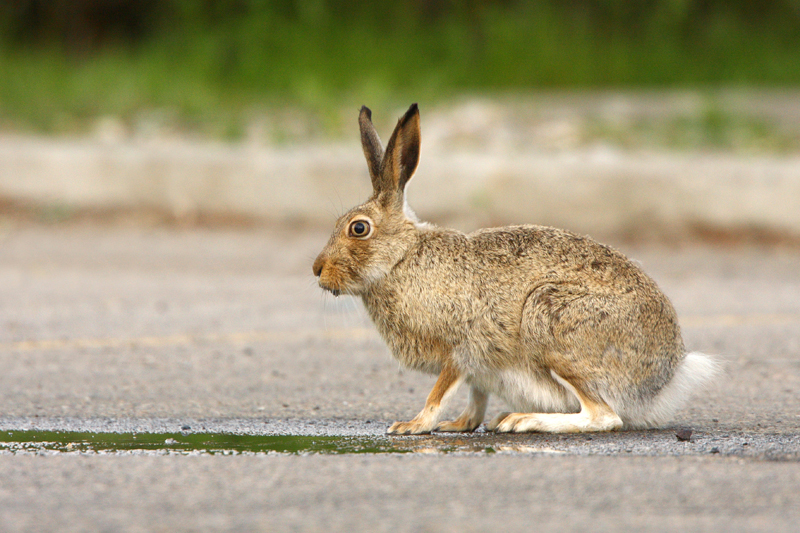
The White-Tailed Jackrabbit is characterized by its distinctive features, including a grayish-brown fur coat, long ears rimmed in white and tipped in black, and the eponymous white tail. These physical attributes set it apart from other species and contribute to its remarkable visual appeal. The species’ physical characteristics also play a crucial role in its adaptation to its natural habitat.

Distribution

The White-Tailed Jackrabbit is primarily found in western North America, with notable sightings in urban and suburban parks in Western Canada. Its distribution spans across regions with suitable environmental conditions, allowing for a diverse range of habitats to support its population. Understanding the distribution patterns of the White-Tailed Jackrabbit is essential for conservation efforts and the preservation of its natural habitats.

Habitat Preferences

White-Tailed Jackrabbits thrive in a variety of ecosystems, including grasslands, shrublands, and open woodlands. These habitats provide the necessary resources for their survival, including food sources and shelter. The species’ ability to adapt to different environments underscores the importance of conserving these diverse ecosystems to ensure the well-being of the White-Tailed Jackrabbit and other species that share its habitat.

By shedding light on the unique characteristics, appearance, distribution, and habitat preferences of the White-Tailed Jackrabbit, this species profile aims to foster a deeper understanding and appreciation for this remarkable mammal, while also highlighting the significance of conservation efforts to protect its natural environment.

Facts About White-Tailed Jackrabbit

  • The White-tailed jackrabbit (Lepus townsendii) is the largest member of the rabbit and hare family, weighing from six to ten pounds.
  • It is found in western North America and is often seen in urban and suburban parks.
  • White-tailed jackrabbits are known for their distinctive long legs and large ears.
  • They have a lifespan of up to 8 years in the wild.
  • White-tailed jackrabbits are herbivores, primarily feeding on grasses, herbs, and twigs.
  • They are well-adapted to open meadows and flat-topped hills with open vegetation.
  • The tail of the White-tailed jackrabbit is always white and may possess a buffy dorsal stripe.
  • These jackrabbits have a characteristic behavior of “hopping” or “bounding” to move quickly.
  • The scientific name for the White-tailed jackrabbit is Lepus townsendii.
  • They are an important part of the ecosystem, serving as prey for various predators.


Scientific Provenance & Verified Sources

Biological taxonomy, conservation status, and physical traits are cross-referenced with authoritative global registers:


Peer-reviewed by Wildlife Science Editors โ€ข Updated for 2026

Explore Other Species Profiles