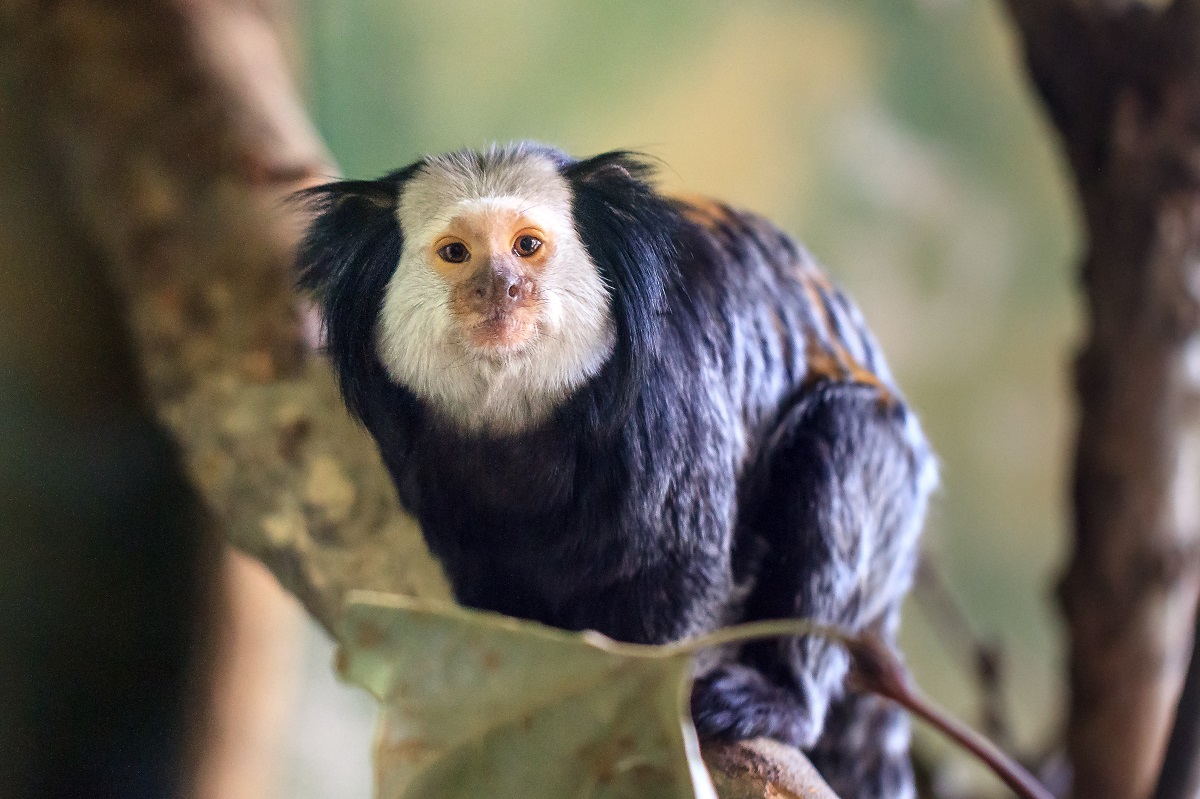
White-headed marmoset

IUCN Red List Conservation Status


Endangered

LC
NT
VU
EN
CR
EW
EX

Official assessment evaluated in accordance with the IUCN Red List of Threatened Species criteria: Endangered.


Species Quick Facts

Scientific Name
Callithrix geoffroyi

Average Lifespan
About 10 years in the wild, up to 17.6 years recorded in captivity

Average Weight
Males: 230-350 g (8-12 oz), Females: about 190 g (6.7 oz)

Average Length
18-23

Overview & Identification

The white-headed marmoset, or Geoffroy’s marmoset, is a small monkey of the Atlantic forest of eastern Brazil, recognised by its pale white face and forehead. It lives in family groups and uses chisel-like teeth to gouge tree bark and feed on the gum that flows out, along with insects and fruit. It is quick and agile in the trees.

Behavior & Social Structure

The white-headed marmoset (Callithrix geoffroyi), also known as Geoffroy’s marmoset, is a strictly diurnal primate, beginning activity shortly after sunrise and retreating to sleeping sites—typically dense vine tangles, tree holes, or epiphyte clusters—before dusk. Activity peaks occur in the early morning and late afternoon, with a midday rest period during the hottest hours, a pattern typical of small-bodied Atlantic Forest primates balancing thermoregulation with foraging needs. Groups move through the forest in a coordinated, quadrupedal manner, using claw-like nails (tegulae) to cling vertically to tree trunks, an adaptation shared across Callithrix species that facilitates exploitation of gum-feeding niches.

Social organization is cooperative and group-living, with troops of 2 to 14 individuals (commonly 6–9) composed of a dominant breeding pair, their offspring, and sometimes additional adult helpers of both sexes. These extended family groups display cooperative infant care, with juveniles, subadults, and even unrelated males assisting in carrying and provisioning infants—a hallmark of callitrichid biology. Communication is multifaceted, including high-pitched trills and long calls for long-distance contact, soft twitters for group cohesion, and specific alarm calls that vary depending on predator type (aerial vs. terrestrial threats). Scent marking via specialized circumgenital and sternal glands is used extensively to communicate reproductive status and demarcate territory boundaries.

Home ranges are relatively small, typically between 0.5 and 3 hectares, but troops defend these areas vigorously against neighboring groups through vocal duels, scent marking, and occasionally physical confrontations at territory edges. This territoriality is closely tied to defense of key gum-exuding trees, which serve as a stable, renewable food resource. The species’ small body size, agility, and cryptic coloration in some populations further aid predator avoidance, while a keen reliance on group vigilance allows individuals to forage with reduced individual predation risk.

Diet & Hunting Patterns

Callithrix geoffroyi is an omnivorous gummivore-insectivore, with a diet dominated seasonally by plant exudates (gums, saps, and latex), fruits, and animal prey. The species possesses specialized dentition—elongated, chisel-like lower incisors—that allow it to gouge holes into the bark of specific tree species (including Anadenanthera and Enterolobium) to stimulate and harvest gum flow, a critical adaptation shared with other marmosets that permits survival during periods of fruit scarcity. Foraging bouts for insects, particularly orthopterans, spiders, and beetle larvae, involve active manual searching through bark crevices, leaf litter, and bromeliads, often using rapid pouncing movements.

Seasonal shifts are pronounced: during the wetter months when fruit is abundant, the diet shifts toward ripe fruits, flowers, and nectar, while during the dry season exudates become the primary caloric fallback resource, sometimes constituting over 30% of feeding time. Small vertebrates such as tree frogs, lizards, and nestling birds are opportunistically consumed, supplementing protein intake. Water is obtained primarily through food moisture (fruits and insects) and rainwater pooled in bromeliads and tree hollows, reducing dependency on ground-level water sources and further minimizing predation exposure.

Reproduction & Life Cycle

Breeding in Callithrix geoffroyi is not strictly seasonal, though births often correlate with periods of increased food availability at the onset of the wet season. The species exhibits a flexible mating system that ranges from monogamy to polyandry and polygyny depending on group composition, with a single dominant female typically monopolizing reproduction within a group through both behavioral dominance and physiological suppression of ovulation in subordinate females. Gestation lasts approximately 140 to 150 days, after which females most commonly give birth to twins, though singletons and, rarely, triplets occur.

Parental investment is notably cooperative: fathers, siblings, and helper adults share carrying duties almost immediately after birth, given the high energetic cost of transporting twin infants whose combined weight can exceed 20% of the mother’s body mass. Infants are weaned at approximately 3 months of age, though they continue to receive food sharing from group members well beyond weaning. Sexual maturity is reached between 12 and 18 months in females and slightly later in males, though reproductive suppression often delays actual breeding in subordinate group members until they disperse or ascend to dominant status.

Threats & Conservation

The white-headed marmoset faces its most severe threat from extensive habitat loss and fragmentation across its native range in the Atlantic Forest of northeastern Brazil (primarily Espírito Santo and southern Bahia), a biome that has been reduced to less than 12% of its original extent due to agriculture, cattle ranching, urban expansion, and eucalyptus plantations. Fragmentation isolates populations into small, genetically vulnerable subpopulations, increasing extinction risk through inbreeding depression and stochastic events. Compounding this, hybridization with introduced or range-expanding congeners—particularly the common marmoset (Callithrix jacchus) and black-tufted marmoset (Callithrix penicillata), both popular in the illegal pet trade and introduced outside their native ranges—poses a serious genetic threat, diluting the species’ distinct genetic identity through interbreeding.

Illegal capture for the pet trade remains a persistent pressure, alongside human-wildlife conflict in agricultural and peri-urban zones where marmosets raid crops and are sometimes killed as pests. Natural predators include forest raptors (such as hawk-eagles), small forest cats (margay and ocelot), and snakes, though these pressures are secondary to anthropogenic impacts. The IUCN currently lists the species as Endangered, with conservation initiatives underway through Brazilian protected areas (e.g., Reserva Biológica de Sooretama and Estação Biológica de Santa Lúcia), habitat corridor restoration projects, and hybridization monitoring programs led by Brazilian primatological research institutions in collaboration with international conservation NGOs.

Interesting Facts

  • Named After a Naturalist: The species’ common and scientific epithet honors French zoologist Étienne Geoffroy Saint-Hilaire, a contemporary of Georges Cuvier who made significant contributions to early comparative anatomy.
  • Gum-Gouging Specialists: Their lower incisors are uniquely elongated compared to other primates, functioning almost like tiny chisels to actively wound tree bark and stimulate continuous sap flow, rather than simply feeding on incidental leaks.
  • Obligate Twinning: Unlike most primates, female marmosets almost always give birth to twins that are typically fraternal but share a fused placenta, resulting in each twin carrying blood stem cells from its sibling—a rare natural case of chimerism in mammals.
  • Cooperative Fatherhood: Males often carry infants more than mothers do, sometimes for up to 70% of daylight hours, only returning them to the mother for nursing bouts.
  • Distinctive Ear Tufts: Adults develop conspicuous white ear tufts and a pale face that darkens with age, allowing researchers to estimate individual age classes visually in the field.
  • Hybridization Hotspot: Wild populations are part of one of the best-documented natural primate hybridization zones, where genetic introgression with introduced marmoset species is actively reshaping regional gene pools.
  • Tiny but Mighty Foragers: Despite weighing under 400 grams, individuals can travel over a kilometer daily within their small home ranges, using an intricate mental map of gum-tree locations refreshed on a rotational basis to avoid resource depletion.

Sure, here is the species profile for the White-headed marmoset:

Description

White-headed marmoset

The White-headed marmoset, scientifically known as Callithrix geoffroyi, is a small New World monkey belonging to the Callitrichidae family. This primate is characterized by its striking appearance, with a distinctive white blaze on the forehead and tufts of white hair on the ears, which contribute to its colloquial names of tufted-ear marmoset, Geoffroy’s marmoset, or Geoffrey’s marmoset. The species typically exhibits a dark brown head fur, creating a captivating contrast with the prominent white features.

Appearance

The White-headed marmoset is easily identifiable by its unique physical attributes. Distinguishing characteristics include the white ear tufts and the prominent white blaze on the forehead, setting it apart from other marmoset species. These features contribute to its charismatic and memorable appearance, making it a subject of fascination for wildlife enthusiasts and researchers alike.

Distribution

This species is endemic to the lush forests of eastern Brazil, specifically native to the states of Bahia, Espírito Santo, and Minas Gerais. While its distribution is primarily concentrated in these regions, the White-headed marmoset’s presence in the wild underscores the importance of preserving the delicate ecosystems of these areas. Conservation efforts are crucial to safeguarding the habitats that sustain this unique primate’s population.

Habitat Preferences

White-headed marmosets thrive in a variety of forested habitats, including lowland forests, dry woodland, scrubland, and sub-montane forests. These ecosystems provide the necessary resources for their survival, including food sources such as fruits, insects, and tree gum. The preservation of these diverse habitats is essential for the species’ well-being, as they rely on the rich biodiversity and natural resources found within these environments.

This comprehensive profile captures the essence of the White-headed marmoset, highlighting its distinctive characteristics, distribution, and habitat preferences, while emphasizing the importance of conservation efforts to protect this remarkable species and its natural habitats.

Facts About White-headed marmoset

  • The white-headed marmoset (Callithrix geoffroyi) is endemic to Brazil.
  • These marmosets have a body length of around 18-23 cm and a tail length of approximately 29 cm.
  • Adult males of this species typically weigh between 230-350 grams, while females weigh around 190 grams.
  • White-headed marmosets primarily inhabit lowland rainforests.
  • They are known for their distinctive black ear tufts and white faces.
  • These marmosets have a diet consisting of fruits, insects, and small animals.
  • White-headed marmosets live in family groups led by the dominant female.
  • They are highly vocal and use a variety of calls to communicate within their social groups.
  • The gestation period for white-headed marmosets is around 140 days.
  • This species is classified as “Least Concern” on the IUCN Red List, indicating a stable population trend.


Scientific Provenance & Verified Sources

Biological taxonomy, conservation status, and physical traits are cross-referenced with authoritative global registers:


Peer-reviewed by Wildlife Science Editors • Updated for 2026

Explore Other Species Profiles