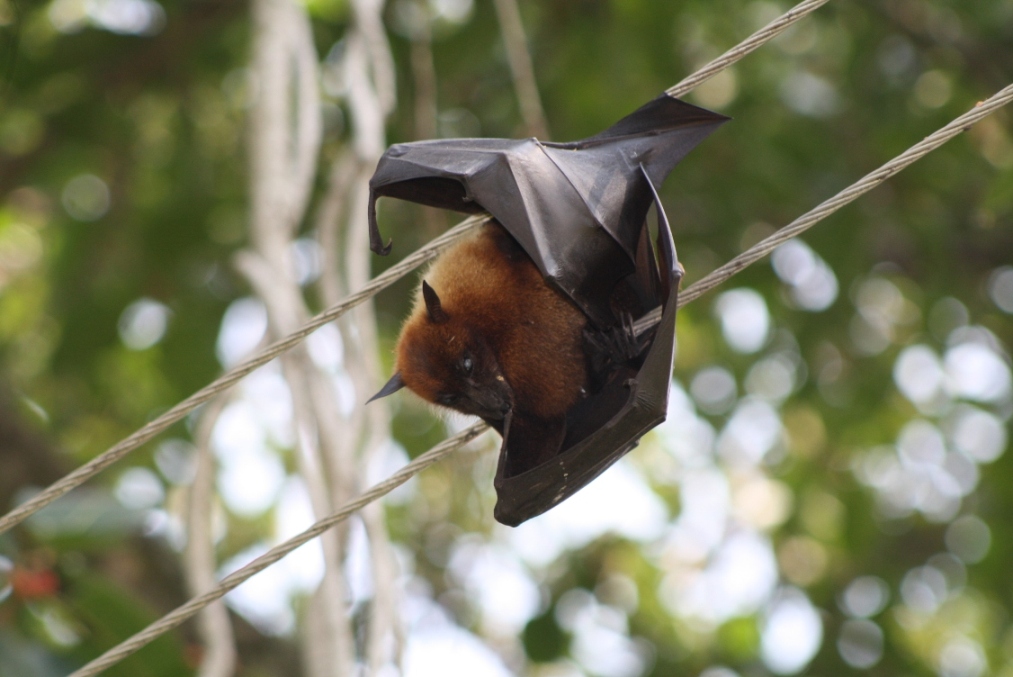
Fruit bats on a tree

IUCN Red List Conservation Status


Least Concern

LC
NT
VU
EN
CR
EW
EX

Official assessment evaluated in accordance with the IUCN Red List of Threatened Species criteria: Least Concern.


Species Quick Facts

Scientific Name
Myotis mystacinus

Average Lifespan
Average 4-5 years in the wild; up to 24 years recorded in exceptional cases

Average Weight
4-8 g (0.14-0.28 oz)

Average Length
35-48 mm (1.4-1.9 inches) head-body length; tail 30-43 mm (1.2-1.7 inches)

Overview & Identification

The whiskered bat is a small insect-eating bat found across Europe, North Africa, and western Asia. It has dark fur and a small face and flies with a fluttering flight low over hedgerows, woodland edges, and water. It roosts in buildings, trees, and caves and hibernates through the winter.

Behavior & Social Structure

The Whiskered Bat (Myotis mystacinus) is a strictly nocturnal species, emerging from its daytime roost shortly after sunset to begin foraging, with a secondary peak of activity before dawn. During daylight hours, individuals roost in tree hollows, bat boxes, rock crevices, and building cavities such as roof spaces and behind shutters, favoring locations close to woodland edges, hedgerows, and riparian corridors that offer sheltered flight paths. Roost fidelity is moderate, with individuals often switching between several roosts within a local network across a season, a behavior thought to reduce parasite load and predation risk.

Social organization is flexible and seasonally variable. In summer, females form maternity colonies numbering from a handful to several dozen individuals, while adult males tend to roost alone or in small bachelor groups. Outside the breeding season, both sexes may aggregate at swarming sites near cave and mine entrances in autumn, a behavior linked to mating and genetic exchange between otherwise isolated colonies. Communication relies heavily on echolocation calls (typically frequency-modulated calls sweeping from around 110 kHz down to 25–30 kHz) used both for orientation and prey detection, supplemented by social calls exchanged between roost-mates and during swarming.

Whiskered Bats are not strongly territorial but do exhibit fidelity to established foraging routes, commuting along linear landscape features such as hedgerows, tree lines, and watercourses that provide protection from wind and predators. Home ranges are generally small, often within 1–3 km of the roost, reflecting the species’ reliance on structurally complex, insect-rich habitats. Their slow, highly maneuverable flight and capacity for hovering allow them to glean prey from foliage and bark, an adaptive behavior distinguishing them from more open-air foraging vespertilionids.

Diet & Hunting Patterns

As an obligate insectivore, the Whiskered Bat forages predominantly within dense vegetation, gleaning stationary or slow-moving invertebrates directly from leaves, bark, and twigs, as well as capturing prey in flight. Its diet is dominated by small dipterans (flies and midges), lepidopterans (moths), and their larvae, along with caddisflies, lacewings, and spiders, reflecting an opportunistic feeding strategy that tracks locally abundant insect populations. Foraging typically occurs at low altitude (1–6 meters) along woodland edges, over water, and within tree canopies, aided by highly maneuverable flight and short, broad wings suited to cluttered environments.

Metabolically, the species relies on torpor to conserve energy during cool nights and periods of low insect availability, a critical adaptation given its small body mass (approximately 4–8 grams) and high surface-area-to-volume ratio. Dietary composition shifts seasonally, with a greater reliance on soft-bodied larvae and emerging aquatic insects in spring, transitioning to a broader mix of flying insects through summer as prey diversity peaks. Water dependency is significant; individuals frequently drink on the wing from ponds and slow-moving streams, and proximity to water bodies strongly influences roost site selection and foraging site quality.

Reproduction & Life Cycle

Breeding in the Whiskered Bat follows a promiscuous mating system centered on autumn swarming, during which both sexes gather at underground hibernacula entrances to mate, often with multiple partners. Following copulation, females store viable sperm through winter hibernation, delaying fertilization until spring in a process known as delayed fertilization—an adaptation common among temperate vespertilionids that synchronizes birth timing with peak insect abundance. Gestation lasts approximately 50 to 60 days following spring fertilization, with timing influenced by ambient temperature and torpor use.

Females give birth to a single pup annually, typically in June, within maternity colonies where communal roosting provides thermoregulatory benefits and reduces individual energetic costs. Pups are altricial at birth, becoming volant (capable of flight) at approximately three to four weeks of age, and weaned shortly thereafter. Sexual maturity is generally reached by the following autumn or the second year of life, though first breeding may be delayed depending on body condition and resource availability, and lifespan can exceed 15–19 years in the wild, remarkable longevity for such a small mammal.

Threats & Conservation

Although classified as Least Concern by the IUCN, the Whiskered Bat faces a range of localized pressures, chief among them habitat loss and fragmentation resulting from deforestation, agricultural intensification, and the removal of hedgerows and mature trees that serve as roosting and commuting habitat. Loss of old and veteran trees with natural cavities reduces available roost sites, while pesticide use diminishes insect prey abundance, indirectly affecting reproductive success and colony viability. Renovation or demolition of buildings used as roosts, along with the sealing of roof spaces, further reduces available shelter, particularly for maternity colonies.

Climate change poses an emerging concern, with shifting phenology potentially causing mismatches between hibernation timing, insect emergence, and pup-rearing periods, while extreme weather events can disrupt swarming behavior and hibernaculum stability. Natural predators include owls, domestic cats, and occasionally larger bat-eating raptors, though predation pressure is generally low relative to anthropogenic threats. Conservation initiatives across Europe, including legal protection under the EUROBATS Agreement and national wildlife legislation, promote roost protection, hedgerow retention, artificial roost box schemes, and monitoring programs that have helped maintain stable population trends across much of the species’ range.

Interesting Facts

  • Delayed Fertilization: Females store sperm through winter hibernation, only fertilizing eggs in spring, allowing precise timing of birth with peak insect availability.
  • Cryptic Species Complex: The Whiskered Bat was long confused with the nearly identical Alcathoe bat until genetic analysis in the 2000s revealed them as distinct species.
  • Echolocation Precision: Its calls sweep across a wide frequency range (110–25 kHz), enabling detection of prey as small as 2mm even within dense foliage.
  • Exceptional Longevity: Despite weighing only a few grams, individuals have been recorded living up to 19 years, among the longest lifespans relative to body size of any mammal.
  • Hibernation Flexibility: Whiskered Bats can enter torpor for short bouts even during active summer nights to conserve energy during cold snaps.
  • Gleaning Specialist: Unlike many vesper bats, it frequently hovers to pick insects directly off leaves and bark rather than catching them purely in flight.
  • Widespread Range: Its distribution spans from Britain and Ireland across continental Europe into the Himalayas and parts of East Asia, reflecting remarkable ecological adaptability.

Description

Uncover the intriguing social dynamics of the Flying Fox bat with this guide, exploring their communal roosting behavior

The whiskered bat, scientifically known as Myotis mystacinus, is a small European bat characterized by its long fur and distinctive features. This species is part of the Vespertilionidae family and is known for its agile flight and remarkable echolocation abilities. The whiskered bat is a nocturnal mammal, displaying heightened activity during the twilight hours when it emerges to forage for prey.

Appearance

Two greater long nose bats

The whiskered bat is easily identified by its long fur and whisker-like projections around the mouth, which give the species its colloquial name. These bats are similar in appearance to Brandt’s bat (Myotis brandtii), with which they were initially confused. However, whiskered bats can be distinguished by their specific morphological characteristics, including subtle differences in size and wing shape.

Distribution

Greater long nosed bats
CreativeNature_nl / Envato

The whiskered bat is primarily found in various regions across Europe, including the United Kingdom, France, Germany, and other parts of the continent. This species exhibits a preference for habitats in close proximity to human habitation and water sources. While not as abundant as some other bat species, the whiskered bat’s population can be found in localized pockets, particularly in woodland areas and near water bodies.

Habitat Preferences

Whiskered bats are known to thrive in diverse ecosystems, including woodlands, riparian habitats, and areas with dense foliage. They often roost in buildings, such as old houses and barns, and can be observed foraging around water bodies, taking advantage of the insect populations that inhabit these areas. The species’ ability to adapt to human-altered landscapes and utilize man-made structures for roosting highlights its resilience in the face of environmental changes.

Overall, the whiskered bat’s presence serves as a testament to the adaptability of certain bat species to coexist with human development while maintaining a vital role in local ecosystems.

Facts About Whiskered bat

  • The whiskered bat, Myotis mystacinus, is a small European bat with long fur.
  • Whiskered bats are found throughout the Palearctic region, with most populations occurring in central Europe.
  • They are often found around human habitation and are known to hibernate in caves and tunnels over winter.
  • The whiskered bat is small, with shaggy, golden-tipped, dark grey or brown fur.
  • Their wingspan ranges from 190 to 225 mm.
  • Whiskered bats are agile flyers adapted to foraging in cluttered environments.
  • Their diet mainly consists of Diptera, including both crepuscular and diurnal species.
  • They frequently fly along a regular route over or alongside a hedgerow or woodland edge.
  • Whiskered bats are regularly found in buildings, though they generally avoid urban and arable areas.
  • The whiskered bat exhibits very lively behavior and is known for its frizzy fur.


Scientific Provenance & Verified Sources

Biological taxonomy, conservation status, and physical traits are cross-referenced with authoritative global registers:


Peer-reviewed by Wildlife Science Editors • Updated for 2026

Explore Other Species Profiles