IUCN Red List Conservation Status


Endangered

LC
NT
VU
EN
CR
EW
EX

Official assessment evaluated in accordance with the IUCN Red List of Threatened Species criteria: Endangered.


Species Quick Facts

Scientific Name
Piliocolobus badius

Average Lifespan
20-25 years in wild, 25-30 years in captivity

Average Weight
9-12 kg (20-26 lbs) – Males: 11 kg, Females: 8 kg

Average Length
45-60 cm (18-24 inches) – head-body length excluding tail

Overview & Identification

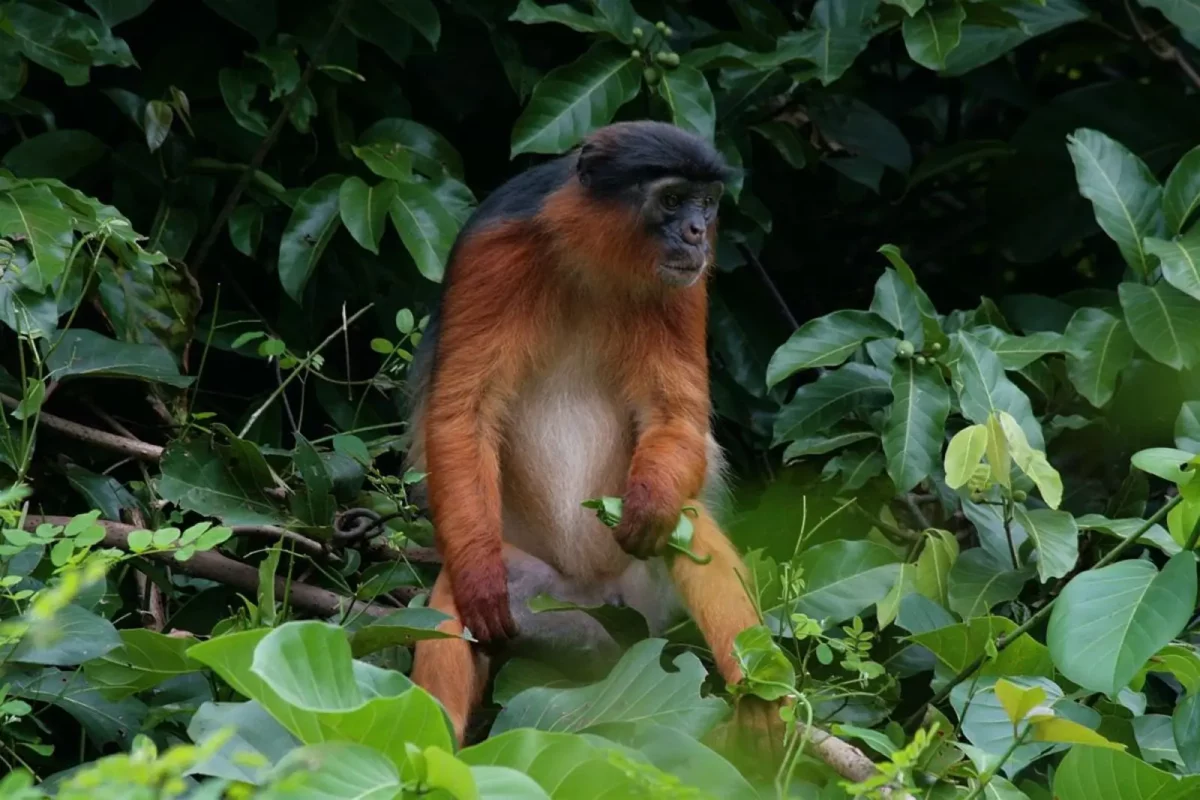
The Western red colobus (Piliocolobus badius) is a mediumโ€‘sized Old World monkey belonging to the family Cercopithecidae, subfamily Colobinae. It inhabits the lowland rainforests of West Africa, with its range extending from Sierra Leone and Liberia through Cรดte dโ€™Ivoire to Ghana. The species prefers primary and secondary moist evergreen forests, swamp forests, and gallery forests along rivers, often staying high in the canopy where its striking reddishโ€‘brown pelage, black face, and long, nonโ€‘prehensile tail provide camouflage among the foliage. Unlike many other colobines, the Western red colobus lacks a thumb, an adaptation that aids in rapid arboreal locomotion. Social groups typically number 15โ€“30 individuals and are organized into multiโ€‘male, multiโ€‘female troops that defend overlapping home ranges. The species is diurnal and spends most of its day feeding, resting, and grooming in the upper canopy. The IUCN classifies P. badius as Endangered, reflecting rapid population declines driven by intensive hunting for bushmeat and extensive habitat loss from logging, agriculture, and mining. Conservation actions focus on protecting remaining forest blocks, enforcing antiโ€‘poaching laws, and promoting communityโ€‘based monitoring programs.

Behavior & Social Structure

Western red colobus troops are highly cohesive, with individuals maintaining close physical proximity through constant grooming and huddling. Groups are composed of several adult males, multiple adult females, and their offspring, and may merge temporarily with neighboring troops to form larger foraging parties of up to 50 monkeys. The species is strictly arboreal and diurnal, spending dawn and dusk periods moving between feeding trees while resting in the midโ€‘ to upper canopy for the majority of daylight hours. Home ranges average 15โ€“30 kmยฒ and are defended through vocal displays, branch shaking, and occasional aggressive encounters between rival males. Communication relies on a repertoire of loud, barkโ€‘like alarm calls that can travel several hundred meters, as well as softer contact calls used to maintain group cohesion while feeding. Visual signals such as tail flicks and facial expressions supplement acoustic signals, allowing individuals to coordinate movements and deter predators.

Diet & Hunting Patterns

The Western red colobus is a specialist folivore, extracting nutrients from a wide variety of young leaves, leaf buds, and tender shoots. Preferred plant families include Rubiaceae, Euphorbiaceae, and Myrtaceae, with a particular affinity for the young leaves of Cola and Ficus species. In addition to foliage, the diet is supplemented with fruits, seeds, flowers, and occasional bark, especially during periods of leaf scarcity. An adult consumes roughly 2โ€“3โ€ฏ% of its body weight in food each day, which translates to 150โ€“250โ€ฏg of fresh plant material. To cope with the high fiber content of leaves, the species possesses an enlarged, multiโ€‘chambered stomach that ferments cellulose with the aid of symbiotic microbes. Feeding is highly selective; individuals inspect leaves for optimal proteinโ€‘toโ€‘tannin ratios and may discard or wash leaves before ingestion. This selective browsing reduces competition with sympatric primates such as the Diana monkey (Cercopithecus diana) and supports the colobusโ€™s role as a key seed disperser in West African forests.

Reproduction & Life Cycle

Females of Piliocolobus badius reach sexual maturity at about 3.5โ€ฏyears, while males mature slightly later at 4โ€“5โ€ฏyears. Breeding occurs yearโ€‘round but peaks during the rainy season when fresh leaf growth is abundant, providing optimal nutrition for gestating females. Gestation lasts 165โ€“170โ€ฏdays, after which a single infant is born, weighing roughly 400โ€“500โ€ฏg. Births typically take place in a concealed fork of a high branch, and the newborn clings to the motherโ€™s belly for the first few weeks. Maternal care is intensive; the mother nurses the infant for 4โ€“6โ€ฏmonths, and the young remains dependent on her for up to 12โ€ฏmonths before achieving full independence. Interโ€‘birth intervals average 18โ€“24โ€ฏmonths, reflecting the high energetic cost of leafโ€‘based diets. Males do not participate in infant care, but dominant males may protect the groupโ€™s infants from predators and rival males.

Threats & Conservation

The IUCN Red List classifies the Western red colobus as Endangered, with an estimated global population of 30,000โ€“50,000 mature individuals that has declined by more than 50โ€ฏ% over the past three generations. The primary threat is unsustainable hunting for bushmeat, driven by growing human populations and limited protein alternatives. Habitat loss compounds this pressure: extensive logging, conversion of forest to oilโ€‘palm plantations, cocoa agriculture, and mining operations fragment the speciesโ€™ continuous canopy, reducing available foraging area and increasing edge effects. Fragmentation also heightens vulnerability to predators and disease. Climate change may further alter leaf phenology, affecting food availability. Conservation measures include the establishment of protected areas such as Taรฏ National Park in Cรดte dโ€™Ivoire, communityโ€‘based antiโ€‘poaching patrols, and habitat restoration projects. International trade is regulated under CITES Appendixโ€ฏI, prohibiting commercial export. Ongoing population monitoring and environmental education are essential to halt further declines.

Interesting Facts

โ€ข The Western red colobus lacks a thumb, an adaptation that enhances its arboreal agility.
โ€ข It possesses a complex, multiโ€‘chambered stomach that ferments cellulose, allowing it to digest tough leaves.
โ€ข Groups can temporarily merge, forming foraging parties of up to 50 individuals.
โ€ข Its alarm calls can travel several hundred meters, alerting distant troops to predators.
โ€ข Despite being a folivore, it plays a crucial role in seed dispersal for many West African tree species.

Description

The Western red colobus, scientifically known as Piliocolobus badius, is a captivating species of Old World monkey found in the lush forests of West Africa. This arboreal mammal is characterized by its striking rust-red coat, which sets it apart from other species of red colobuses. Renowned for its graceful and agile movements through the forest canopy, the Western red colobus is a captivating sight in its natural habitat.

Appearance

The Western red colobus is distinguished by its vibrant rust-red coat, which varies in intensity among individuals. Its long, slender limbs and a distinctive white tail provide a striking contrast against the rich red fur, creating a visually stunning spectacle amidst the verdant forest canopy. This unique coloration and graceful physique make the Western red colobus a truly remarkable sight in its natural environment.

Distribution

The Western red colobus inhabits the West African forests, ranging from Senegal to Ghana. Within this region, it can be found in countries such as Cote d’Ivoire, Liberia, and Sierra Leone. Notably, the species demonstrates a preference for specific forest ecosystems within this range, exhibiting a fascinating distribution pattern that reflects its reliance on particular environmental conditions.

Habitat Preferences

This species thrives in diverse forest ecosystems, including primary and secondary forests, as well as gallery forests along riverbanks. The Western red colobus relies on these habitats for its survival, utilizing the dense canopies and abundant foliage for foraging and shelter. The intricate balance of these forest environments sustains the Western red colobus and contributes to its well-being, highlighting the crucial interplay between the species and its natural habitat.

By delving into the unique characteristics, distribution, and habitat preferences of the Western red colobus, we gain a deeper understanding of this captivating species and the intricate ecosystems that support its existence. Through continued conservation efforts and education, we can work towards safeguarding the future of the Western red colobus and the invaluable biodiversity of West African forests.

Facts About Western Red Colobus

  • The Western Red Colobus (Piliocolobus badius) primarily inhabits the higher canopy of trees, typically at heights of 26 to 40 meters.
  • This species is diurnal, meaning it is active during the day.
  • The Western Red Colobus is listed as Endangered, with a population decline exceeding 50% over the past three generations.
  • They are herbivorous and primarily feed on leaves, fruits, and flowers.
  • The average weight of a Western Red Colobus ranges from 5 to 11 kilograms.
  • Their long tails and hind legs enable them to leap through the forest canopy.
  • Western Red Colobus groups spend approximately 55% of their day feeding, 37% resting, and 5% moving.
  • These monkeys are found in the Upper Guinea region of West Africa.
  • The species is known for its striking appearance, with a reddish-brown coat and a distinct white face and throat.
  • Western Red Colobus monkeys live in social groups, typically consisting of one adult male, several females, and their offspring.


Scientific Provenance & Verified Sources

Biological taxonomy, conservation status, and physical traits are cross-referenced with authoritative global registers:


Peer-reviewed by Wildlife Science Editors โ€ข Updated for 2026

Explore Other Species Profiles