
Description

The West African potto, scientifically known as Perodicticus potto, is a fascinating nocturnal strepsirrhine primate found in the lush tropical forests of West Africa. This elusive species is also referred to as Bosman’s potto, in honor of Willem Bosman, the Dutch explorer who first described the primate in 1704. The West African potto is known for its solitary and nocturnal nature, spending its days hidden away in the dense canopy of the rainforest.
Appearance

The West African potto possesses a distinct appearance that sets it apart from other primate species. Its large, soulful eyes and round head give it an endearing and almost teddy bear-like appearance. The potto’s dense fur is typically a mix of grey, brown, and red tones, providing excellent camouflage in the dappled light of the forest canopy. Notably, the potto has a unique feature – a short tail that is absent in many other primate species, further distinguishing it from its relatives.
Distribution
The West African potto’s range spans across tropical West Africa, encompassing countries such as Gambia, Senegal, Guinea, Nigeria, and extending eastward to western Kenya. This primate’s distribution is primarily concentrated within the dense rainforests and swamp forests of these regions, where it finds the ideal conditions for its secretive and arboreal lifestyle.
Habitat Preferences
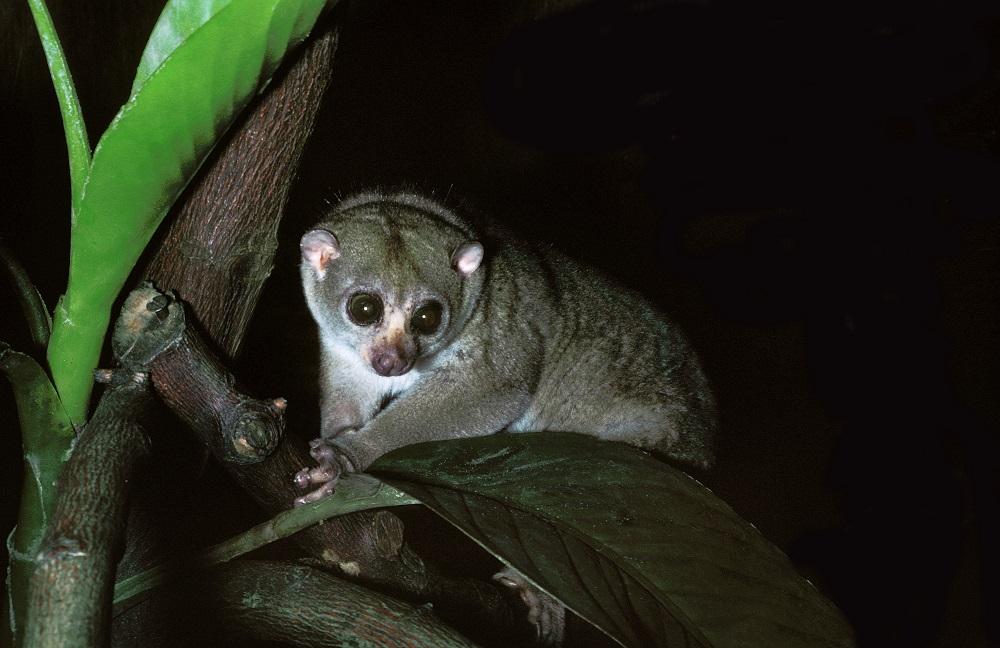
The West African potto thrives in a variety of forested habitats, including lowland tropical forests, swamp forests, coastal forests, and montane forests. These environments provide the potto with ample tree cover, allowing it to move with agility and stealth through the canopy. The dense foliage also offers protection and a wealth of food sources, contributing to the potto’s survival and well-being in its natural habitat.
Facts About West African Potto
- The West African Potto (Perodicticus potto) is a nocturnal strepsirrhine primate found in tropical West Africa.
- Pottos are primarily solitary and nocturnal animals, except for females with their young.
- They are the only species in the genus Perodicticus.
- Pottos inhabit the canopy of rainforests in tropical Africa, from Nigeria and Guinea to Kenya and Uganda, into the north of the Democratic Republic of Congo.
- Adult pottos can weigh up to 2.4 lbs and grow up to 15 inches in length, plus up to a 4-inch tail.
- The West African Potto is also known as Bosman’s potto.
- They have a specialized wrist bone that allows them to maintain a strong grip while climbing and hanging from branches.
- Pottos have a slow and deliberate movement, making them well adapted to life in the trees.
- This species has a distinctive call, a high-pitched whistle, used for communication.
- Pottos have a specialized diet that includes fruits, insects, and small vertebrates.


