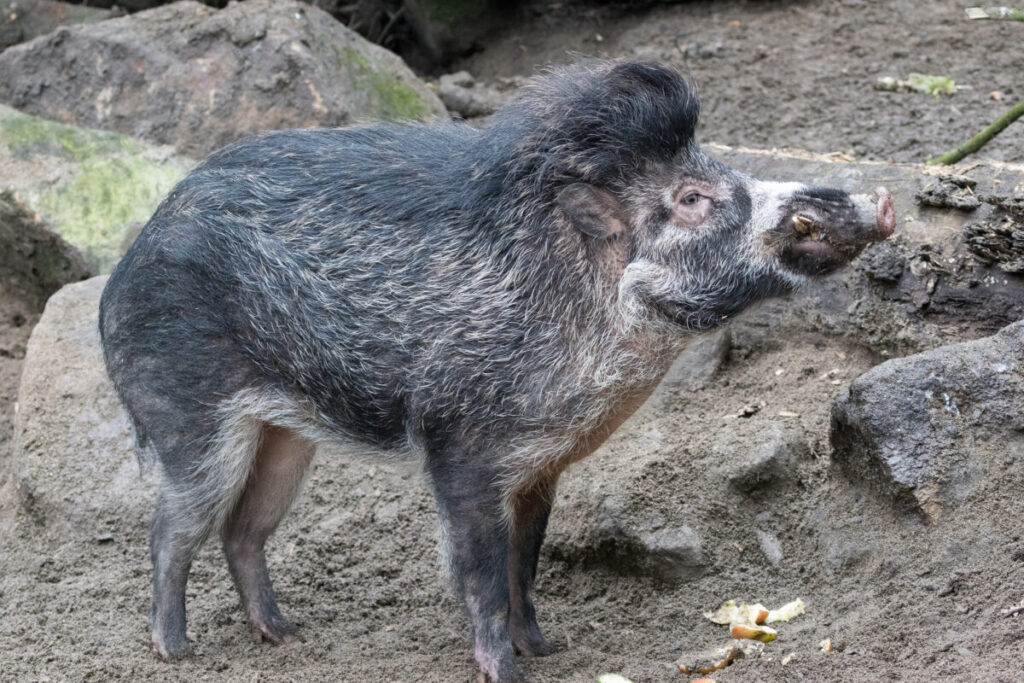
Visayan warty pig standing among rocks in a shaded enclosure

IUCN Red List Conservation Status


Critically Endangered

LC
NT
VU
EN
CR
EW
EX

Official assessment evaluated in accordance with the IUCN Red List of Threatened Species criteria: Critically Endangered.


Species Quick Facts

Scientific Name
Sus cebifrons

Average Lifespan
About 10-15 years in the wild and up to 20 years in human care.

Average Weight
20-82 kg (45-180 lb); males up to four times larger than females.

Average Length
Head-body about 1-1.6 m; shoulder height 63-80 cm (25-31 inches).

Overview & Identification

The Visayan warty pig (Sus cebifrons) is a critically endangered wild pig endemic to a few islands in the central Philippines. Males develop facial warts and a striking mane of hair during the breeding season. Found in forest fragments, it forages for roots, fruit, and tubers and is threatened by habitat loss and hunting.

Behavior & Social Structure

The Visayan warty pig (Sus cebifrons) is primarily diurnal to crepuscular, foraging actively during early morning and late afternoon hours while resting in dense vegetation during the heat of midday. Social organization centers on small matriarchal groups called sounders, typically consisting of one or two adult females and their offspring, while adult boars are largely solitary except during the breeding season. This fission-fusion social structure allows flexibility in response to food availability and predation pressure within their fragmented forest habitat.

Communication among Visayan warty pigs includes a range of vocalizations such as grunts, squeals, and chuffing sounds used to maintain contact within sounders and signal alarm. Scent marking, achieved through wallowing in mud and rubbing against trees, plays a role in both thermoregulation and chemical communication, potentially conveying information about individual identity and reproductive status. Tactile behaviors, including mutual grooming and nuzzling, reinforce social bonds within family groups, particularly between sows and piglets.

Territoriality in this species is not strictly defined, but boars may exhibit aggressive displaysโ€”including tusk clashing and vocal threatsโ€”during the mating season to compete for access to receptive females. Home ranges vary considerably depending on habitat quality and human disturbance, with individuals in degraded or fragmented forests often traveling greater distances to meet nutritional needs. A notable adaptive behavior is the growth of a dramatic mane of long, stiff hair along the back and a “warty” facial ridge in males, which may serve as a visual signal of dominance and also provide minor protection during boar-to-boar combat.

Diet & Hunting Patterns

Visayan warty pigs are opportunistic omnivores, though their diet leans heavily toward plant material, making them functionally herbivorous for much of the year. Their foraging behavior involves rooting through leaf litter and soil using their robust snouts to unearth roots, tubers, and invertebrates. Documented plant foods include fruits, seeds, young shoots, and fallen forest produce such as figs, while opportunistic consumption of insects, small invertebrates, and occasionally carrion supplements their protein intake, particularly for lactating sows and growing piglets.

Seasonal dietary shifts are closely tied to fruiting cycles within their tropical forest habitat; during periods of fruit abundance, warty pigs may travel further to exploit these resources, while during leaner months they rely more heavily on roots and fibrous vegetation. Metabolically, their digestive system is adapted to process a wide range of plant fibers, an important trait given the seasonal unpredictability of fruit availability in Philippine forests. Water dependency is moderate; the species relies on natural streams, seasonal pools, and moisture-rich vegetation, though they can obtain significant hydration from succulent plant matter when standing water is scarce.

Reproduction & Life Cycle

Breeding in Visayan warty pigs is not strictly seasonal in captivity but tends to correlate with periods of resource abundance in the wild, often linked to the rainy season when food availability supports lactation demands. The mating system is polygynous, with dominant boars competing for access to receptive sows through vocal displays and physical confrontations involving their tusks. Gestation lasts approximately 115 to 120 days, after which females give birth to litters ranging from two to six piglets, with an average litter size of around three to four.

Maternal care is intensive, with sows constructing nests of vegetation prior to farrowing and remaining highly protective of piglets during the vulnerable first weeks of life. Piglets are typically weaned between three and four months of age, though they may remain within the maternal sounder for a year or longer to benefit from social learning and protection. Sexual maturity is reached at approximately 18 months in females and slightly later in males, though male breeding success is often delayed until they can successfully compete with more dominant boars for mating opportunities.

Threats & Conservation

The Visayan warty pig faces severe ecological threats primarily driven by habitat loss and fragmentation, as the lowland and mid-elevation forests of the Visayan Islandsโ€”including Panay and Negrosโ€”have been reduced to less than 10% of their original extent due to agricultural expansion, logging, and human settlement. This fragmentation isolates populations into small, genetically vulnerable groups, increasing susceptibility to inbreeding depression and local extinction. Poaching remains a critical pressure, as the species is hunted for bushmeat and sport, with snares and dogs commonly used by local hunters, further compounding population declines already exacerbated by habitat destruction.

Human-wildlife conflict arises as pigs occasionally raid agricultural crops in areas where forest habitat abuts farmland, leading to retaliatory killing by farmers. Natural predators historically included large raptors and possibly the now-extinct Philippine populations of larger carnivores, though today anthropogenic threats far outweigh natural predation pressures. Climate change poses an emerging concern through altered rainfall patterns affecting fruiting cycles and forest composition. Conservation initiatives led by the IUCN SSC Wild Pig Specialist Group, the Philippine Biodiversity Conservation Foundation, and coordinated ex-situ breeding programsโ€”including the Talarak Foundation’s conservation breeding centerโ€”are actively working to protect remaining wild populations, reintroduce captive-bred individuals, and secure protected forest corridors on Panay and Negros islands.

Interesting Facts

  • Island Endemism: The Visayan warty pig is found only on a handful of islands in the Visayan region of the Philippines, including Panay and Negros, making it one of the most geographically restricted wild pig species in the world.
  • Dramatic Mohawk: Adult males develop a striking crest of long, upright hair running along the spine, which becomes especially pronounced during the breeding season, likely serving as a visual signal of vigor and dominance.
  • Facial “Warts”: The species’ common name derives from three pairs of fleshy protrusions on the face of males, which are believed to offer minor protective padding during aggressive tusk-based confrontations with rivals.
  • Critically Endangered Status: Fewer than 200 mature individuals are estimated to remain in the wild, making the Visayan warty pig one of the most endangered wild pig species globally.
  • Taxonomic Confusion: For decades, the Visayan warty pig was confused with and classified alongside the Palawan bearded pig and other Sus species until molecular and morphological studies confirmed its status as a distinct species.
  • Successful Captive Breeding: Coordinated conservation breeding programs across zoos worldwide, including facilities in Europe and the Philippines, have established an insurance population, with some individuals successfully reintroduced into protected forest reserves.
  • Ecosystem Engineers: Through their rooting behavior, Visayan warty pigs aerate soil and disperse seeds across the forest floor, playing an important ecological role in maintaining the health and regeneration of their native tropical forest habitat.

Description

The Visayan warty pig, scientifically known as Sus cebifrons, is a critically endangered species belonging to the pig genus (Sus). This small, forest-dwelling pig is native to the Visayan Islands in the central Philippines. The species is characterized by its distinctive warts, which are more pronounced in males, and a coarse, bristly coat. The males, or boars, are notably larger than females, with well-developed facial warts and tusks. The species is known by various names in the region, often translating to “wild pig,” such as baboy ilahas.

Appearance

The Visayan warty pig possesses unique physical characteristics that distinguish it from other pig species. It features prominent facial warts, particularly in males, which are believed to serve as secondary sexual characteristics. Additionally, both males and females have a coarse, dark coat and a distinctive tuft of hair at the end of their tails. These features contribute to the species’ distinct appearance and aid in its recognition and differentiation from other pig species.

Distribution

The Visayan warty pig is endemic to the Visayan Islands in the Philippines, including islands such as Bohol, Cebu, Leyte, Negros, and Panay. However, due to extensive habitat loss and hunting pressures, the species’ population has significantly declined, leading to its classification as critically endangered. Notably, conservation efforts are focused on protecting the remaining populations and restoring their habitats to ensure the survival of this unique species.

Habitat Preferences

Visayan warty pigs inhabit dense forests, including both primary and secondary forest habitats, within the Visayan Islands. They were historically found in a variety of ecosystems, including lowland and highland grasslands. However, deforestation and human encroachment have led to the fragmentation of their natural habitats, posing significant challenges to their survival. Conservation initiatives aim to preserve and restore these forest ecosystems to support the well-being and sustainability of the Visayan warty pig population.

As a renowned expert in animal conservation and wildlife biology, I emphasize the critical importance of protecting and conserving the Visayan warty pig to ensure the preservation of this unique and endangered species. Through concerted efforts in habitat restoration, anti-poaching measures, and community engagement, we can work towards securing a sustainable future for the Visayan warty pig and other threatened wildlife species.

Facts About Visayan Warty Pig

  • The Visayan warty pig (Sus cebifrons) is a critically endangered species endemic to the Visayan Islands in the central Philippines.
  • Males of the species can grow a spiky head tuft into a mane as long as 9 inches during mating season.
  • Visayan warty pigs inhabit dense forests in the Visayan chain of islands in the Philippines.
  • They have medium-sized, barrel-shaped bodies and short legs, with short necks.
  • The species is known by various names in the region, depending on the specific island.
  • Once ranging over at least six islands, Visayan warty pigs can now only be found on the islands of Panay and Negros.
  • Boars can be identified by their stiff, spiky crests and manes.
  • The species is characterized by its warts, which are more pronounced in males.
  • Visayan warty pigs are known for their distinct and unique appearance among wild pig species.
  • The species is the only wild pig species native to the Philippines.


Scientific Provenance & Verified Sources

Biological taxonomy, conservation status, and physical traits are cross-referenced with authoritative global registers:


Peer-reviewed by Wildlife Science Editors โ€ข Updated for 2026

Explore Other Species Profiles