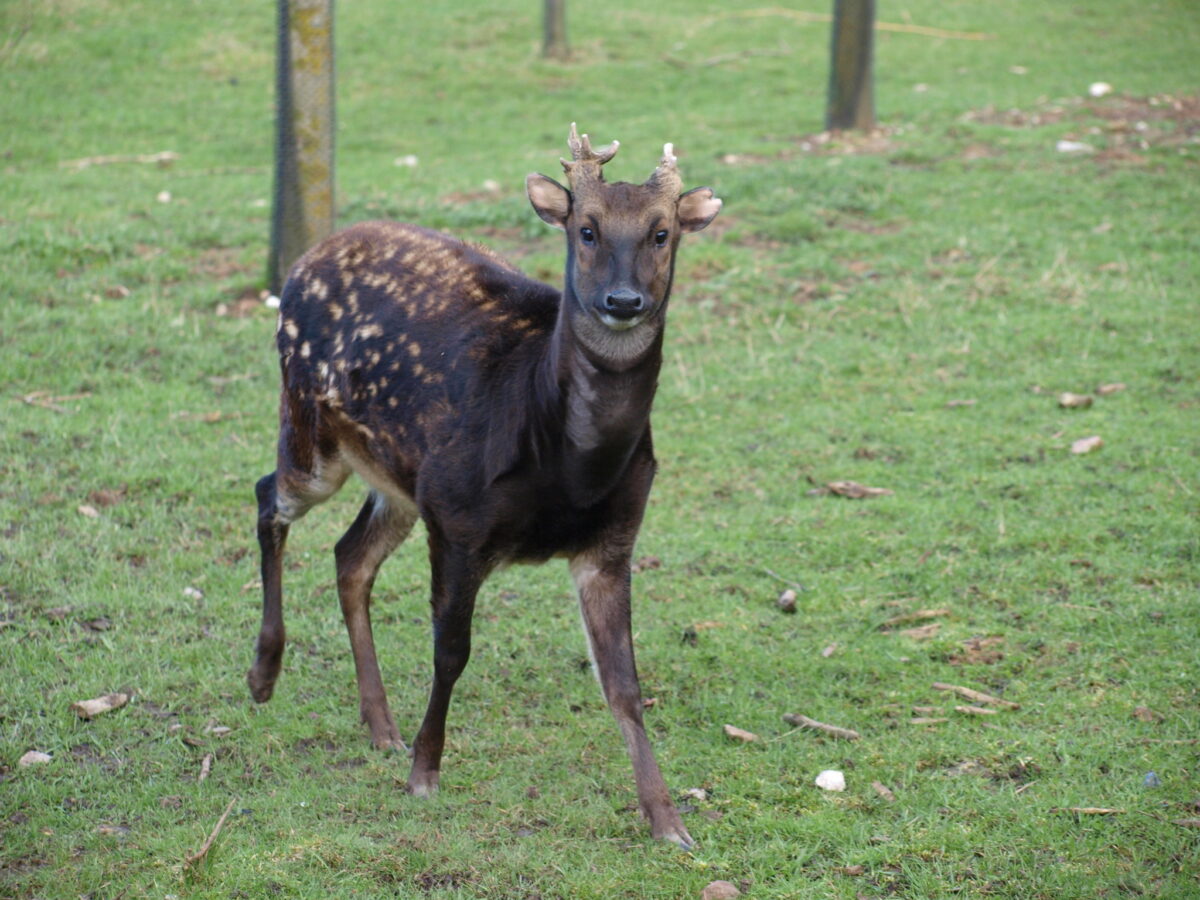
Visayan Spotted Deer

IUCN Red List Conservation Status


Endangered

LC
NT
VU
EN
CR
EW
EX

Official assessment evaluated in accordance with the IUCN Red List of Threatened Species criteria: Endangered.


Species Quick Facts

Scientific Name
Rusa alfredi

Average Lifespan
10-12 years in wild, 15-20 years in captivity

Average Weight
20-40 kg (44-88 lbs) – Males: 30 kg, Females: 25 kg

Average Length
120-150 cm (47-59 inches) – head-body length excluding tail

Overview & Identification

The Visayan spotted deer (Rusa alfredi) is a small, endemic cervid of the Philippine islands of Panay and Negros. Belonging to the family Cervidae and the genus Rusa, it is one of the few deer species restricted to a single archipelago. Adults display a reddishโ€‘brown coat marked with white spots that fade with age, and males grow short, threeโ€‘tined antlers that are shed each year. The species inhabits primary and secondary lowland dipterocarp forest as well as montane forest up to 1,800โ€ฏm, often preferring dense understory near water sources. Its range has contracted to less than 2,000โ€ฏkmยฒ, fragmented into isolated pockets within protected areas such as the Central Panay Mountain Range and the Northern Negros Natural Park. The Visayan spotted deer is primarily a browser, feeding on young shoots, leaves, fruits, and herbs, and it plays a modest role in seed dispersal. Reproductive output is low, with a single fawn born after a gestation of about seven months, contributing to its vulnerability. The International Union for Conservation of Nature (IUCN) classifies the species as Endangered, citing rapid habitat loss, illegal hunting, and competition with livestock as major drivers of decline. Conservation programs focus on habitat protection, antiโ€‘poaching patrols, and communityโ€‘based awareness, but population estimates remain uncertain, with fewer than 2,500 mature individuals believed to persist in the wild.

Behavior & Social Structure

The Visayan spotted deer is a shy, primarily crepuscular animal that becomes most active at dawn and dusk. Individuals are usually solitary or found in small family groups of two to four, consisting of a mother and her offspring; adult males may join groups only during the brief rutting season. Home ranges are modest, typically 1โ€“3โ€ฏkmยฒ in dense forest, and are defended through scent marking from preorbital glands and occasional lowโ€‘intensity vocalizations. When threatened, the deer emit a sharp bark and flee along narrow forest trails, relying on its agility and cryptic spotting to evade predators such as Philippine eagles and feral dogs. Communication also includes subtle body postures and ear movements that convey social status within the group. Seasonal movements are limited, but during the dry season some individuals descend to lower elevations to access fresh foliage.

Diet & Hunting Patterns

The Visayan spotted deer is a strict herbivore that forages primarily on a variety of forest vegetation. Its diet consists of young leaves, shoots, buds, fruits, and lowโ€‘lying herbs, with a preference for the tender foliage of dipterocarp trees, bamboo shoots, and understory shrubs such as Ficus and Alocasia. Seasonal availability influences feeding patterns; during the wet season the deer consume abundant fruit and flower buds, while in the dry season they rely more on grasses and lichens. An adult requires roughly 2โ€“3โ€ฏkg of fresh biomass per day, obtained through selective browsing rather than grazing. Feeding usually occurs in small patches to minimize exposure to predators, and the deer use its keen sense of smell to locate nutritious plant parts. By browsing on seedlings, the species can affect forest regeneration dynamics, and occasional consumption of fallen fruits aids in seed dispersal across its fragmented habitat.

Reproduction & Life Cycle

Females reach sexual maturity at about 18โ€ฏmonths, while males mature slightly later at 24โ€ฏmonths. The breeding season in the Visayan spotted deer peaks between November and January, coinciding with the onset of the rainy season when food is abundant. Males establish temporary territories and engage in brief antler clashes and vocal displays to attract receptive females. After a gestation period of roughly 210โ€ฏdays, a single fawn is born, weighing 2โ€“3โ€ฏkg and covered in a spotted coat that provides camouflage. Newborns are hidden in dense vegetation for the first few weeks, nursing frequently and gaining strength rapidly. The mother cares for the fawn alone, teaching it to browse and recognize predator cues. Fawns become independent at about 6โ€“8โ€ฏmonths, after which they join other juveniles or remain solitary until the next breeding cycle.

Threats & Conservation

The IUCN lists the Visayan spotted deer as Endangered, with an estimated 2,000โ€“2,500 mature individuals remaining in the wild. The principal threat is habitat loss: lowland and montane forests on Panay and Negros have been cleared at an average rate of 2โ€ฏ% per year for timber extraction, agricultural expansion, and mining. Illegal hunting for meat and antlers further reduces numbers, especially in remote forest blocks where enforcement is limited. Small, isolated populations suffer from inbreeding depression and reduced genetic diversity, making them more vulnerable to disease and environmental change. Climate change poses an additional risk by altering the phenology of food plants and increasing the frequency of extreme weather events. Conservation actions include the establishment of protected areas, communityโ€‘based monitoring, reforestation projects, and captiveโ€‘breeding programs aimed at future reintroduction, yet funding and political support remain inconsistent.

Interesting Facts

โ€ข Endemic to only two Philippine islands, Panay and Negros.
โ€ข One of the smallest deer species, standing just 60โ€ฏcm at the shoulder.
โ€ข Its spotted coat provides camouflage among dappled forest light.
โ€ข Males shed and regrow their antlers annually, typically growing three tines.
โ€ข Captive breeding has produced successful offspring, offering hope for reintroduction.

Description

Visayan Spotted Deer

The Visayan spotted deer, scientifically known as Rusa alfredi, is a small and endangered species of deer native to the Visayan islands of the Philippines. It is also referred to as the Visayan deer, the Philippine spotted deer, or Prince Alfred’s deer. This nocturnal mammal is recognized by its distinctive spotted coat, short legs, and crouched build, making it a unique and captivating species within the deer family.

Appearance

Visayan Spotted Deer Appearance

The Visayan spotted deer is easily distinguished by its namesake spots, which adorn its dark coat. The overall coloration of the coat is a deep and rich hue, and its physical build features a compact body, with a body length of about 128 cm and a shoulder height of approximately 70 cm. These physical characteristics set it apart from other deer species, contributing to its allure and conservation significance.

Distribution

The species is primarily found in the rainforests of the Visayan islands, with a notable presence on Panay and Negros. Historically, the Visayan spotted deer inhabited a larger range across the Central Visayan region, but due to habitat loss and hunting, its population has become restricted to specific areas. As a result, it is considered one of the rarest deer species on Earth, emphasizing the urgency of conservation efforts to protect its remaining habitats.

Habitat Preferences

Visayan Spotted Deer Habitat

The Visayan spotted deer thrives in the lush and biodiverse rainforests of the Visayan islands. These ecosystems provide the necessary cover and resources for the species to forage and seek shelter, contributing to its survival and well-being. However, the ongoing deforestation and human encroachment pose significant threats to its habitat, making conservation initiatives crucial for the preservation of this remarkable species.

As a renowned conservation scientist, I emphasize the importance of collaborative efforts to safeguard the Visayan spotted deer and its natural habitat, ensuring the continued existence of this unique and invaluable component of our planet’s biodiversity.

Facts About Visayan Spotted Deer

  • The Visayan spotted deer (Rusa alfredi) is one of three endemic deer species in the Philippines.
  • It was not recognized as a separate species until 1983.
  • The deer is most commonly found in the dense interior of the Visayan islands.
  • The overall coat color of the Visayan spotted deer is very dark with distinct white spots.
  • It is a small, short-legged deer with a crouched build.
  • The Visayan spotted deer prefers habitat areas where natural disturbances such as fires or landslides have opened the forest canopy.
  • The Philippine spotted deer is the largest land animal in the Philippines.
  • In the 1980s, the species was believed to be almost extinct, but now there is a relatively stable population.
  • The maximum longevity of the Visayan spotted deer in captivity is 18.5 years.
  • The adult weight of the Visayan spotted deer is approximately 138.892 lbs (63.00 kg).


Scientific Provenance & Verified Sources

Biological taxonomy, conservation status, and physical traits are cross-referenced with authoritative global registers:


Peer-reviewed by Wildlife Science Editors โ€ข Updated for 2026

Explore Other Species Profiles