Vancouver Island Wolf

IUCN Red List Conservation Status


Extinct

LC
NT
VU
EN
CR
EW
EX

Official assessment evaluated in accordance with the IUCN Red List of Threatened Species criteria: Extinct.


Species Quick Facts

Scientific Name
Canis lupus

Average Lifespan
Likely 6โ€“8 years in the wild, comparable to other grey wolves (a subspecies).

Average Weight
About 10-28 kg (20-60 lb).

Average Length
About 1.2-1.5 m (4-5 ft) long; shoulder height 66-81 cm.

Overview & Identification

The Vancouver Island wolf (Canis lupus occidentalis) is a critically endangered subspecies found exclusively on Vancouver Island, British Columbia, inhabiting coastal rainforests and meadows. As a primarily carnivorous predator, their diet consists mainly of deer, elk, and smaller mammals, though they occasionally consume berries and carrion. Distinguishingly, Vancouver Island wolves have a noticeably shaggy coat and a smaller skull compared to other gray wolf populations, likely adaptations t

Behavior & Social Structure

The Vancouver Island Wolf is primarily crepuscular and nocturnal, with peak activity occurring at dawn and dusk when prey species such as black-tailed deer are most active. Unlike many mainland gray wolf populations, this subspecies has adapted to a highly insular, temperate rainforest environment, often moving along shorelines and river systems to access seasonal food resources, including marine-derived nutrients. Packs are known to travel extensively between coastal and interior forest habitats depending on prey availability and tidal cycles.

Social organization is centered around close-knit family packs typically consisting of a breeding alpha pair, their offspring, and occasionally unrelated adults that have joined the group. Pack sizes on Vancouver Island tend to be smaller than mainland counterparts, often ranging from 3 to 8 individuals, likely due to limited landmass and prey density. Communication includes howling (used for long-distance pack coordination and territory advertisement), scent marking via urine and glandular secretions along trail systems, and a rich repertoire of body language and tactile behaviors such as facial licking and play bowing to reinforce social bonds.

Territoriality is pronounced, with packs defending home ranges that can span from 50 to over 300 square kilometers depending on terrain and prey density. Boundary disputes between packs can be lethal, and scent-marking intensity increases near territorial edges. This subspecies displays a notable adaptive behavior of exploiting intertidal zones for food, including foraging on beaches for carrion, salmon carcasses, and even invertebrates during lean periodsโ€”a behavior less common in interior wolf populations.

Diet & Hunting Patterns

The Vancouver Island Wolf is an opportunistic carnivore whose diet is dominated by Columbian black-tailed deer, which comprise the majority of biomass consumed. Packs employ cooperative hunting strategies, using terrain features such as ridgelines and water barriers to corral prey, with younger deer and weakened individuals preferentially targeted. Hunting success is highest in winter months when deep snow at higher elevations reduces deer mobility, forcing them into more accessible lowland areas.

A distinctive feature of this subspecies’ diet is its heavy reliance on marine resources, an adaptation rare among gray wolves globally. Wolves regularly forage along shorelines for beached marine mammal carcasses, fish (including spawning salmon), shellfish, and even river otters. This dietary flexibility allows populations to persist through seasonal deer scarcity. Water dependency is low relative to prey moisture content, as wolves derive most hydration from consumed tissue, though they will drink freely from streams and rain-fed pools throughout their forested range.

Reproduction & Life Cycle

Breeding occurs annually between late January and March, coinciding with the onset of increased daylight. The species is generally monogamous within packs, with only the alpha breeding pair reproducing in a given season, though this social monogamy can occasionally break down in resource-rich areas. Gestation lasts approximately 63 days, culminating in the birth of a litter typically ranging from 4 to 6 pups, born in dens dug into soil, hollow logs, or rock crevices within dense forest cover.

Pups are altricial at birthโ€”blind, deaf, and entirely dependent on maternal care. The entire pack participates in provisioning food to the mother and pups through regurgitation once pups begin weaning, typically around 5 to 8 weeks of age. Sexual maturity is reached at approximately 2 years, though most young wolves remain within the natal pack as non-breeding helpers for one to three years before dispersing to establish or join new packs.

Threats & Conservation

Historically, the primary threat to Vancouver Island Wolves has been direct human persecution, including government-sanctioned bounty hunting and predator control programs implemented throughout the 20th century to protect livestock and deer populations valued for sport hunting. While such widespread eradication campaigns have ceased, illegal poaching and human-wildlife conflictโ€”particularly involving livestock predation and occasional pet attacks near rural communitiesโ€”remain ongoing pressures. Habitat fragmentation from industrial logging operations across Vancouver Island continues to disrupt traditional pack territories and prey migration corridors, forcing wolves into closer contact with human settlements.

Climate change poses an emerging threat by altering deer population dynamics and disrupting salmon runs, a critical secondary food source. Natural predators are essentially absent given the wolf’s apex status on the island, though cougars (Puma concolor) may compete for prey resources and occasionally clash with wolves over kills. Conservation initiatives include collaborative monitoring programs between the British Columbia government, First Nations communities, and conservation biologists to track population genetics and movement via GPS collaring, alongside advocacy for reduced logging in critical old-growth habitat and stricter enforcement against illegal hunting.

Interesting Facts

  • Island Endemism: Canis lupus crassodon is genetically distinct from mainland gray wolves, having evolved in isolation on Vancouver Island since the last ice age, resulting in unique cranial and dental morphology.
  • Marine Wolves: This subspecies is one of the few wolf populations in the world known to regularly forage in intertidal zones, earning them the nickname “sea wolves” among researchers and Indigenous communities.
  • Swimming Ability: Vancouver Island Wolves are excellent swimmers, capable of crossing several kilometers of open water between islands in the Broughton Archipelago and Discovery Islands region.
  • Small Pack Adaptation: Due to limited prey biomass on the island, pack sizes here are notably smaller than mainland North American wolf packs, reflecting a unique ecological carrying capacity.
  • Indigenous Cultural Significance: Coastal First Nations, including the Nuu-chah-nulth and Kwakwaka’wakw peoples, hold deep cultural and spiritual reverence for wolves, featuring them prominently in oral histories, art, and ceremonial regalia.
  • Bounty History: Between the 1900s and 1950s, thousands of Vancouver Island wolves were killed under provincial bounty programs, nearly extirpating the population before conservation attitudes shifted.
  • Apex Ecosystem Engineers: By regulating black-tailed deer populations, these wolves indirectly protect understory vegetation and forest regeneration, playing a critical trophic role in Vancouver Island’s temperate rainforest ecosystem.

Description

Vancouver Island Wolf

The Vancouver Island Wolf, scientifically known as Canis lupus crassodon, is a fascinating subspecies of the grey wolf found along the Pacific Coast of Canada. These wolves are renowned for their elusive nature, making them one of the shyest and most rarely seen creatures in the region. Their mysterious behavior and limited interactions with humans contribute to their enigmatic allure.

Appearance
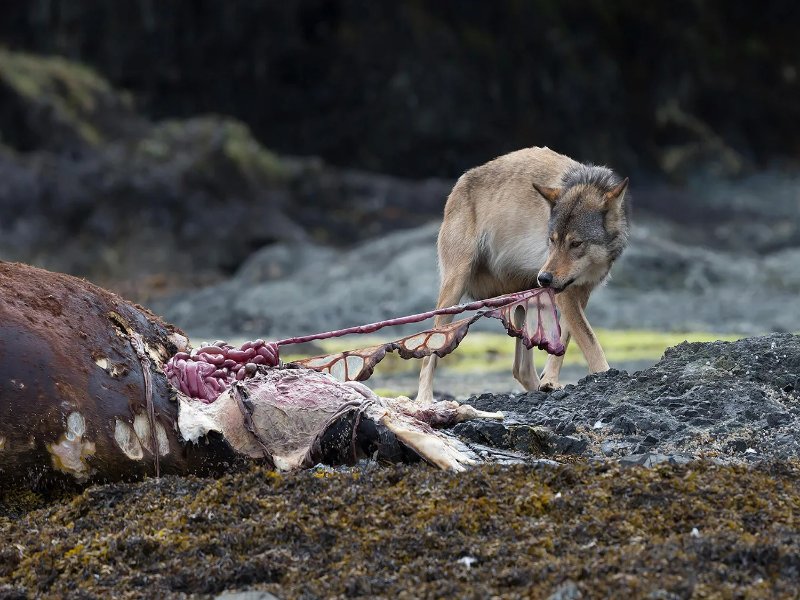
Vancouver Island Wolf Appearance

The Vancouver Island Wolf possesses unique physical characteristics that distinguish it from other subspecies of grey wolves. Typically, these wolves exhibit a distinctive coat coloration, often featuring a mix of gray, black, and brown fur, enabling them to blend seamlessly with the coastal landscapes. Their robust build and agile stature are well-adapted to the rugged terrain of their habitat, allowing them to navigate the diverse ecosystems with ease.

Distribution

The Vancouver Island Wolf is primarily found along the Pacific Coast of Canada, with a specific focus on the Vancouver Island region. This subspecies has adapted to thrive in the coastal environments, carving out a niche within this distinctive ecosystem. Their distribution is limited to this geographical area, emphasizing their localized presence and ecological significance within the region.

Habitat Preferences

Vancouver Island Wolf Habitat

These wolves exhibit a strong affinity for coastal habitats, including forests, prairies, and other terrestrial biomes found along the Pacific Coast. Their adaptability to these diverse ecosystems reflects their resilience and ability to thrive in challenging environments. The Vancouver Island Wolf’s preference for coastal regions underscores the intricate relationship between their survival and the unique ecological dynamics of these areas.

In conclusion, the Vancouver Island Wolf, with its elusive nature, unique appearance, and specialized habitat preferences, represents a captivating example of the diverse and awe-inspiring wildlife found along the Pacific Coast of Canada. Understanding and conserving the delicate balance of their ecosystems is crucial for the continued well-being of this remarkable subspecies.

Facts About Vancouver Island Wolf

  • The Vancouver Island wolf, also known as the coastal wolf or sea wolf, is a subspecies of the gray wolf endemic to the coast of the Pacific Northwest.
  • These rare wolves can be found only in the Great Bear Rainforest and northern Vancouver Island within the Pacific Northwest Coast of North America.
  • The Vancouver Island wolf has a high living density, with up to 14 animals per square kilometer.
  • About 350 wolves live on Vancouver Island, although it’s difficult to get an accurate count of the elusive and seldom seen animal.
  • The Vancouver Island wolf is a very sociable animal that forms packs of 5 to 35 individuals.
  • The sea wolves have an extensive range, from southern Alaska all the way south to Vancouver Island.
  • Genetically distinct from their inland cousins, the sea wolves are a unique strain of wolf that lives in the rainforest along the Pacific coast of Canada.
  • According to TimesColonist, about 70% of the wolves inhabit uninhabited northern coastal portions of the island.
  • The Vancouver Island wolf’s diet includes a variety of prey such as deer, elk, and small mammals.
  • The Vancouver Island wolf plays a significant role in the ecosystem of its habitat, contributing to the balance of prey populations and overall biodiversity.


Scientific Provenance & Verified Sources

Biological taxonomy, conservation status, and physical traits are cross-referenced with authoritative global registers:


Peer-reviewed by Wildlife Science Editors โ€ข Updated for 2026

Explore Other Species Profiles