

Description
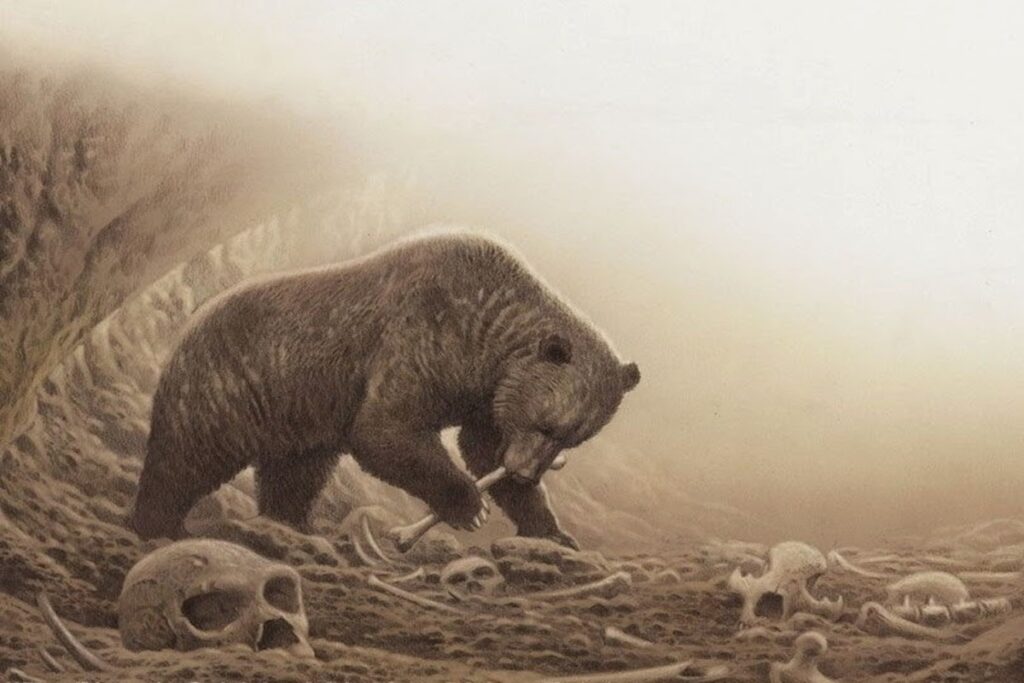
Ursus deningeri, commonly known as Deninger’s bear, was an extinct species of bear that inhabited Eurasia during the Pleistocene epoch, spanning approximately 1.7 million years from 1.8 to 0.1 million years ago. This majestic bear species exhibited remarkable characteristics that distinguished it from its contemporary counterparts.
Appearance

Ursus deningeri was a formidable creature, characterized by its robust build and large size, with some individuals reaching up to 3.5 meters in length. It possessed a distinctive cranial and mandibular morphology, indicative of its adaptation to a herbivorous diet, and its powerful limb structure suggested adeptness in foraging and locomotion. The species’ physical features set it apart from other bears of its time, showcasing its unique evolutionary adaptations.
Distribution
The range of Ursus deningeri encompassed both Europe and Asia, demonstrating its remarkable adaptability to various Pleistocene environments. Fossil remains of this species have been discovered in regions such as Germany, Spain, and southern France, shedding light on its widespread presence across Eurasia during its existence. Notable patterns in its population density indicate a significant presence in diverse habitats across the continent.
Habitat Preferences

Ursus deningeri thrived in a range of ecosystems, including open-air sites such as river sands and travertines, indicating its ability to adapt to different environmental conditions. The species also inhabited karst terrains, showcasing its resilience in diverse habitats. Its preference for such varied ecosystems underscores its adaptability and ecological flexibility, contributing to its survival and well-being during the Pleistocene era.
As an extinct species, Ursus deningeri provides valuable insights into the prehistoric biodiversity of Eurasia, offering a fascinating glimpse into the evolutionary history of bears and their adaptation to changing environments.
Facts About Ursus deningeri
- Ursus deningeri, also known as Deninger’s bear, was an extinct species of bear endemic to Eurasia during the Pleistocene for approximately 1.7 million years.
- It lived from about 1.8 million years ago to 0.1 million years ago.
- Ursus deningeri was a member of the family Ursidae, which includes modern bears.
- Fossil remains of Ursus deningeri have been found in various locations in Europe, including Germany.
- This species had a wide distribution, with evidence of its presence in regions such as France, Italy, and Spain.
- Ursus deningeri was a large bear, estimated to have been similar in size to the modern brown bear.
- Analysis of the cranial and mandibular morphology of Ursus deningeri has provided insights into its diet and evolution.
- The extinction of Ursus deningeri is thought to be related to environmental changes and human activities during the late Pleistocene.
- The discovery of Ursus deningeri fossils has contributed to our understanding of prehistoric bear species and their adaptations.
- Studying Ursus deningeri helps researchers piece together the ecological dynamics and biodiversity of the Pleistocene era.


