Tufted Gray Langur

IUCN Red List Conservation Status


Near Threatened

LC
NT
VU
EN
CR
EW
EX

Official assessment evaluated in accordance with the IUCN Red List of Threatened Species criteria: Near Threatened.


Species Quick Facts

Scientific Name
Semnopithecus priam

Average Lifespan
20-25 years in wild, 30-35 years in captivity

Average Weight
8-14 kg (17.6-30.9 lbs) – Males: 12 kg, Females: 9 kg

Average Length
45-60 cm (17.7-23.6 inches) – head-body length excluding tail

Overview & Identification

The tufted gray langur (Semnopithecus priam) is a mediumโ€‘sized Old World monkey belonging to the family Cercopithecidae. Endemic to the Western Ghats and adjacent hill ranges of southern India, it inhabits moist evergreen forests, semiโ€‘evergreen woodlands, and montane shola grasslands up to 2,200โ€ฏm elevation. Its distinctive feature is a dense, silveryโ€‘gray pelage with a pronounced tuft of hair on the crown, giving the species its common name. The species is diurnal and primarily arboreal, though it descends to the forest floor to forage or cross gaps. The tufted gray langur plays a crucial ecological role as a seed disperser for over 30 tree species, including several economically important timber trees. Although classified as Near Threatened by the IUCN, the species remains relatively widespread within protected areas, but its fragmented distribution outside reserves raises conservation concerns.

Behavior & Social Structure

Tufted gray langurs live in multimaleโ€‘multifemale troops ranging from 5 to 30 individuals, with occasional superโ€‘troops exceeding 50 during fruiting events. Troops maintain a loose home range of 2โ€“5โ€ฏkmยฒ, defended through vocal alarm calls and occasional scent marking using urine and glandular secretions. Activity peaks in the early morning and late afternoon; the langurs spend 60โ€“70โ€ฏ% of daylight feeding, 15โ€ฏ% resting, and the remainder moving or socializing. Communication includes a repertoire of grunts, barks, and a distinctive highโ€‘pitched โ€œwhoopโ€ used for longโ€‘distance contact. Grooming bonds are strong, with females often forming close alliances that influence group cohesion and infant care. Males compete for dominance through displays rather than frequent physical fights, and subordinate males may disperse to form bachelor groups or join neighboring troops.

Diet & Hunting Patterns

The tufted gray langur is primarily folivorous, extracting up to 70โ€ฏ% of its daily intake from mature leaves of over 40 plant species, including Ficus, Terminalia, and Syzygium. During the fruiting season, fruit and young shoots can comprise up to 30โ€ฏ% of the diet, with figs, mangoes, and berries being preferred. Occasional ingestion of insects, bark, and flowers supplements protein and mineral intake, especially in the dry season when leaf quality declines. Daily food consumption averages 1.5โ€“2.0โ€ฏkg of fresh matter, and the langur employs a selective browsing strategy, preferring leaves with high protein:fiber ratios and low tannin content. Water is obtained from dew, rainโ€‘filled tree hollows, and occasional drinking from streams. The species exhibits a low metabolic rate, aided by a large, sacculated stomach that ferments cellulose, allowing it to thrive on a diet low in readily digestible carbohydrates.

Reproduction & Life Cycle

Females reach sexual maturity at 3โ€“4โ€ฏyears, while males mature slightly later at 4โ€“5โ€ฏyears. Breeding is seasonal, with peaks from November to February coinciding with the postโ€‘monsoon fruit flush. The gestation period averages 200โ€ฏdays (โ‰ˆ6.5โ€ฏmonths), after which a single infant is born; twins are exceptionally rare (<1โ€ฏ%). Newborns weigh about 300โ€ฏg and cling to the motherโ€™s belly for the first 6โ€ฏweeks before transitioning to ventral riding. Maternal care is intensive, with the mother nursing for 6โ€“8โ€ฏmonths and weaning by 12โ€ฏmonths, though juveniles remain dependent on the troop for up to 3โ€ฏyears. Infant mortality averages 15โ€ฏ% in the wild, primarily due to predation by leopards and raptors, while captive survival exceeds 90โ€ฏ% with veterinary support.

Threats & Conservation

The IUCN classifies Semnopithecus priam as Near Threatened, with an estimated 10,000โ€“15,000 mature individuals remaining. Habitat loss is the principal threat; expanding tea plantations, hydroelectric projects, and urbanization have fragmented the Western Ghats forest matrix, reducing connectivity between subpopulations. Road mortality is significant, with an estimated 5โ€ฏ% of annual deaths caused by vehicle collisions along major highways intersecting their range. Humanโ€‘langur conflict arises when troops raid crops such as mangoes and cashews, leading to retaliatory killings. Illegal hunting for meat and the pet trade, though less common than for other primates, still occurs in remote villages. Conservation actions include the establishment of wildlife corridors, communityโ€‘based awareness programs, and strict enforcement of the Wildlife Protection Act of India. Population monitoring using lineโ€‘transect surveys suggests a modest decline of 1โ€“2โ€ฏ% per year over the past decade.

Interesting Facts

โ€ข The tufted gray langurโ€™s crown tuft can grow up to 10โ€ฏcm long, giving it a distinctive silhouette.
โ€ข It possesses a sacculated stomach similar to that of ruminants, enabling efficient cellulose digestion.
โ€ข Unlike many primates, it can tolerate high levels of plant secondary compounds, allowing it to feed on otherwise toxic leaves.
โ€ข Males emit a lowโ€‘frequency โ€œrumbleโ€ that can travel up to 1โ€ฏkm, used to announce presence and deter rivals.
โ€ข The species has been observed using stone tools to crack open hardโ€‘shelled fruits in a few isolated populations.

Description

Tufted Gray Langur

The Tufted Gray Langur, also known as Madras gray langur and Coromandel sacred langur, is an Old World monkey belonging to the species of langurs. Like other gray langurs, this primate is primarily a leaf-eating monkey, displaying a herbivorous diet that influences its behavior and habitat preferences.

Appearance
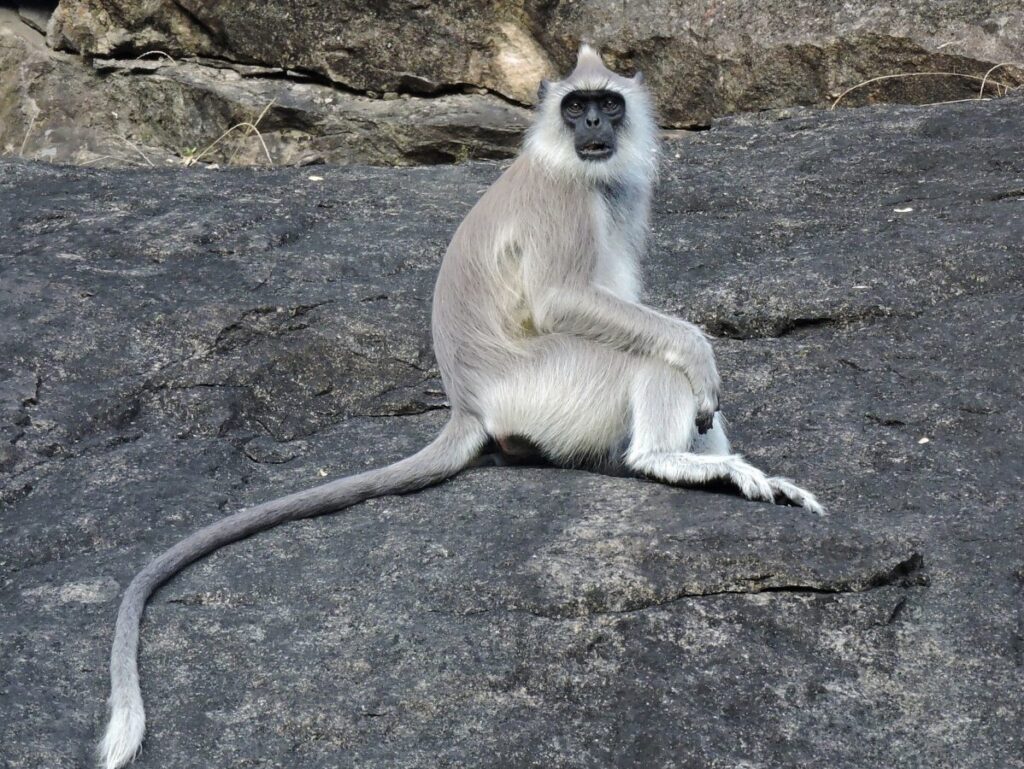
Tufted Gray Langur Appearance

The Tufted Gray Langur is characterized by its distinctively tufted appearance, with a longer tail compared to the rest of its body. This species exhibits a gray coloration, with subtle variations in shade, and its fur is notably dense and soft. The tufted gray langur’s physical features set it apart from similar species, contributing to its unique and recognizable presence.

Distribution

This species is endemic to the forests of southern India and Sri Lanka. In India, it is notably found in the Western Ghats, a region of mountainous forests renowned for its rich biodiversity. In Sri Lanka, tufted gray langurs are abundant in dry zone forests, and they have also been observed within human dwellings. The distribution of the tufted gray langur underscores its adaptability to diverse environments, reflecting its ability to thrive in both natural and human-altered landscapes.

Habitat Preferences

Tufted Gray Langur Habitat

The Tufted Gray Langur thrives in various ecosystems, including mountainous forests and dry zone forests. Its adaptability to different habitat types and its ability to coexist with human populations highlight its resilience and flexibility as a species. The availability of suitable vegetation for foraging and the presence of trees for shelter and safety are crucial factors in supporting the survival and well-being of the tufted gray langur in its chosen habitats.

This comprehensive species profile provides valuable insights into the unique characteristics, appearance, distribution, and habitat preferences of the Tufted Gray Langur, shedding light on the ecological significance of this remarkable primate species.

Facts About Tufted Gray Langur

  • The Tufted Gray Langur (Semnopithecus priam) is the largest native primate on Sri Lanka based on average sizes.
  • This species primarily has a diet consisting of 60% leaves, 20% twigs, and 18.87% fruits.
  • The Tufted Gray Langur has a narrow tail that is longer than the rest of its body.
  • The species is pale brown-gray, with a whitish head and a creamy yellow ventrum.
  • Tufted Gray Langurs are Old World monkeys and one of the species of langurs.
  • There are two subspecies of Tufted Gray Langurs, one of which occurs in India.
  • The Tufted Gray Langur is found in Sri Lanka and southern India.
  • Tufted Gray Langurs are known for their distinctive tuft of hair on their heads.
  • This species is primarily a leaf-eating monkey, similar to other gray langurs.
  • Tufted Gray Langurs are considered a species of concern and are part of the mammal species group.


Scientific Provenance & Verified Sources

Biological taxonomy, conservation status, and physical traits are cross-referenced with authoritative global registers:


Peer-reviewed by Wildlife Science Editors โ€ข Updated for 2026

Explore Other Species Profiles