IUCN Red List Conservation Status


Least Concern

LC
NT
VU
EN
CR
EW
EX

Official assessment evaluated in accordance with the IUCN Red List of Threatened Species criteria: Least Concern.


Species Quick Facts

Scientific Name
Elaphodus cephalophus

Average Lifespan
10-12 years in wild, 15-20 years in captivity

Average Weight
20-45 kg (44-99 lbs) – Males: 30-45 kg, Females: 20-30 kg

Average Length
115-150 cm (45-59 inches) – head-body length excluding tail

Overview & Identification

The tufted deer (Elaphodus cephalophus) is a small, solitary cervid endemic to the mountainous forests of central and southwestern China. Belonging to the family Cervidae, it is the sole species in the genus Elaphodus. Its range extends across the provinces of Sichuan, Yunnan, Gansu, Shaanxi, and Qinghai, occupying elevations of 1,500โ€“4,000โ€ฏm where mixed coniferโ€‘bamboo forests and shrublands provide cover and forage. The species is distinguished by a prominent black tuft of hair on the forehead, a short, dense coat that varies from reddishโ€‘brown in summer to darker grayโ€‘brown in winter, and males bearing short, threeโ€‘tined antlers that lack a brow tine. Adult males weigh 30โ€“45โ€ฏkg, females 20โ€“30โ€ฏkg, and both sexes measure 115โ€“150โ€ฏcm in headโ€‘body length. The tufted deer is primarily nocturnal, retreating to dense understory during daylight. Although once considered rare, recent surveys indicate a stable population of roughly 30,000โ€“40,000 mature individuals, leading the IUCN to list it as Least Concern. Nevertheless, habitat fragmentation and hunting pressure remain localized threats, prompting targeted conservation actions in several nature reserves.

Behavior & Social Structure

Tufted deer are largely solitary, with adult males maintaining territories that overlap the home ranges of several females. Home ranges vary from 0.5 to 2โ€ฏkmยฒ for females and up to 3โ€ฏkmยฒ for males, depending on habitat quality and season. The species is crepuscular to nocturnal, feeding under the cover of dusk and night to avoid predators such as leopards and wolves. Vocal communication is limited; individuals emit a soft bark or whistling call when alarmed, and males produce a brief grunt during the rut. Scent marking is achieved by rubbing the forehead tuft and antlers against vegetation, leaving scent from preorbital glands. During the breeding season (Octoberโ€“December), males increase patrols, display their antlers, and engage in brief bouts of antler wrestling to establish dominance. Outside the rut, tufted deer exhibit low social interaction, occasionally forming loose aggregations around abundant food sources.

Diet & Hunting Patterns

Tufted deer are strict herbivores, browsing on a diverse array of woody and herbaceous plants. Their diet consists primarily of fresh leaves, twigs, and buds of broadโ€‘leaf trees such as oak (Quercus spp.) and maple (Acer spp.), as well as bamboo shoots, fern fronds, and understory shrubs like rhododendron. Seasonal shifts occur: in spring they favor young shoots and buds, while in autumn they consume fallen fruits and seeds, particularly from the genus Viburnum. An adult requires roughly 2โ€“3โ€ฏkg of forage daily, obtaining most moisture from the vegetation itself. Feeding is typically conducted in small patches to reduce predation risk, and individuals may travel up to 2โ€ฏkm per day to locate highโ€‘quality browse. The tufted deerโ€™s specialized dentition, including sharp incisors and a wellโ€‘developed selenodont molar pattern, enables efficient processing of fibrous plant material.

Reproduction & Life Cycle

Tufted deer reach sexual maturity at 1.5โ€“2โ€ฏyears for females and 2โ€“3โ€ฏyears for males. The breeding season, or rut, occurs from October to December, when males establish territories and engage in brief antler contests. After a gestation period of approximately 210โ€ฏdays, females give birth to a single fawn, usually in May or June, coinciding with the peak of spring vegetation. Newborns weigh about 2.5โ€ฏkg and are concealed in dense vegetation for the first 10โ€“12โ€ฏdays, during which the mother visits briefly to nurse. Fawns are precocial, standing within hours of birth and beginning to graze on soft foliage within two weeks. Maternal care continues for 8โ€“10โ€ฏmonths, after which the juvenile becomes independent. The species exhibits a low reproductive rate, with females typically breeding once every 1โ€“2โ€ฏyears, a factor that influences population resilience.

Threats & Conservation

The IUCN classifies the tufted deer as Least Concern, reflecting its relatively wide distribution and stable population estimates of 30,000โ€“40,000 mature individuals. However, localized threats persist. Habitat loss due to logging, agricultural expansion, and infrastructure development fragments the highโ€‘altitude forests the species depends on, reducing available forage and increasing edge effects. Illegal hunting for meat and traditional medicine, though not widespread, adds mortality pressure in some provinces. Climate change poses a longerโ€‘term risk by altering vegetation phenology and shifting suitable habitat upward, potentially squeezing populations into smaller refugia. Conservation measures include the establishment of protected areas such as the Wolong and Jiuzhaigou nature reserves, antiโ€‘poaching patrols, and communityโ€‘based monitoring programs. Ongoing research aims to refine population trends and assess genetic diversity to guide future management.

Interesting Facts

โ€ข The tufted deerโ€™s most distinctive feature is a black hair tuft on its forehead, which can be raised when the animal is alarmed.
โ€ข Males possess short, threeโ€‘tined antlers that lack a brow tine, unlike most other cervids.
โ€ข It is one of the few deer species that inhabits elevations above 4,000โ€ฏm, adapting to cold, lowโ€‘oxygen environments.
โ€ข Despite its solitary nature, the species can form temporary feeding aggregations when bamboo shoots are abundant.
โ€ข The tufted deerโ€™s genome shows a unique adaptation in hemoglobin that improves oxygen transport at high altitudes.

Description

The Tufted Deer, scientifically known as Elaphodus cephalophus, is a small species of deer characterized by a prominent tuft of black hair on its forehead and fang-like canines for the males. This unique physical appearance sets it apart from other deer species and makes it easily recognizable in its natural habitat.

Appearance
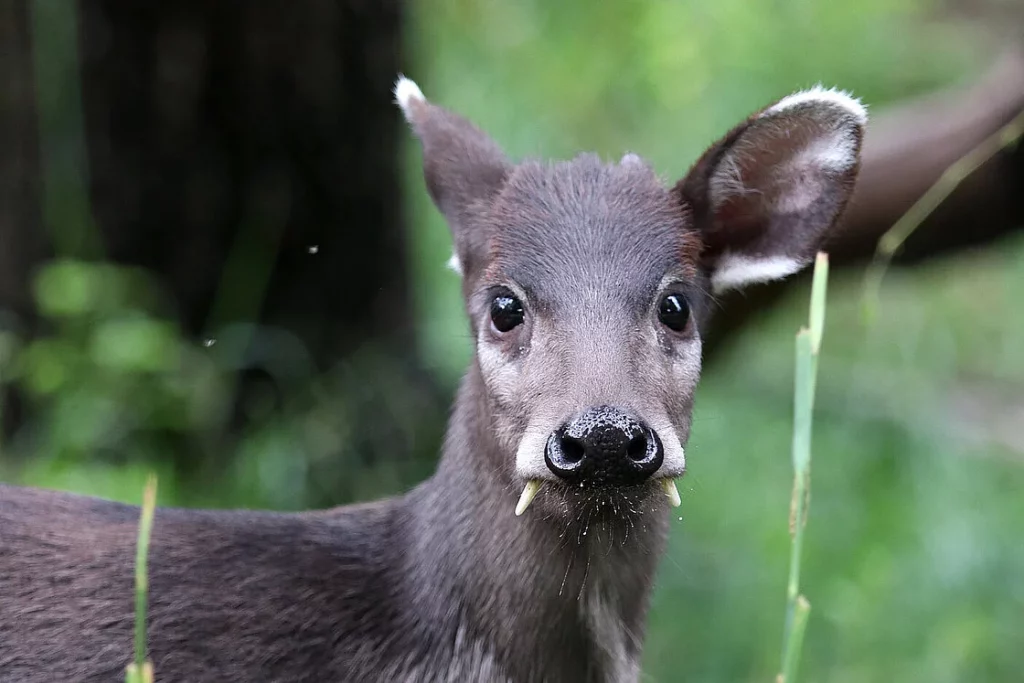
The Tufted Deer is distinguished by its tuft of black hair on the forehead, which gives it a distinctive and somewhat regal appearance. The males are further characterized by their fang-like canines, adding to their striking and memorable features. These physical traits make the Tufted Deer easily identifiable and set it apart from other deer species.

Distribution

The Tufted Deer is primarily found in the forested regions of southern and central China, extending from the eastern coast to eastern Tibet. It is also known to inhabit areas in northeast Burma (Myanmar). The species exhibits a preference for high, damp forests near the tree line, and its distribution is notable for its concentration in these specific ecosystems.

Habitat Preferences

Tufted Deer thrive in high valley jungles and mountain forests, where they have access to fresh water supplies. These habitats provide the necessary resources for their survival and well-being, supporting their dietary needs and offering suitable shelter. The species’ preference for specific ecosystems underscores the importance of preserving these environments to ensure the continued existence of the Tufted Deer.

This comprehensive species profile provides valuable insights into the unique characteristics, appearance, distribution, and habitat preferences of the Tufted Deer, shedding light on the importance of conservation efforts to protect this remarkable species and its natural habitats.

Facts About Tufted Deer

  • The tufted deer (Elaphodus cephalophus) is a small species of deer characterized by a prominent tuft of black hair on its forehead.
  • It is the only member of the genus Elaphodus.
  • The tufted deer is native to Asia and is found in parts of China, Myanmar, and Vietnam.
  • This species is listed as near threatened by the IUCN due to overhunting and habitat loss.
  • Adult tufted deer typically weigh between 37 to 66 pounds.
  • The lifespan of tufted deer in the wild is approximately 10 to 12 years.
  • Tufted deer are crepuscular, meaning they are most active during dawn and dusk.
  • Male tufted deer have fang-like canines, which are used in mating rituals and territorial displays.
  • They are known for their shy and gentle nature.
  • The tufted deer is not known to pose a threat to crops and is considered too rare to have adverse effects on agriculture.


Scientific Provenance & Verified Sources

Biological taxonomy, conservation status, and physical traits are cross-referenced with authoritative global registers:


Peer-reviewed by Wildlife Science Editors โ€ข Updated for 2026

Explore Other Species Profiles