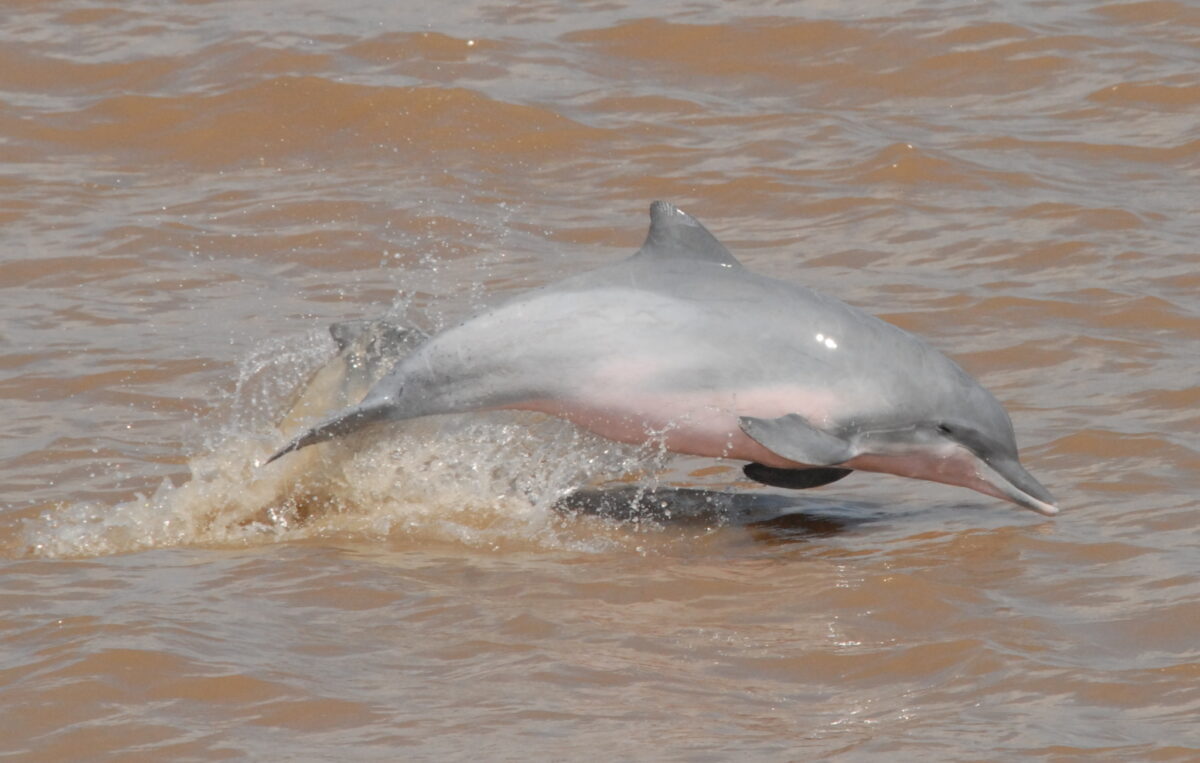
Tucuxi river dolphin leaping from brown freshwater with splashing water

IUCN Red List Conservation Status


Data Deficient

This species has no threat category on the IUCN Red List scale (status: Data Deficient), so no threat level is shown.


Species Quick Facts

Scientific Name
Sotalia fluviatilis

Average Lifespan
20-30 years in wild, 30-35 years in captivity

Average Weight
100-150 kg (220-330 lbs) – Males: 130 kg, Females: 110 kg

Average Length
170-200 cm (67-79 inches) – head-body length excluding tail

Overview & Identification

The Tucuxi (Sotalia fluviatilis) is a small riverine dolphin belonging to the family Delphinidae, the oceanic dolphin family. It inhabits the freshwater systems of the Amazon and Orinoco basins, extending into tributaries of the Guianas and northern Brazil. Unlike its marine relatives, the Tucuxi is adapted to turbid, slowโ€‘moving waters, where it frequents floodplain lakes, oxbow lakes, and the main channels of large rivers. Adults reach 1.7โ€“2.0โ€ฏm in total length and weigh 100โ€“150โ€ฏkg, with males typically larger than females. Its body is sleek and torpedoโ€‘shaped, covered by a smooth, dark gray to bluishโ€‘gray skin that lightens on the ventral side. A low, curved dorsal fin and a long, slender beak distinguish it from other South American river dolphins. The species is one of the few truly freshwater dolphins, and its distribution overlaps with extensive seasonal flooding, which expands its habitat during the rainy season. The IUCN currently classifies the Tucuxi as Data Deficient, reflecting limited knowledge of its population trends, though localized studies suggest it may be more abundant than previously thought. Conservation concerns focus on habitat degradation, byโ€‘catch in fisheries, and water pollution. Ongoing research and monitoring are essential to clarify its status and to implement effective protection measures across its range.

Behavior & Social Structure

The Tucuxi lives in small, fluid groups that typically range from two to ten individuals, although larger aggregations of up to 30 have been recorded in highly productive floodplain sections. Groups are often composed of a dominant adult female, her offspring, and a few adult males, suggesting a loosely matriarchal structure. The species is diurnal, undertaking most foraging activities during daylight hours when visibility is greatest, but it may also feed at night in clear waters. Home ranges are not fixed; individuals travel extensive distancesโ€”up to 150โ€ฏkm per yearโ€”following seasonal flood pulses that create new feeding corridors. Communication relies on a repertoire of highโ€‘frequency clicks for echolocation and a series of whistles and burstโ€‘pulse sounds that convey identity and social status. Acoustic signaling is essential for maintaining cohesion in the turbid river environment, where visual cues are limited. Territoriality is weak; overlapping ranges are common, and individuals readily associate with conspecifics from neighboring groups, especially during the breeding season.

Diet & Hunting Patterns

The Tucuxi is a strict carnivore that feeds primarily on small to mediumโ€‘sized freshwater fish such as characins (family Characidae), catfish (order Siluriformes), and cichlids, supplemented by occasional crustaceans like freshwater shrimp and small cephalopods when available. Daily food intake represents roughly 3โ€“5โ€ฏ% of body mass, equating to 3โ€“7โ€ฏkg for an adult. Foraging is opportunistic and highly adaptable; the dolphin uses echolocation clicks to locate prey hidden in murky water or among submerged vegetation. In the flood season, the Tucuxi exploits the influx of migratory fish schools, often forming coordinated hunting formations that herd prey into shallow channels. In clearer tributaries, it may employ a โ€œburstโ€‘pulseโ€ strategy, rapidly accelerating to chase and capture individual fish. Seasonal shifts in diet composition have been documented, with a higher proportion of catfish during lowโ€‘water periods when these species dominate the available fauna.

Reproduction & Life Cycle

Tucuxi females reach sexual maturity at about 5โ€“7โ€ฏyears, while males mature slightly later at 6โ€“8โ€ฏyears. Breeding occurs yearโ€‘round, with a peak in the early rainy season when prey abundance is highest. The gestation period lasts 10โ€“11โ€ฏmonths, after which a single calf is born, measuring roughly 70โ€ฏcm and weighing 10โ€“12โ€ฏkg. Calving intervals are typically 2โ€“3โ€ฏyears, reflecting the energetic cost of rearing a large offspring in a variable environment. Newborns are nursed for 12โ€“18โ€ฏmonths, during which the mother provides constant protection and teaches the calf basic foraging techniques. Weaning is gradual; calves begin to accompany the group on feeding excursions at about 9โ€ฏmonths but remain dependent on maternal milk until they can capture fish independently. Both sexes remain with their natal group for several years, and females may exhibit site fidelity to preferred breeding grounds, while males often disperse to seek new territories.

Threats & Conservation

The IUCN lists the Tucuxi as Data Deficient, reflecting the paucity of comprehensive population surveys across its extensive range. Nevertheless, regional assessments indicate that the species faces a suite of escalating threats. Largeโ€‘scale hydroelectric dam projects fragment river connectivity, restrict migratory routes, and alter flood regimes essential for the dolphinโ€™s seasonal movements. Byโ€‘catch in gillโ€‘nets and purseโ€‘seine fisheries is a major source of mortality; estimates from the Brazilian Amazon suggest that up to 5โ€ฏ% of the local dolphin population may be lost annually to incidental capture. Water pollution from mining, oil extraction, and agricultural runoff degrades habitat quality and can lead to bioaccumulation of heavy metals in dolphin tissue. Increased boat traffic contributes to noise pollution, which interferes with echolocation and communication, and raises the risk of collisions. Climateโ€‘driven changes in precipitation patterns may further exacerbate habitat loss by modifying flood dynamics. Conservation actions currently focus on promoting dolphinโ€‘safe fishing gear, establishing protected river sections, and conducting systematic population monitoring to inform future management plans.

Interesting Facts

โ€ข The Tucuxi is the smallest of the South American river dolphins, reaching only about 2โ€ฏm in length.
โ€ข It possesses a dorsal fin that is low and curved, unlike the tall, triangular fin of many marine dolphins.
โ€ข Unlike many river dolphins, the Tucuxi can tolerate relatively clear water and is often seen near the surface.
โ€ข Its echolocation clicks can exceed 150โ€ฏkHz, allowing it to navigate the turbid Amazon waters.
โ€ข Genetic studies show that the Tucuxi is more closely related to the marine bottlenose dolphin (Tursiops truncatus) than to other South American river dolphins.

Description

The Tucuxi, scientifically known as Sotalia fluviatilis, is a fascinating freshwater dolphin species found in the rivers of the Amazon basin. Belonging to the family Delphinidae, the Tucuxi is known for its unique characteristics that set it apart from other river dolphins. Despite sharing geographic locations with ‘true’ river dolphins such as the boto, the Tucuxi is not closely related to them, making it a distinct and intriguing species in its own right.

Appearance

The Tucuxi is distinguishable by its sleek, streamlined body, typically reaching lengths of 5 to 6 feet. Its coloration varies from light to dark gray on the dorsal side, while the ventral side is lighter, often with a pinkish hue. One of the most striking features of the Tucuxi is its prominent, elongated beak, which sets it apart from other river dolphins. This species is known for its agile and acrobatic behavior, often seen leaping and playing in the water, showcasing its remarkable physical capabilities.

Distribution

The Tucuxi inhabits a wide range of river systems within the Amazon basin, including the Amazon River itself and its tributaries. Its distribution extends through countries such as Brazil, Colombia, Peru, and Ecuador, with notable populations residing in the freshwater habitats of these regions. While the Tucuxi’s population density varies across its range, it is known to thrive in areas with abundant fish populations, which serve as a crucial food source for the species.

Habitat Preferences

Tucuxis are well adapted to thriving in diverse freshwater ecosystems, including river channels, oxbow lakes, and estuaries. Their survival and well-being are closely tied to these environments, which provide rich biodiversity and ample prey for the species. The Tucuxi’s preference for freshwater habitats underscores the importance of conserving these ecosystems, as they play a vital role in sustaining the species’ population and overall ecological balance within the Amazon basin.

This comprehensive species profile provides valuable insights into the unique characteristics, distribution, and habitat preferences of the Tucuxi, shedding light on the importance of conservation efforts to protect this remarkable freshwater dolphin species.

Facts About Tucuxi

  • Tucuxis, also known as Sotalia fluviatilis, are freshwater dolphins found in the rivers of the Amazon basin.
  • They are not genetically related to the South American river dolphins, despite being found in similar geographic locations.
  • Tucuxis breed during late summer and early fall, with a gestation period ranging from 10 to 11.6 months, resulting in the birth of one calf during the fall low-water season.
  • The population density estimates in the Amazon drainage area show an average density of tucuxis.
  • Tucuxi dolphins are found in the central Amazon river basin, with confirmed presence in Brazil, Colombia, Ecuador, and Peru.
  • The tucuxi population near Cananรฉia Island was estimated at 2,829.
  • The species’ range largely overlaps with the distribution of another species, the Guiana dolphin.
  • Tucuxis have a longer and narrower snout compared to the bottlenose dolphin, and their flippers are broader.
  • The scientific name for the tucuxi, Sotalia fluviatilis, means “dolphin of the river.”
  • Tucuxis are a small species of dolphin, described initially in 1853.


Scientific Provenance & Verified Sources

Biological taxonomy, conservation status, and physical traits are cross-referenced with authoritative global registers:


Peer-reviewed by Wildlife Science Editors โ€ข Updated for 2026

Explore Other Species Profiles