Tonkin Snub-Nosed Monkey

IUCN Red List Conservation Status


Endangered

LC
NT
VU
EN
CR
EW
EX

Official assessment evaluated in accordance with the IUCN Red List of Threatened Species criteria: Endangered.


Species Quick Facts

Scientific Name
Rhinopithecus avunculus

Average Lifespan
20-25 years in wild, 30-35 years in captivity

Average Weight
6-12 kg (13-26 lbs) – Males: 9-12 kg, Females: 6-9 kg

Average Length
45-55 cm (18-22 inches) – head-body length excluding tail

Overview & Identification

The Tonkin snubโ€‘nosed monkey (Rhinopithecus avunculus) belongs to the family Cercopithecidae, subfamily Colobinae. It is endemic to the highโ€‘altitude evergreen forests of northern Vietnam, with a few historic records from adjacent Laos. The species inhabits montane primary forest between 1,000 and 2,200โ€ฏm elevation, preferring dense canopy and abundant lichen growth. Adults are distinguished by a short, upturned nose, a thick silverโ€‘gray coat on the back, a reddishโ€‘brown face, and a white beard that frames the muzzle. Small, dexterous hands and a specialized threeโ€‘chambered stomach enable efficient digestion of fibrous leaves. The Tonkin snubโ€‘nosed monkey is listed as Endangered on the IUCN Red List, with fewer than 500 mature individuals remaining in the wild. Habitat fragmentation, illegal logging, and hunting for meat and the pet trade are the principal drivers of decline. Conservation actions include the establishment of protected areas such as the Hoang Lien National Park, communityโ€‘based forest management, and a captiveโ€‘breeding program coordinated by the Vietnam National Zoo. Ongoing research on population genetics and habitat connectivity aims to improve longโ€‘term survival prospects.

Behavior & Social Structure

Tonkin snubโ€‘nosed monkeys live in multiโ€‘male, multiโ€‘female troops ranging from 10 to 30 individuals, although smaller oneโ€‘male units have been observed in heavily disturbed habitats. The groups are highly arboreal, spending most of the day foraging in the upper canopy and sleeping on sturdy branches at night. They are diurnal, with peak activity at dawn and dusk when they move between feeding sites. Territorial boundaries are fluid; neighboring groups may overlap but avoid direct conflict through vocal displays and branchโ€‘shaking signals. Communication includes a repertoire of loud โ€œwhoops,โ€ soft โ€œcoos,โ€ and facial expressions such as lipโ€‘pursing. Grooming occupies a large portion of social time, reinforcing alliances and reducing tension. Seasonal variations in food availability lead to temporary fissionโ€‘fusion dynamics, where subโ€‘groups split to exploit dispersed resources before reโ€‘uniting.

Diet & Hunting Patterns

The Tonkin snubโ€‘nosed monkey is primarily a folivore, relying on young leaves, leaf buds, and shoots of broadโ€‘leaf trees such as Castanopsis and Quercus species. During the fruiting season (Aprilโ€“June), they supplement their diet with ripe figs, berries, and occasional seeds, making them opportunistic frugivores. Lichens and mosses, abundant on damp branches, provide a critical protein source during the lean winter months. Daily intake can reach up to 1.5โ€ฏkg of foliage per individual, processed by a complex, foregutโ€‘fermenting stomach that houses cellulolytic bacteria. Feeding occurs in short bouts throughout the day, with individuals often moving in small foraging parties to minimize competition. Water is obtained from dewโ€‘laden leaves and occasional streams, as permanent water sources are scarce at their elevation.

Reproduction & Life Cycle

Females reach sexual maturity at about 4โ€“5โ€ฏyears, while males mature slightly later at 5โ€“6โ€ฏyears. Breeding is seasonal, typically occurring from November to January, coinciding with the onset of the cool, dry season when leaf buds are abundant. The gestation period lasts 215โ€“230โ€ฏdays, after which a single infant is born, weighing roughly 400โ€“500โ€ฏg. Newborns are altricial, clinging to the motherโ€™s belly for the first two months and receiving intensive grooming and protection. Infants are weaned at 6โ€“8โ€ฏmonths but remain dependent on the mother for up to two years. Females may give birth every 2โ€“3โ€ฏyears, reflecting the high energetic cost of rearing in a lowโ€‘nutrient environment. Male dominance rank influences mating success, with higherโ€‘ranking males siring the majority of offspring.

Threats & Conservation

The IUCN classifies the Tonkin snubโ€‘nosed monkey as Endangered, with an estimated 300โ€“500 mature individuals remaining. Habitat loss is the most severe threat; illegal logging and conversion of forest to tea, coffee, and rubber plantations have reduced suitable habitat by over 40โ€ฏ% in the past three decades. Fragmentation isolates subโ€‘populations, limiting gene flow and increasing inbreeding risk. Poaching for bushmeat and the illegal pet trade, though less common than for larger primates, still occurs in remote villages. Climate change may shift the distribution of the montane forest, further constricting the speciesโ€™ range. Conservation measures include the designation of protected areas, antiโ€‘poaching patrols, and a captiveโ€‘breeding program that has produced over 30 offspring since 2005. Community outreach programs promote sustainable livelihoods and forest stewardship, aiming to reduce humanโ€‘induced pressures on the remaining populations.

Interesting Facts

โ€ข The Tonkin snubโ€‘nosed monkey has one of the most upturned noses among primates, giving it a permanently โ€œsnubโ€‘noseโ€ appearance.
โ€ข It possesses a threeโ€‘chambered stomach, similar to ruminants, to ferment tough leaf material.
โ€ข This species is one of the worldโ€™s rarest primates, with fewer than 500 individuals in the wild.
โ€ข It can survive on lichens, a food source few other mammals can digest efficiently.
โ€ข The Tonkin snubโ€‘nosed monkey was only formally described by science in 1997, making it a relatively recent discovery.

Description

Tonkin Snub-Nosed Monkey

The Tonkin Snub-Nosed Monkey, also known as Dollman’s Snub-Nosed Monkey, is a slender-bodied arboreal Old World monkey, endemic to northern Vietnam. It is characterized by its striking black and white fur, a distinctive pink nose and lips, and captivating blue patches around the eyes. This unique combination of features makes it one of the most visually captivating primate species in the world.

Appearance

Tonkin Snub-Nosed Monkey Appeaearance

The Tonkin Snub-Nosed Monkey’s appearance is distinguished by its black and white fur, which provides effective camouflage in its natural habitat. The most notable features are its pink nose and lips, which stand out against the contrasting fur, and the striking blue patches around its eyes. These features set it apart from similar species and make it easily recognizable in the wild.

Distribution

The Tonkin Snub-Nosed Monkey is endemic to northern Vietnam, specifically in the border regions with China. Its distribution is limited to a few isolated areas within this region, making it a critically endangered species with a highly restricted range. The population density of the Tonkin Snub-Nosed Monkey is notably low, further emphasizing the urgent need for conservation efforts to protect and preserve this species.

Habitat Preferences
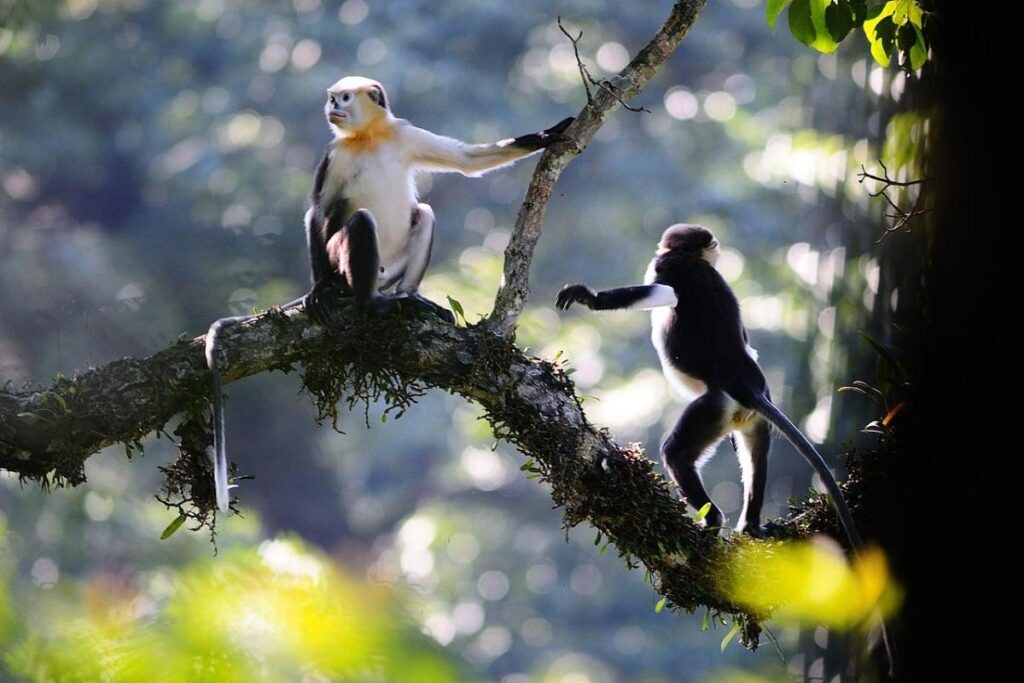
Tonkin Snub-Nosed Monkey Habitat

The Tonkin Snub-Nosed Monkey thrives in primary subtropical lowland broadleaf forests on steep limestone hills. These ecosystems provide the essential resources for its survival, including suitable food sources and shelter. The species’ habitat preferences are closely linked to the availability of specific tree species and the presence of suitable feeding grounds, emphasizing the importance of preserving these unique forest ecosystems to ensure the well-being of the Tonkin Snub-Nosed Monkey population.

By highlighting the unique characteristics, appearance, distribution, and habitat preferences of the Tonkin Snub-Nosed Monkey, this species profile aims to increase awareness of the importance of conservation efforts to protect this remarkable primate from the brink of extinction.

Facts About Tonkin Snub-Nosed Monkey

  • The Tonkin snub-nosed monkey (Rhinopithecus avunculus) is one of the rarest mammals globally.
  • This species is native to Vietnam and is considered one of the most endangered primates.
  • They communicate with each other through a system of vocalizations.
  • The social structure of Tonkin snub-nosed monkeys has been described as being one male monkey with multiple females and juveniles or groups of all males.
  • They construct their nighttime nests on a tree’s lower branches near a steep mountainside for protection from cold winds.
  • The Tonkin snub-nosed monkey is monotypic; it has no subspecies.
  • This monkey is an arboreal and diurnal species, meaning they are active during the day and live in trees.
  • The head-body length of the Tonkin snub-nosed monkey ranges from 51-62 cm, and tail length ranges from 66-92 cm.
  • The species is largely threatened by hunting for consumption and habitat loss.
  • The Tonkin Snub-nosed Monkey is a critically endangered primate that is endemic to Vietnam.


Scientific Provenance & Verified Sources

Biological taxonomy, conservation status, and physical traits are cross-referenced with authoritative global registers:


Peer-reviewed by Wildlife Science Editors โ€ข Updated for 2026

Explore Other Species Profiles