

Description

The Taruca, scientifically known as Hippocamelus antisensis, is a medium-sized deer species that inhabits the high regions of South America. Its common name, “taruca,” originates from the Quechua and Aymara languages, both of which translate to “deer.” This species is closely related to the Southern guemal.
Appearance

The Taruca is characterized by its medium size, with a body length typically ranging from 1.2 to 1.5 meters and a shoulder height of around 80 centimeters. It possesses a distinctive reddish-brown coat, with a lighter underside and a dark stripe running along its back. The males are distinguished by their short, straight, and smooth antlers, which typically have three points. These antlers set the Taruca apart from similar species and are a key feature for identification.
Distribution
The Taruca is primarily found in the high-altitude regions of South America, including the Andes Mountains. Its range spans across countries such as Peru, Bolivia, and parts of Argentina and Chile. Within this region, the Taruca exhibits a preference for montane and alpine habitats, often inhabiting rugged terrain at elevations between 3,000 and 5,000 meters above sea level. Despite its limited distribution, the Taruca plays a vital role in the ecosystem of these high-altitude environments.
Habitat Preferences
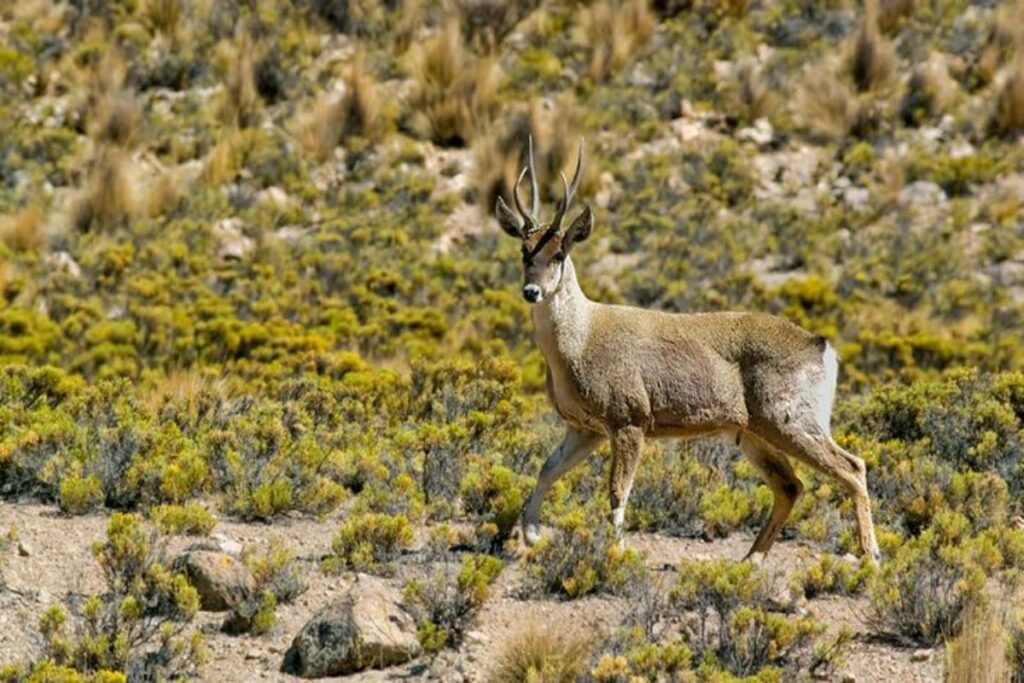
Taruca thrives in a variety of ecosystems, including grasslands, shrublands, and mountain forests. It is well-adapted to the harsh conditions of its high-altitude habitat, where it can endure cold temperatures and low oxygen levels. These environments provide the Taruca with access to suitable forage and cover, contributing to its survival and well-being.
As a renowned conservation scientist with a passion for wildlife, I hope this species profile provides valuable insights into the unique characteristics and ecological significance of the Taruca.
Facts About Taruca
- The Taruca, also known as the north Andean deer, is native to South America.
- Its habitat ranges from Peru, Bolivia, and Argentina to the upper part of Chile.
- The species is considered vulnerable due to a small population size and decline.
- Tarucas mainly feed on small dicotyledon plants that grow near the ground.
- The gestation period for Taruca is approximately 7.5 months.
- Adult males possess small, V-shaped antlers, with the front prong generally smaller than the rear one.
- The average weight of Taruca ranges from 69 to 80 kilograms (151.8 to 176 pounds).
- They live at high elevations, typically between 4,100 to 5,000 meters, and are rarely found below elevations of 3,960 meters.
- The home ranges of Taruca exceed 2 square kilometers.
- The population size of Taruca ranges from 15.7 to 21 thousand.


