IUCN Red List Conservation Status


Least Concern

LC
NT
VU
EN
CR
EW
EX

Official assessment evaluated in accordance with the IUCN Red List of Threatened Species criteria: Least Concern.


Species Quick Facts

Scientific Name
Pteropus conspicillatus

Average Lifespan
10-15 years in wild, 15-20 years in captivity

Average Weight
0.8-1.2 kg (1.8-2.6 lbs) – Males: 1.0 kg, Females: 0.9 kg

Average Length
30-38 cm (12-15 inches) – head-body length excluding tail

Overview & Identification

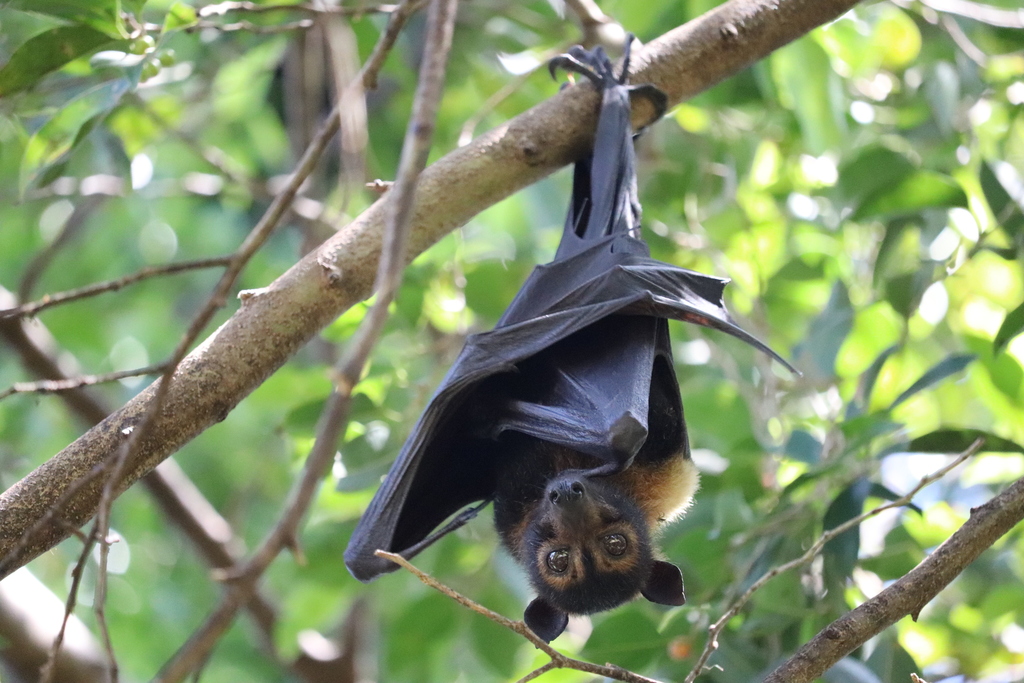
The Spectacled Flying Fox (Pteropus conspicillatus) is a large megabat belonging to the family Pteropodidae within the order Chiroptera. Endemic to the lowland forests and coastal mangroves of Papua New Guinea and the Solomon Islands, it inhabits primary rainforest, secondary growth, and occasionally cultivated orchards. Adults display a distinctive white facial mask that frames the eyes, giving the species its common name. Wingspan can exceed 1.5 meters, making it one of the largest fruitโ€‘eating bats in the region. Roosts are typically formed in tall canopy trees, where colonies of several hundred individuals gather at dusk before foraging. The IUCN Red List classifies the species as Least Concern, although populations are thought to be declining due to hunting pressure and habitat conversion. Conservation actions include monitoring of roost sites, community education on sustainable hunting, and protection of key forest corridors.

Behavior & Social Structure

Spectacled Flying Foxes are highly social, forming day roosts that can number from a few dozen to several thousand individuals. They are strictly nocturnal, leaving the roost at twilight to travel up to 30 km in search of ripe fruit and nectar. Foraging is conducted in loose, loosely coordinated groups that communicate through a repertoire of lowโ€‘frequency vocalizations and wingโ€‘flap sounds. Individuals maintain personal space within the colony but engage in frequent allogrooming, which reinforces social bonds. Territoriality is limited to preferred foraging trees rather than fixed home ranges, and individuals often revisit the same fruiting trees nightly. Scent marking with glandular secretions on branches helps individuals recognize familiar roost mates and reduces aggressive encounters.

Diet & Hunting Patterns

The Spectacled Flying Fox is a strict frugivore and occasional nectarivore, relying on a diet dominated by figs (Ficus spp.), mangoes (Mangifera indica), and native forest fruits such as breadfruit (Artocarpus altilis) and papaya (Carica papaya). An adult can consume up to 1.5 kg of fruit per night, selecting ripe, sugarโ€‘rich portions while discarding seeds and fibrous material. Feeding is performed in flight, with the bat using its elongated tongue to extract pulp and juice. In addition to fruit, the species supplements its diet with nectar from flowering trees like Eucalyptus and Pandanus, which provides essential proteins and minerals. Seasonal fluctuations in fruiting patterns drive migratory foraging movements, and the bat plays a crucial role in seed dispersal across its island habitats.

Reproduction & Life Cycle

Sexual maturity is reached at about 12โ€“18 months for both sexes, with females typically breeding once per year. Mating occurs in the early dry season (Mayโ€“July), and females give birth after a gestation period of approximately 150โ€“180 days. Litter size is almost always a single pup, which is born altricial, hairless, and weighing around 30โ€“40 grams. The mother carries the newborn on her ventral side for the first two weeks, nursing it nightly while hanging upsideโ€‘down in the roost. Pups are weaned at 8โ€“10 weeks and become volant shortly thereafter, though they remain in the colony for several months before achieving full independence. Reproductive success is closely linked to fruit availability, with higher birth rates observed in years of abundant fig production.

Threats & Conservation

The IUCN lists the Spectacled Flying Fox as Least Concern, yet the species faces several escalating threats. Unsustainable hunting for bushmeat remains the primary pressure, with estimates that up to 15% of local adult populations are removed annually in some villages. Habitat loss due to logging, agricultural expansion, and coastal development reduces the availability of roosting trees and foraging resources. Climateโ€‘induced changes in fruiting phenology can lead to food shortages, especially during prolonged dry periods. Although exact numbers are uncertain, current population estimates range between 100,000 and 150,000 mature individuals, with a declining trend of roughly 5% per decade. Conservation measures include communityโ€‘based hunting quotas, protection of key roost trees, and inclusion of the species in national wildlife protection legislation.

Interesting Facts

โ€ข The white facial mask gives the bat a โ€˜spectacledโ€™ appearance, unique among Pacific flying foxes.
โ€ข It can travel over 30 km in a single night to locate fruiting trees.
โ€ข A single individual can disperse thousands of seeds per year, aiding forest regeneration.
โ€ข Unlike many bats, it lacks a tail, relying on its large wings for maneuverability.
โ€ข Its wingspan can exceed 1.5 meters, making it one of the largest bat species in the world.

Description

The Spectacled Flying Fox (Pteropus conspicillatus), also known as the Spectacled Fruit Bat, is a remarkable megabat species known for its striking appearance and important ecological role. As one of the largest bats in Australia, it possesses a wingspan of up to a meter, making it an impressive sight in its natural habitat.

Appearance

This species is characterized by its unique facial markings, which resemble a pair of spectacles, giving rise to its common name. The fur of the Spectacled Flying Fox is typically dark brown or black with a contrasting golden mantle across its shoulders. Its large eyes and fox-like face contribute to its distinctive and charismatic appearance, setting it apart from other bat species.

Distribution

The Spectacled Flying Fox is primarily found in the north-eastern regions of Queensland, Australia. It also inhabits New Guinea and various offshore islands. This species demonstrates a preference for coastal areas and is known to roost in large colonies, contributing to its significance in the ecosystems of these regions. However, it is important to note that the population density of the Spectacled Flying Fox has faced notable challenges due to habitat loss and human-wildlife conflict.

Habitat Preferences

These fascinating creatures are known to thrive in primary and secondary growth tropical rainforests, where they play a crucial role as seed dispersers and pollinators. They often roost in dead trees or stripped trees, utilizing these locations as communal resting sites. The Spectacled Flying Fox’s reliance on specific ecosystems underscores the importance of conserving these habitats to ensure the species’ survival and well-being.

By shedding light on the unique characteristics, appearance, distribution, and habitat preferences of the Spectacled Flying Fox, this species profile aims to enhance understanding and appreciation for this captivating mammal, encouraging efforts to support its conservation and the preservation of its natural habitats.

Facts About Spectacled Flying Fox

  • The spectacled flying fox (Pteropus conspicillatus) is a megabat species found in Australia’s northeastern regions.
  • They are primarily found in or around rainforests and sometimes in mangroves associated with black flying-foxes.
  • Spectacled flying foxes are important pollinators and seed dispersers for many native tree species in their habitat.
  • These bats have a wingspan of up to one meter, making them one of the largest bat species in Australia.
  • They primarily feed on nectar, pollen, and native fruits, playing a crucial role in maintaining the ecological balance of their habitat.
  • The species is known for its distinctive creamy-yellow to orange “spectacles” around the eyes, which give them their name.
  • Spectacled flying foxes have a complex and irregular movement pattern primarily determined by seasonal nectar flows.
  • They are listed as a vulnerable species due to habitat loss, human disturbance, and extreme weather events impacting their populations.
  • Female spectacled flying foxes typically give birth to a single offspring each year, with the young bats remaining dependent on their mothers for several months.
  • Conservation efforts are underway to protect and preserve the spectacled flying fox population, including habitat conservation and community education initiatives.


Scientific Provenance & Verified Sources

Biological taxonomy, conservation status, and physical traits are cross-referenced with authoritative global registers:


Peer-reviewed by Wildlife Science Editors โ€ข Updated for 2026

Explore Other Species Profiles