IUCN Red List Conservation Status


Least Concern

LC
NT
VU
EN
CR
EW
EX

Official assessment evaluated in accordance with the IUCN Red List of Threatened Species criteria: Least Concern.


Species Quick Facts

Scientific Name
Capra pyrenaica

Average Lifespan
12-14 years in wild, 15-20 years in captivity

Average Weight
30-100 kg (66-220 lbs) – Males: 70 kg, Females: 40 kg

Average Length
115-150 cm (45-59 inches) – head-body length excluding tail

Overview & Identification

The Spanish ibex (Capra pyrenaica), also called the Iberian ibex, is a wild goat endemic to the mountainous regions of the Iberian Peninsula in southwestern Europe. Belonging to the family Bovidae and the order Artiodactyla, it is one of four recognized subspecies of the Iberian ibex, with the Spanish ibex (C. p. hispanica) occupying the central and northern ranges of Spain and Portugal. Its preferred habitats are steep, rugged terrain such as limestone cliffs, rocky outcrops, and highโ€‘altitude grasslands between 1,000 and 2,500โ€ฏm, where dense shrub cover provides both forage and protection from predators. The species is wellโ€‘adapted to the harsh Mediterranean climate, tolerating hot, dry summers and cold, snowy winters. Morphologically, the Spanish ibex displays a robust body, short legs, and a distinctive set of backwardโ€‘curving horns that can reach up to 70โ€ฏcm in length in males. Seasonal coat changesโ€”from a light brown summer pelage to a thicker, grayโ€‘brown winter coatโ€”aid thermoregulation. Historically hunted for meat and trophies, the ibex has rebounded after legal protection and reโ€‘introduction programs, and the IUCN currently lists it as Least Concern, although localized pressures persist. Ongoing monitoring focuses on habitat connectivity, disease surveillance, and mitigating humanโ€‘wildlife conflict to ensure longโ€‘term viability.

Behavior & Social Structure

Spanish ibex are primarily diurnal, spending daylight hours foraging on steep slopes and resting in sheltered ledges. Females form stable matriarchal groups of 5โ€‘15 individuals that include juveniles and subโ€‘adults, while adult males are either solitary or assemble into loose bachelor groups outside the rut. During the autumn rut, dominant males establish and defend territories on prominent ridges, using vocal barks, horn clashes, and scent marking from preorbital glands to deter rivals. Territorial boundaries are fluid, with overlap tolerated when resources are abundant. Communication also includes lowโ€‘frequency bleats that maintain cohesion within female groups and signal alarm. Home ranges vary from 2 to 10 kmยฒ depending on habitat quality, and individuals exhibit strong site fidelity, returning to traditional feeding patches and bedding sites year after year.

Diet & Hunting Patterns

The Spanish ibex is a strict herbivore, feeding primarily on a diverse array of alpine and subโ€‘alpine vegetation. In spring, the diet is dominated by herbaceous grasses (e.g., Festuca spp., Bromus spp.) and tender shoots of forbs such as Plantago and Scrophularia. Summer sees a shift toward woody browse, including leaves and twigs of evergreen shrubs like Genista, Erica, and Juniperus, as well as the occasional consumption of lichens on exposed rock. Autumn diets incorporate acorns and fallen fruits when available, providing essential fats for the upcoming winter. During the harsh winter months, ibex rely heavily on dwarf shrubs and the bark of hardy trees, supplementing with snowโ€‘melt water. Daily intake averages 2โ€‘3โ€ฏ% of body weight, and the species employs a selective grazing strategy, using its keen sense of smell and tactile whiskers to assess plant palatability and nutritional content. Seasonal migrations to higher elevations allow access to fresh growth, while the steep terrain reduces competition with domestic livestock.

Reproduction & Life Cycle

Spanish ibex reach sexual maturity at 2โ€‘3 years for females and 3โ€‘4 years for males, though successful breeding often occurs later for males due to competition. The rut occurs from late October to early December, when males engage in spectacular horn clashes and vocal displays to win access to estrous females. After successful mating, gestation lasts approximately 150โ€‘160 days, resulting in the birth of a single kid in late March to early May, timed with the spring vegetation flush. Kids are born with a woolly coat and are able to stand within an hour, following the mother to nurse. Maternal care is intensive during the first 2โ€‘3 months; kids remain hidden in dense shrub cover while the mother forages. Weaning occurs at about 3 months, after which juveniles join female groups. Survival rates exceed 70โ€ฏ% in protected areas but are lower where predation by wolves or human disturbance is high.

Threats & Conservation

The IUCN classifies the Spanish ibex as Least Concern, with an estimated global population of 30,000โ€‘35,000 mature individuals, most of which reside in protected areas of Spain and Portugal. Nevertheless, the species faces several localized threats. Habitat fragmentation from expanding road networks and ski resort development reduces connectivity between subโ€‘populations, increasing genetic isolation. Illegal hunting, though reduced by strict enforcement, still occurs in remote valleys, targeting males for trophies. Disease poses a significant risk; outbreaks of sarcoptic mange and pneumonia have caused mortality spikes of up to 15โ€ฏ% in affected herds. Climate change threatens the alpine habitats by altering vegetation phenology and increasing the frequency of extreme weather events, potentially reducing winter forage availability. Conservation actions include habitat corridor creation, disease monitoring programs, and communityโ€‘based antiโ€‘poaching initiatives, which together have contributed to a stable or slightly increasing population trend over the past decade.

Interesting Facts

โ€ข The Spanish ibex can leap up to 3 meters vertically to navigate sheer cliffs.
โ€ข Its backwardโ€‘curving horns grow continuously throughout life, adding a new ring each year.
โ€ข Ibex have a specialized rumen that can ferment highโ€‘fiber alpine plants efficiently.
โ€ข During the rut, males can lose up to 15โ€ฏ% of body weight due to intense fighting and reduced feeding.
โ€ข Reโ€‘introduction projects in the Sierra de Gredos have successfully established new subโ€‘populations after local extirpation.

Description

The Spanish Ibex, scientifically known as Capra pyrenaica, is a majestic species of ibex endemic to the Iberian Peninsula. This wild goat species is characterized by its striking appearance, robust build, and impressive curved horns. With four described subspecies, the Spanish Ibex has faced conservation challenges, including the extinction of two subspecies, making its preservation a critical focus for wildlife conservation efforts.

Appearance
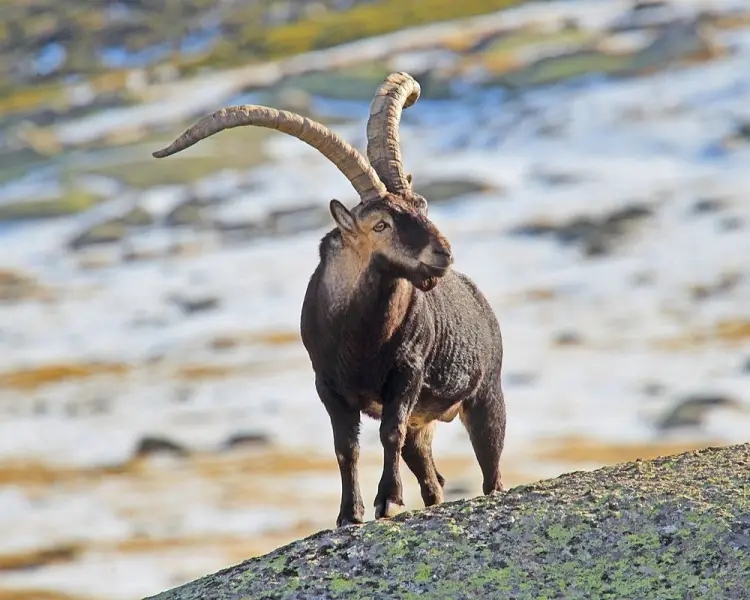
The Spanish Ibex possesses distinct physical features that set it apart from other species. It exhibits a sturdy body with a short, coarse coat that provides insulation in its mountainous habitat. The most notable feature is the male’s magnificent, backward-curving horns, which can grow to remarkable lengths, adding to the species’ allure and grandeur. These impressive horns are a defining characteristic of the Spanish Ibex and contribute to its iconic presence in its natural environment.

Distribution

The Spanish Ibex primarily inhabits the mountainous regions of the Iberian Peninsula, including Spain and parts of Portugal. Notably, the species has been reintroduced to the French Pyrenees, showcasing ongoing conservation efforts to expand its range. However, the Spanish Ibex has faced population declines and extirpation from certain areas, emphasizing the importance of conservation initiatives to safeguard its presence in the wild.

Habitat Preferences
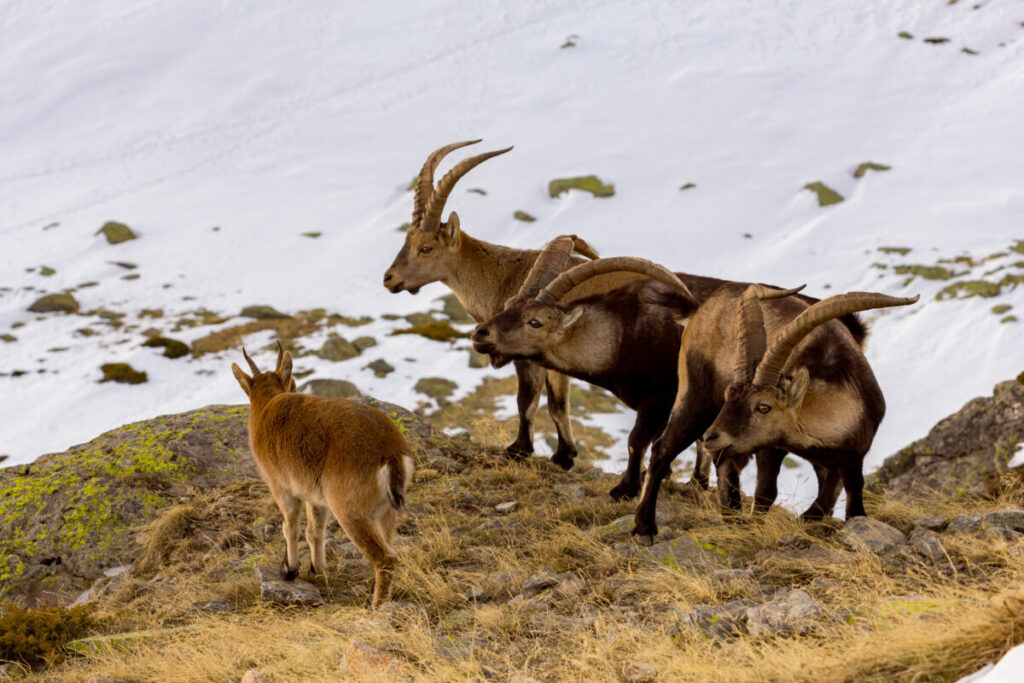
The Spanish Ibex thrives in rugged, mountainous terrain, demonstrating a preference for rocky habitats interspersed with scrub or pine trees. These environments provide the species with natural shelter, foraging opportunities, and strategic vantage points for evading predators. The adaptability of the Spanish Ibex to these challenging ecosystems underscores its resilience and ability to thrive in diverse mountainous landscapes.

As a renowned expert in animal conservation and wildlife education, I trust that this comprehensive species profile provides valuable insights into the captivating world of the Spanish Ibex, shedding light on its unique characteristics, distribution, and habitat preferences.

Facts About Spanish Ibex

  • The Spanish ibex (Capra pyrenaica) is found in the Carzorla-Segura and Eastern Sierra Nevada mountain ranges on the Iberian Peninsula, Spain.
  • It is a small-sized ungulate with great sexual dimorphism, with the female head-body length ranging from 120 to 150 cm and the male ranging from 150 to 220 cm.
  • The Iberian ibex has a lifespan of up to 16 years in the wild.
  • This species primarily feeds on plants, with a diet consisting of 100% herbivorous foraging.
  • The Spanish ibex is known for its remarkable agility and climbing abilities, often found in steep and rocky terrain.
  • It is also referred to as the Spanish wild goat or Iberian wild goat.
  • The Pyrenean ibex (Capra pyrenaica pyrenaica) is a subspecies of the Iberian ibex, found in the Pyrenees mountain range.
  • The Spanish ibex is a culturally significant species in Spain and is a popular target for wildlife photographers and nature enthusiasts.
  • The species exhibits significant sexual dimorphism, with male Spanish ibex weighing around 100 kg and females weighing around 30-40 kg.
  • Conservation efforts have been implemented to protect the Spanish ibex, including captive breeding programs and habitat conservation initiatives.


Scientific Provenance & Verified Sources

Biological taxonomy, conservation status, and physical traits are cross-referenced with authoritative global registers:


Peer-reviewed by Wildlife Science Editors โ€ข Updated for 2026

Explore Other Species Profiles