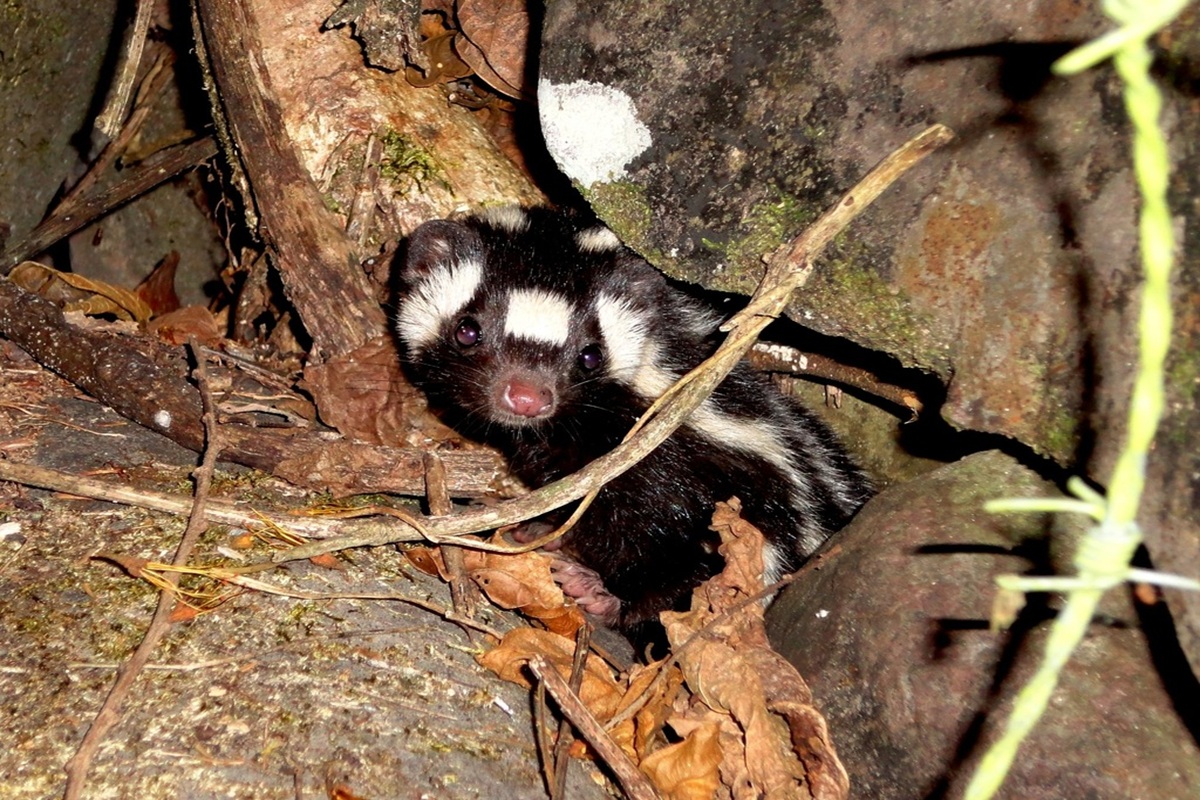
Southern spotted skunk

IUCN Red List Conservation Status


Least Concern

LC
NT
VU
EN
CR
EW
EX

Official assessment evaluated in accordance with the IUCN Red List of Threatened Species criteria: Least Concern.


Species Quick Facts

Scientific Name
Spilogale angustifrons

Average Lifespan
2-4 years in wild, 7-10 years in captivity

Average Weight
0.5-1.2 kg (1.1-2.6 lbs) – Males: 0.9 kg, Females: 0.7 kg

Average Length
30-45 cm (12-18 inches) – head-body length excluding tail

Overview & Identification

Spilogale angustifrons, commonly known as the southern spotted skunk, is a small mustelid native to the lowland and montane forests of southern Mexico, Central America, and the northern edge of South America. Belonging to the family Mustelidae, it is one of three spottedโ€‘skunk species that display a distinctive pattern of white dorsal spots set against a black coat. Adults measure 30โ€“45โ€ฏcm in headโ€‘body length, with a bushy tail adding another 15โ€“20โ€ฏcm, and weigh between 0.5 and 1.2โ€ฏkg. The species occupies a mosaic of habitats, including tropical dry forest, secondary growth, scrub, and open grasslands, often near human settlements where it can exploit agricultural waste. Its nocturnal habits, keen sense of smell, and wellโ€‘developed anal scent glands provide effective defense against predators. The IUCN classifies S.โ€ฏangustifrons as Least Concern, reflecting its relatively wide distribution and adaptability, although localized declines have been recorded where habitat conversion and road mortality are intense. Conservation actions focus on preserving forest corridors and mitigating humanโ€‘wildlife conflict.

Behavior & Social Structure

Southern spotted skunks are primarily solitary, with individuals maintaining overlapping home ranges that average 2โ€“4โ€ฏkmยฒ for males and 1โ€“2โ€ฏkmยฒ for females. They are crepuscular to nocturnal, emerging at dusk to forage and retreat to densโ€”often abandoned burrows, hollow logs, or dense thicketsโ€”by sunrise. Territorial marking relies heavily on the secretion of a pungent musk from paired anal glands; individuals rub the scent on vegetation, rocks, and their own fur to delineate boundaries. Vocalizations are limited but include low growls, hisses, and a sharp, highโ€‘pitched alarm trill when threatened. Scent marking is supplemented by footโ€‘stamping and tailโ€‘raising displays that signal aggression without resorting to physical confrontation. While generally asocial, females may share den with their offspring for up to three months, and occasional mating aggregations occur during the brief breeding season.

Diet & Hunting Patterns

The southern spotted skunk is an opportunistic omnivore, with a diet that shifts seasonally and locally. Insectivory dominates during the wet season; beetles, grasshoppers, termites, and larvae can comprise up to 60โ€ฏ% of stomach contents. Small vertebratesโ€”including rodents, amphibians, and lizardsโ€”add protein, while fruits, berries, and seeds provide carbohydrates, especially during the dry months when insects are scarce. Individuals may also scavenge carrion or raid poultry farms, leading to occasional humanโ€‘wildlife conflict. Daily food intake averages 5โ€“10โ€ฏ% of body mass, roughly 30โ€“80โ€ฏg for an adult, obtained through nocturnal foraging trips lasting 2โ€“4โ€ฏhours. The species employs keen olfaction and tactile probing of leaf litter to locate prey, and its strong forelimbs allow it to dig for subterranean insects.

Reproduction & Life Cycle

Females reach sexual maturity at 10โ€“12โ€ฏmonths, while males mature slightly later at 12โ€“14โ€ฏmonths. Breeding is seasonal, typically occurring between February and April, timed so that kits are born during the rainy season when prey is abundant. After a gestation period of 60โ€“70โ€ฏdays, litters of 2โ€“5 kits are born in concealed nests within burrows or dense vegetation. Neonates are altricial, blind and hairless, weighing about 30โ€ฏg. The mother provides exclusive care, nursing the young for 8โ€“10โ€ฏweeks and gradually introducing them to solid foods such as insects and small vertebrates. By eight weeks, kits are weaned and begin to explore beyond the den, though they remain with the mother for an additional 4โ€“6โ€ฏweeks before dispersing to establish their own territories. Parental investment is high, with a single breeding female producing up to two litters per year in optimal conditions.

Threats & Conservation

The IUCN lists Spilogale angustifrons as Least Concern, yet the species faces several anthropogenic pressures that could accelerate population declines. Habitat loss from agricultural expansion, logging, and urban development fragments the forest and grassland mosaics essential for foraging and denning. Road mortality is a significant source of adult mortality in regions with expanding highway networks, accounting for an estimated 5โ€“10โ€ฏ% of local mortality rates. Persecution by farmers, who sometimes trap or poison skunks to protect poultry, adds direct lethal pressure. Although the overall population is presumed stable, localized surveys in southern Mexico and Costa Rica have reported declines of up to 20โ€ฏ% over the past two decades. Conservation measures focus on protecting contiguous habitat corridors, implementing wildlifeโ€‘friendly road crossings, and educating rural communities about the ecological benefits of skunks as pest controllers.

Interesting Facts

โ€ข Southern spotted skunks can spray their musk up to 3โ€ฏmeters with a distinctive hissing warning.
โ€ข They have a highly developed sense of smell, capable of detecting prey hidden under leaf litter.
โ€ข Unlike many mustelids, they give birth to relatively large litters of up to five kits.
โ€ข Their white dorsal spots are unique to each individual, similar to fingerprints.
โ€ข They play a key role in controlling insect populations, especially agricultural pests.

Description

Southern spotted skunk

The Southern spotted skunk, scientifically known as Spilogale angustifrons, is a captivating species of mammal belonging to the skunk family, Mephitidae. It is renowned for its distinct appearance and behavior, making it a subject of fascination for wildlife enthusiasts and conservationists alike.

Appearance

Southern spotted skunk Appearance

The Southern spotted skunk is characterized by its unique physical features, setting it apart from other species within the skunk family. It is smaller in size compared to its relatives, with a slender body and a tail adorned with striking white and black stripes. The most distinguishing feature is its spotted coat, which showcases a mesmerizing pattern of white spots against a sleek black fur, hence its name. This remarkable coat serves as a natural defense mechanism, warning potential predators of its potent scent and deterring them from confrontation.

Distribution

The Southern spotted skunk is predominantly found in the Central American region, ranging from Costa Rica to southern Mexico. Its distribution encompasses diverse ecosystems within this geographical area, reflecting its adaptability to varying environmental conditions. Despite facing historical challenges to its population, concerted conservation efforts have contributed to the preservation of this species in its natural habitat.

Habitat Preferences

Southern spotted skunk Habitat

This resilient species exhibits a preference for a range of habitats, including woodlands, semi-open farmland, and old abandoned fields. It is also known to thrive in forested areas, grasslands, and brush, showcasing its adaptability to different ecological niches. The Southern spotted skunk’s survival is intricately linked to the availability of suitable habitats that provide ample cover and resources for foraging and shelter, emphasizing the importance of preserving these ecosystems for the species’ well-being.

In conclusion, the Southern spotted skunk, with its captivating appearance and adaptability, serves as a testament to the rich biodiversity of the Central American region. By understanding and appreciating the unique characteristics and habitat requirements of this species, we can contribute to its conservation and ensure its continued presence in the natural world.

Facts About Southern spotted skunk

  • The Southern spotted skunk (Spilogale angustifrons) is a small and elusive carnivore known for its distinctive coat pattern.
  • It ranges from Costa Rica to southern Mexico.
  • Southern spotted skunks have a body length between 12 and 34 cm (4.7 – 13.4 inches).
  • They have a tail length between 9 and 23 cm (3.5 – 9 inches).
  • Southern spotted skunks are omnivores.
  • They rely on running to move around.
  • The genus Spilogale includes all skunks commonly known as spotted skunks.
  • Currently, there are four accepted extant species within the Spilogale genus.
  • They are found throughout much of the eastern United States.
  • Southern spotted skunks are known for their unique and fascinating behavior in the wild.


Scientific Provenance & Verified Sources

Biological taxonomy, conservation status, and physical traits are cross-referenced with authoritative global registers:


Peer-reviewed by Wildlife Science Editors โ€ข Updated for 2026

Explore Other Species Profiles