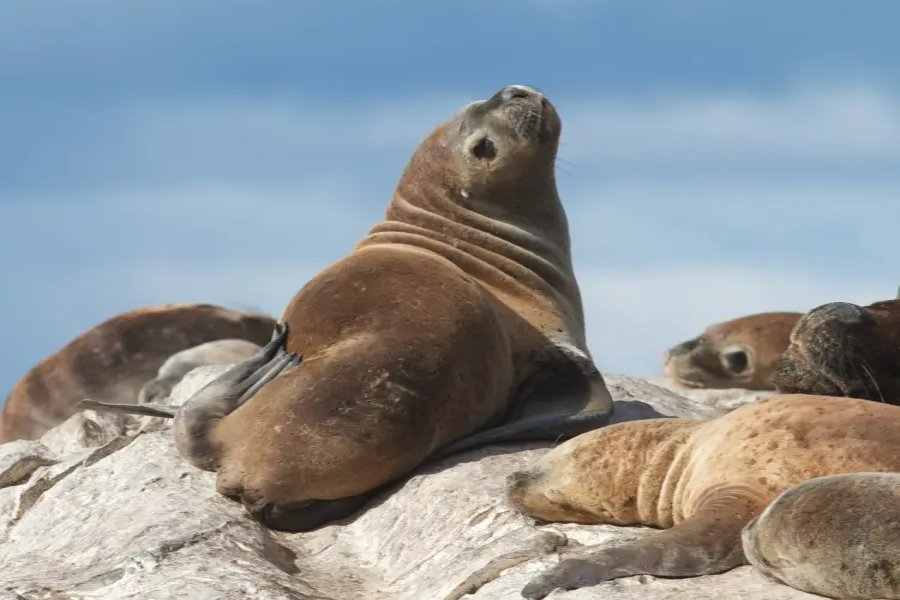
South American Fur Seal

IUCN Red List Conservation Status


Least Concern

LC
NT
VU
EN
CR
EW
EX

Official assessment evaluated in accordance with the IUCN Red List of Threatened Species criteria: Least Concern.


Species Quick Facts

Scientific Name
Arctocephalus australis

Average Lifespan
About 15–20 years in the wild (females up to ~30, males up to ~20).

Average Weight
Males 150-200 kg; females 30-60 kg.

Average Length
Males up to 2 m (6.6 ft); females up to 1.5 m.

Overview & Identification

The South American fur seal breeds along the rocky coasts of southern South America, from Peru and Brazil to the Falkland Islands. Males are considerably larger than females and defend harems during the breeding season. It feeds on fish, squid, and crustaceans in coastal waters.

Behavior & Social Structure

South American fur seals (Arctocephalus australis) are primarily crepuscular and nocturnal foragers at sea, timing their diving activity to the vertical migration of prey species that rise toward the surface after dusk, though they haul out and rest on rocky coastlines and offshore islands throughout daylight hours. On land, colonies display a highly gregarious social structure organized around a polygynous breeding system: dominant bulls establish and aggressively defend small territories on the shoreline during the austral breeding season, gathering harems of 5–15 females that they guard against rival males through vocal threats, physical posturing, and occasional violent combat involving biting and body-slamming. Outside the breeding season, the species becomes considerably less territorial, forming loose non-breeding aggregations or hauling out in mixed-sex, mixed-age groups.

Communication in this species relies heavily on acoustic signaling, including distinctive guttural barks, growls, and clicking vocalizations used by bulls to advertise territory ownership and by mothers and pups to maintain contact through individually recognizable calls amid noisy, crowded colonies. Tactile behavior is also important, particularly between mothers and pups, who reinforce bonds through nuzzling and close physical contact, and scent may play a secondary role in individual recognition. Home ranges at sea can extend up to several hundred kilometers from the natal colony, especially outside the breeding season, and the species exhibits notable behavioral plasticity, adjusting foraging trip duration and diving depth in response to local prey availability and oceanographic conditions such as El Niño events.

Diet & Hunting Patterns

As opportunistic carnivorous foragers, South American fur seals feed primarily on small schooling fish such as anchovy (Engraulis spp.), Argentine hake, and sardines, along with various species of squid and, to a lesser extent, small cephalopods and occasional crustaceans. Foraging dives are typically shallow to moderate in depth (commonly 20–70 meters, though dives exceeding 100 meters have been recorded), reflecting the species’ reliance on epipelagic and mesopelagic prey layers that migrate upward at night. Individuals employ pursuit-diving strategies, using their streamlined bodies, powerful foreflippers, and acute underwater vision and vibrissae-based prey detection to chase and capture agile, fast-moving prey in open water.

Metabolically, the species relies on a thick blubber layer for both thermoregulation and energy storage, allowing females to sustain long fasting periods on land while nursing pups between multi-day foraging trips at sea. Diet composition shifts seasonally and regionally in response to prey abundance, with populations off Peru and Chile heavily impacted by El Niño-Southern Oscillation events that reduce fish stocks and force seals to switch prey or travel farther to forage. Like other otariids, South American fur seals obtain the bulk of their water needs metabolically from prey and through specialized kidney function, drinking seawater only rarely.

Reproduction & Life Cycle

Breeding occurs seasonally, typically between October and December in most populations, with females giving birth to a single pup shortly after arriving at the colony and then mating again within about a week postpartum, a strategy facilitated by delayed implantation that postpones actual embryonic development for roughly 3–4 months. The mating system is strongly polygynous, with a small proportion of territorial males monopolizing access to multiple females, while total gestation, including the delayed implantation period, lasts approximately 11–12 months.

Females provide extended maternal care, alternating between several-day foraging trips at sea and short nursing bouts ashore, a pattern that continues for close to a year, with pups typically weaned between 8 and 12 months of age, sometimes longer in food-limited environments. Sexual maturity is reached earlier in females, around 3–4 years of age, while males mature physiologically around 4–5 years but rarely secure breeding territories until 8–10 years old due to intense male-male competition.

Threats & Conservation

While currently classified as Least Concern, South American fur seals face a range of ongoing pressures, including historical overexploitation from commercial sealing that dramatically reduced populations across their range prior to the 20th century, with some populations still recovering. Entanglement in fishing gear, incidental bycatch in gillnet and trawl fisheries, and competition with commercial fisheries for shared prey resources such as anchovy remain significant concerns, particularly off Peru, Uruguay, and southern Brazil. Habitat disturbance from coastal development and tourism at breeding colonies can also cause pup abandonment and colony disruption.

Climate variability, especially recurring El Niño events, poses a major natural threat by disrupting prey availability and causing mass mortality events in some populations, particularly in Peru, while natural predators such as orcas and large sharks exert additional pressure on adults and juveniles at sea. Conservation initiatives include legal protections in most range countries, monitoring by regional marine mammal research programs, designation of marine protected areas encompassing key breeding colonies, and ongoing population surveys coordinated through IUCN Species Survival Commission pinniped specialists to track recovery trends and inform fisheries management policy.

Interesting Facts

  • Delayed Implantation Mastery: Females delay embryo implantation for several months after mating, synchronizing births with optimal seasonal conditions despite year-round reproductive activity.
  • Dense Fur Insulation: Unlike true seals, this species possesses a dense underfur layer trapping air for insulation, a feature that made it historically prized—and heavily hunted—for the fur trade.
  • Extended Nursing Marathon: Pups may nurse for up to a year or longer, one of the longest lactation periods among otariid seals, reflecting variable prey availability in their range.
  • Rotating Foreflipper Locomotion: Their large, rotating foreflippers allow surprisingly agile movement on land, distinguishing eared seals from true seals which must crawl on their bellies.
  • El Niño Sentinel Species: Population fluctuations in Peruvian colonies serve as a biological indicator for oceanographers tracking the severity of El Niño events.
  • Historic Population Crash and Rebound: Commercial sealing in the 18th–19th centuries nearly extirpated some colonies, but strict protections have enabled substantial population recovery across much of the range.
  • Vocal Individual Recognition: Mothers and pups use distinctive vocal signatures to reunite in crowded, noisy colonies of thousands of animals, a critical adaptation for pup survival.

Description

South American Fur Seal

The South American fur seal, scientifically known as Arctocephalus australis, is a charismatic and agile marine mammal belonging to the Otariidae family. These seals are known for their sleek, streamlined bodies, which are well-adapted for swift movement through the water. They possess a thick layer of blubber, which aids in insulation and buoyancy, and their hind flippers are rotated forward, enabling them to move effectively on land.

Appearance
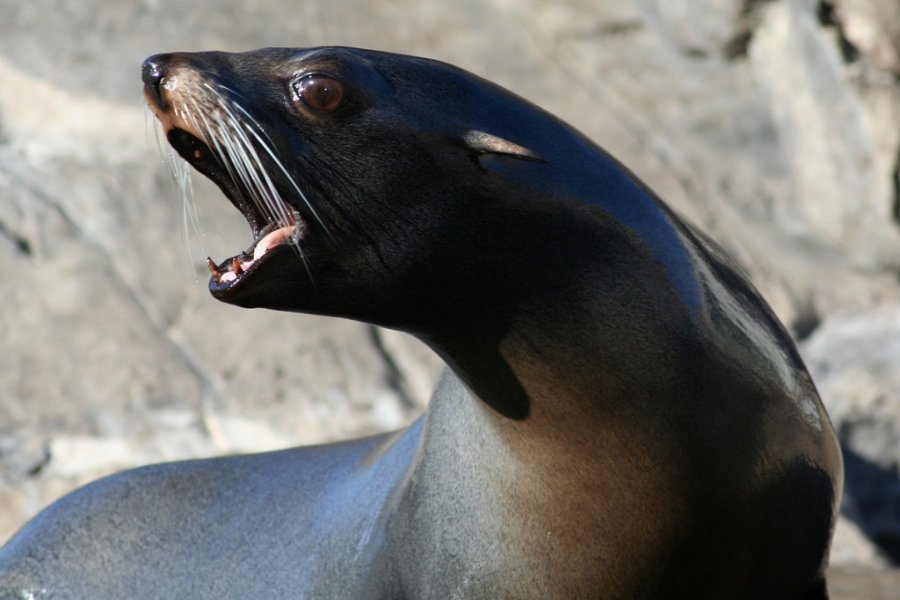
South American Fur Seal Appearance

The South American fur seal is characterized by its dense, waterproof fur, which ranges in color from dark brown to gray, with males typically being darker than females. Adult males, known as bulls, exhibit a robust build and a distinctive mane of coarse guard hairs, giving them a regal appearance during the breeding season. Females, or cows, are comparatively smaller and lighter in color. These seals are easily distinguishable from other species by their small, pointed snouts and large, dark eyes.

Distribution

The South American fur seal is predominantly found along the coasts of Peru, Chile, the Malvinas Islands, Argentina, Uruguay, and Brazil. They inhabit a range of coastal and offshore environments, with breeding colonies established on remote, rocky shorelines and islands. The population density of South American fur seals varies across their range, with significant breeding concentrations observed in certain key locations.

Habitat Preferences

South American Fur Seal Habitat

South American fur seals are highly adaptable and thrive in diverse marine ecosystems, including rocky coastlines, beaches, and offshore islands. Their preferred habitats offer access to abundant food sources and provide shelter for breeding and molting. These seals are known to forage in both demersal and pelagic zones, feeding primarily on fish and cephalopods.

By embodying these key aspects, the species profile for the South American fur seal provides a comprehensive overview of its unique characteristics, appearance, distribution, and habitat preferences.

Facts About South American Fur Seal

  • The South American fur seal (Arctocephalus australis) breeds on the coasts of Peru, Chile, the Falkland Islands, Argentina, Uruguay, and Brazil.
  • Adult males are approximately 1.3 times longer and 3.3 times heavier than adult females.
  • South American fur seals are sexually dimorphic.
  • They are polygynous, with males mating with more than one female each breeding period.
  • The color of South American fur seals is grey/brown.
  • The length of South American fur seals ranges from 1.4 to 2 meters (4.6 to 6.6 feet).
  • South American fur seals are classified as “Least Concern” in terms of conservation status.
  • They breed annually between October and December.
  • Two subspecies are recognized: Arctocephalus australis australis and Arctocephalus australis gracilis.
  • The South American fur seal is protected in certain areas due to conservation efforts.


Scientific Provenance & Verified Sources

Biological taxonomy, conservation status, and physical traits are cross-referenced with authoritative global registers:


Peer-reviewed by Wildlife Science Editors • Updated for 2026

Explore Other Species Profiles