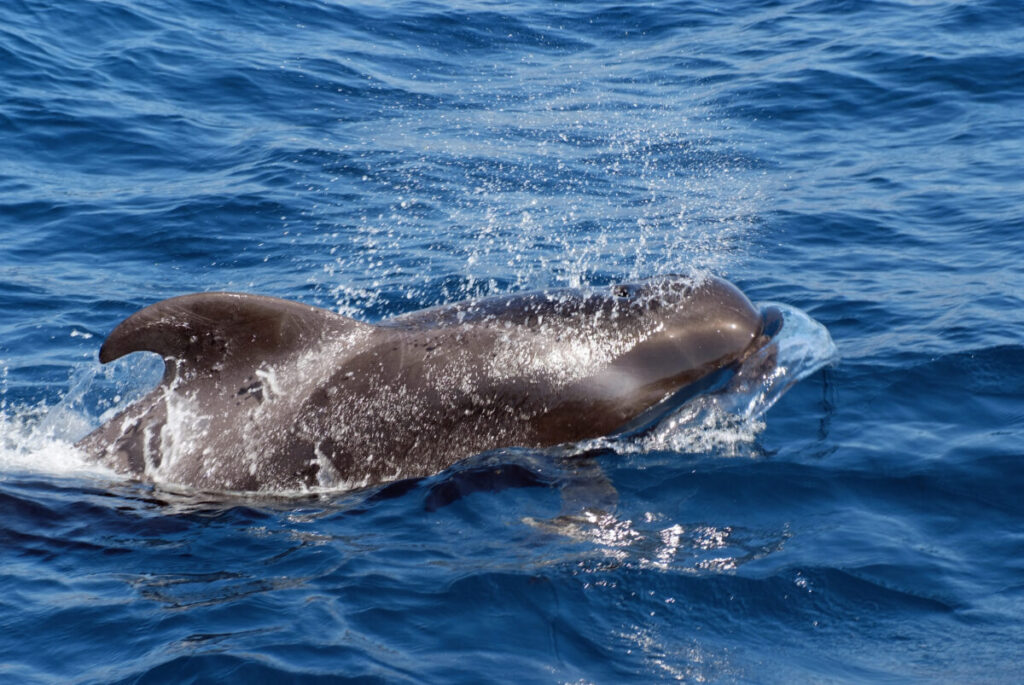
IUCN Red List Conservation Status


Least Concern

LC
NT
VU
EN
CR
EW
EX

Official assessment evaluated in accordance with the IUCN Red List of Threatened Species criteria: Least Concern.


Species Quick Facts

Scientific Name
Globicephala macrorhynchus

Average Lifespan
Males up to ~45 years, Females up to ~60 years

Average Weight
1-4 tons (1,000-4,000 kg)

Average Length
Males 4-6 m, Females 3-5 m (10-20 feet)

Overview & Identification

The Short-Finned Pilot Whale (Globicephala macrorhynchus) is a deep-diving oceanic dolphin found in tropical and temperate waters worldwide, particularly in the Atlantic, Pacific, and Indian Oceans. These intelligent animals primarily feed on schooling fish like herring and mackerel, utilizing cooperative hunting techniques. Notably, they are one of the deepest diving marine mammals, capable of reaching depths of over 3,200 feet (975 meters) during their searches for food.

Behavior & Social Structure

Short-finned pilot whales (Globicephala macrorhynchus) are highly social odontocetes that live in stable matrilineal pods typically ranging from 10 to 30 individuals, though temporary aggregations of several hundred can form when pods merge for social interaction or feeding. Unlike many delphinids, short-finned pilot whales exhibit a menopausal life history similar to killer whales and humans, with post-reproductive females living for decades and playing critical roles as knowledge repositories and caregivers within the pod. Activity patterns are largely cathemeral, with deep foraging dives concentrated during nighttime hours when prey—particularly squid—migrate closer to the surface, while daytime is often spent resting, socializing, and traveling in tighter surface formations.

Communication in this species is sophisticated, relying on a repertoire of clicks for echolocation, burst-pulse sounds, and whistles that facilitate group cohesion, coordinated hunting, and possibly individual or pod-specific identification, akin to dialects observed in other Globicephala populations. Tactile behaviors such as flipper-rubbing, synchronized swimming, and body contact reinforce social bonds within tight-knit family units. Pods demonstrate strong site fidelity in some regions, such as around Hawaii and the Canary Islands, where individuals have been photo-identified returning to the same coastal and pelagic waters over multiple years, suggesting defined but non-exclusive home ranges rather than strict territoriality.

Adaptive behaviors include deep, extended dives exceeding 1,000 meters and lasting up to 15–20 minutes, supported by physiological adaptations such as elevated myoglobin concentrations and flexible rib cages that withstand pressure changes. Pods have also been observed engaging in cooperative defense against predators and mass strandings, a poorly understood phenomenon potentially linked to strong social cohesion, navigational errors, or matriarch-led decision-making that inadvertently leads healthy individuals to follow sick or disoriented pod members into shallow waters.

Diet & Hunting Patterns

Short-finned pilot whales are specialized deep-diving predators whose diet consists predominantly of cephalopods, particularly large squid species such as Dosidicus gigas (Humboldt squid) and various Sthenoteuthis and Ommastrephid species, supplemented by fish including mackerel, herring, and occasionally octopus. Foraging typically occurs during nocturnal dives that coincide with the vertical migration of the deep scattering layer, allowing whales to intercept concentrated prey biomass as it rises toward the surface at dusk. Their hunting strategy relies heavily on echolocation to detect and track fast-moving squid in low-light or complete darkness at depth, with recent tagging studies revealing rapid, high-speed lunges during the terminal phase of deep dives to capture evasive prey.

Metabolically, short-finned pilot whales possess adaptations for extended breath-holding and thermoregulation in varying water temperatures, including elevated blood volume and oxygen-storing myoglobin that support dives regularly exceeding 500–1,000 meters. Seasonal dietary shifts have been documented in some populations, with prey composition changing in response to squid spawning migrations and oceanographic conditions such as El Niño events, which can temporarily reduce prey availability and force pods to travel greater distances. As obligate marine carnivores, they derive all hydration needs metabolically from prey tissue, requiring no freshwater intake throughout their entirely pelagic and coastal oceanic lifestyle.

Reproduction & Life Cycle

Short-finned pilot whales exhibit a polygynous, promiscuous mating system in which mature males mate with multiple females across and sometimes within their natal pod, a strategy supported by genetic studies showing limited close inbreeding despite lifelong pod residency of both sexes. Breeding is not strictly seasonal but shows peaks that vary by region—for example, calving in Japanese coastal waters tends to peak in spring and autumn. Gestation is prolonged, lasting approximately 15 months, among the longer gestation periods recorded in delphinids, and typically results in the birth of a single calf measuring around 1.4 to 1.9 meters in length.

Maternal care is intensive and extended, with calves nursing for at least 1 to 2 years, though weaning can be delayed considerably longer, and post-reproductive females frequently assist in alloparental care, babysitting and even nursing calves that are not their own. Females reach sexual maturity around 7 to 12 years of age, while males mature later, typically between 14 and 17 years, though behavioral and social maturity allowing successful mating may occur even later due to intense male-male competition within multi-male pod structures.

Threats & Conservation

The primary ecological threats facing short-finned pilot whales include bycatch in commercial fisheries—particularly longline and purse-seine operations targeting tuna and squid—as well as historical and ongoing directed hunts in Japan, where drive hunts in locations such as Taiji continue to take several hundred individuals annually for meat and, in smaller numbers, live capture for marine parks. Climate change poses an emerging threat through shifts in squid distribution and abundance driven by ocean warming and altered current systems, potentially disrupting established foraging grounds and increasing energetic costs of prey searching. Anthropogenic noise pollution from shipping, naval sonar, and seismic surveys is also strongly implicated in disrupting echolocation-dependent foraging and has been linked to several documented mass stranding events involving this species.

Natural predation pressure is limited primarily to large sharks and orcas targeting young or vulnerable individuals, though such predation is infrequently documented due to the species’ strong group defense behaviors. Conservation initiatives include monitoring and photo-identification programs in the Canary Islands, Hawaii, and Japan, regional fisheries bycatch mitigation measures under agreements such as ACCOBAMS in the Mediterranean, and IUCN Cetacean Specialist Group assessments that currently classify the species as Least Concern globally, while certain regional subpopulations, such as the Mediterranean short-finned pilot whale population, are considered more vulnerable and monitored under separate regional Red List assessments due to smaller, more isolated population sizes.

Interesting Facts

  • Menopause in the Ocean: Short-finned pilot whales are one of only a handful of species, along with orcas, belugas, narwhals, and humans, known to undergo true menopause, with females ceasing reproduction decades before death.
  • Grandmother Effect: Post-reproductive females provide critical babysitting, nursing, and ecological knowledge to their pods, improving calf survival rates even when they are not the biological mother.
  • Deep-Diving Champions: They can dive to depths exceeding 1,000 meters in pursuit of squid, among the deepest recorded dives of any delphinid species.
  • Misleading Name: Despite being called “whales,” short-finned pilot whales are technically the second-largest members of the oceanic dolphin family Delphinidae, after orcas.
  • Bulbous Melon: Their distinctively rounded, bulbous forehead houses a large melon organ used for focusing echolocation clicks, giving them a highly recognizable silhouette at sea.
  • Stranding Mystery: Their intensely cohesive social bonds are believed to contribute to mass stranding events, as healthy pod members may follow sick or disoriented individuals into dangerously shallow waters.
  • Sibling Species Confusion: Short-finned and long-finned pilot whales (Globicephala melas) are so morphologically similar that reliable field identification often requires genetic or detailed skeletal analysis, and their ranges overlap in some temperate transition zones.

Description

The short-finned pilot whale, scientifically known as Globicephala macrorhynchus, is a remarkable cetacean belonging to the oceanic dolphin family (Delphinidae). This species is one of the two members of the genus Globicephala, alongside the long-finned pilot whale (G. melas). Short-finned pilot whales are characterized by their distinct physical features and fascinating behavioral traits, making them a subject of great interest in the field of marine biology and conservation.

Appearance
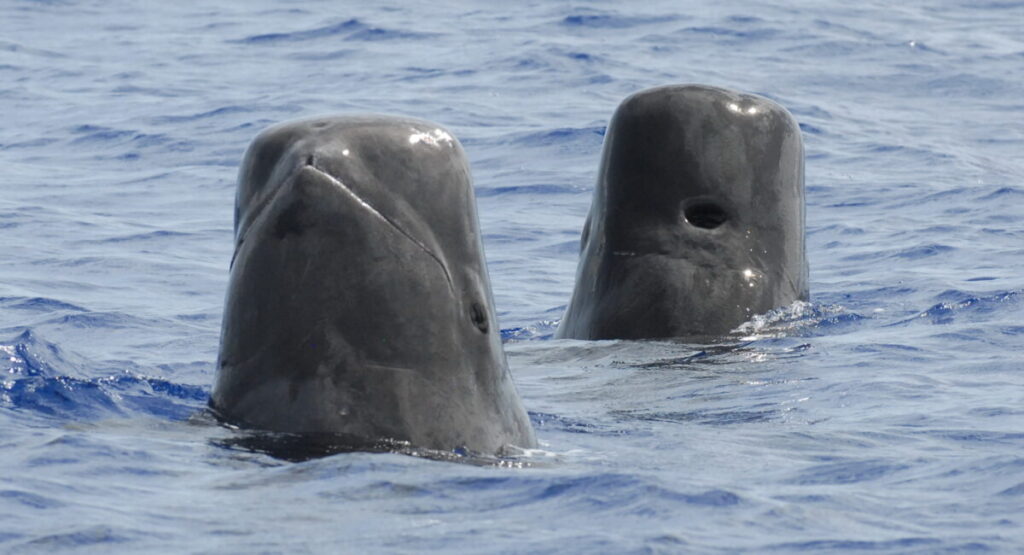
Short-finned pilot whales exhibit a sleek and robust body, with a rounded bulging forehead and a short beak-like snout. Their dorsal fin is notably sickle-shaped and their flippers are slender and pointed, contributing to their unique appearance within the cetacean family. This species is distinguished by its shorter flippers compared to its close relative, the long-finned pilot whale (G. melas), which aids in differentiating between the two species.

Distribution

Short-finned pilot whales are found in both coastal and pelagic waters, inhabiting temperate and tropical regions across the Indian, Atlantic, and Pacific Oceans. They are known to frequent continental shelf break and slope waters, as well as areas with high topographic relief. Their nomadic nature leads them to varying distances from shore, with a preference for deeper waters where squid, a staple part of their diet, are abundant. Notably, these whales are primarily nocturnal, displaying social and kinship behaviors, with females forming pods and males migrating between them.

Habitat Preferences

Short-finned pilot whales thrive in diverse marine ecosystems, including continental shelf break and slope waters, where they can find plentiful food sources and suitable conditions for social interactions and breeding. Their preference for deeper waters aligns with the distribution of their main prey, squid, indicating a strong ecological adaptation to their habitat. These whales’ ability to navigate and thrive in a range of oceanic environments underscores their resilience and adaptability as a species.

Overall, the short-finned pilot whale, with its distinct characteristics and widespread distribution, represents an intriguing and vital component of the marine ecosystem, warranting continued attention and conservation efforts to ensure its long-term survival and well-being.

Facts About Short-Finned Pilot Whale

  • Short-finned pilot whales are highly social animals, usually found in pods of 10 to 30 individuals.
  • They are known for their deep, high-speed, sprint-dives to chase and capture large squid, earning them the nickname “cheetahs of the deep sea.”
  • Adult short-finned pilot whales measure around 3.5 to 6.5 meters in length and weigh between 1 and 4 tonnes.
  • Short-finned pilot whales have a muscular body with a thick tail stock and a forehead that bulges over their beakless mouth.
  • They have a wider, shorter skull with fewer teeth compared to the long-finned pilot whale species.
  • These whales are long-lived and slow to reproduce.
  • Short-finned pilot whales have a mostly tropical and warm-temperate distribution, including both nearshore and open-ocean waters.
  • The globular shape of their head is more prominent in males.
  • The short-finned pilot whale is the second largest species of dolphin, only surpassed by the orca (Orcinus orca).
  • There are likely to be almost a million long-finned pilot whales and at least 200,000 short-finned pilot whales worldwide.


Scientific Provenance & Verified Sources

Biological taxonomy, conservation status, and physical traits are cross-referenced with authoritative global registers:


Peer-reviewed by Wildlife Science Editors • Updated for 2026

Explore Other Species Profiles