Senegal bushbaby perched on a tree branch at night

IUCN Red List Conservation Status


Least Concern

LC
NT
VU
EN
CR
EW
EX

Official assessment evaluated in accordance with the IUCN Red List of Threatened Species criteria: Least Concern.


Species Quick Facts

Scientific Name
Galago senegalensis

Average Lifespan
Up to about 13 years in captivity (record 17 years); wild lifespan is not well documented.

Average Weight
112-300 g (0.25-0.66 lb).

Average Length
Head-body 13-21 cm (5-8 inches), plus a long tail.

Overview & Identification

Senegal Bushbaby (Galago senegalensis)

The Senegal bushbaby, scientifically known as Galago senegalensis, is a captivating small primate belonging to the galago family Galagidae. This nocturnal creature is renowned for its endearing appearance and distinctive vocalizations, which have earned it the colloquial name “bush baby.”

Description
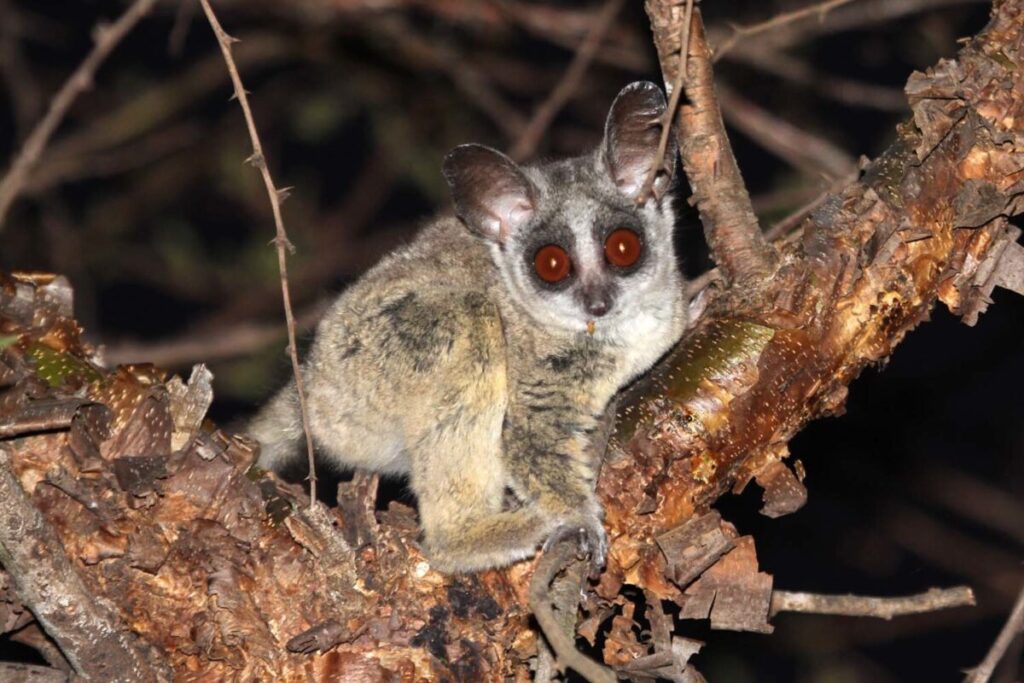
The Senegal bushbaby is characterized by its large, round eyes, prominent ears, and long tail, which aids in balance and movement through its arboreal habitat. These agile creatures possess specialized adaptations for nocturnal life, including keen night vision and excellent leaping abilities. The bushbaby’s vocalizations, often likened to a baby’s cry, serve as a means of communication and play a crucial role in their social interactions and territorial defense.

Appearance

Distinctive features of the Senegal bushbaby include its large, forward-facing eyes, which enable enhanced depth perception for navigating through dimly lit environments. Their soft, dense fur provides insulation and comes in various shades, ranging from gray to brown, allowing for effective camouflage within their natural habitat. Additionally, their long, tufted tails aid in balance and agility, contributing to their remarkable leaping abilities.

Distribution

The Senegal bushbaby is found across a wide range of habitats in Sub-Saharan Africa, including savannah woodlands, rainforests, and scrublands. Its distri

Behavior & Social Structure

The Senegal bushbaby (Galago senegalensis) is strictly nocturnal, emerging shortly after dusk to begin an active period of foraging, socializing, and territorial patrolling that continues until just before dawn. During daylight hours, individuals retreat into dense vegetation, tree hollows, or abandoned bird nests, often curling into a tight ball to conserve heat and remain camouflaged from diurnal predators. This species possesses large, forward-facing eyes with a tapetum lucidum that maximizes light capture in low-light conditions, along with rotatable ears that can be independently moved to pinpoint the source of rustling prey or approaching threats.

Socially, Senegal bushbabies exhibit a dispersed or “solitary but social” system, wherein individuals forage alone at night but share overlapping home ranges and sleeping sites with related females, forming loose matrilineal groups. Males typically maintain larger territories that overlap with multiple female ranges, and dominant males will vocally and physically defend access to receptive females during breeding periods. Communication is highly sophisticated, involving a repertoire of over a dozen distinct vocalizationsโ€”including the eponymous infant-like “cry” that gives bushbabies their common nameโ€”as well as extensive scent marking via urine-washing on hands and feet to mark travel routes and assert territorial boundaries.

Locomotion is characterized by powerful vertical clinging and leaping, facilitated by elongated hindlimbs and a specialized tarsus bone that allows leaps exceeding two meters between branches. Home ranges typically span 1-4.6 hectares depending on habitat quality and resource density, with males patrolling larger areas than females. This species also displays notable behavioral plasticity, adjusting activity intensity and movement patterns seasonally in response to temperature, rainfall, and food availability.

Diet & Hunting Patterns

Senegal bushbabies are opportunistic omnivores whose diet consists primarily of gum (tree exudates), insects, and fruit, with proportions shifting based on seasonal availability. Gum from Acacia trees forms a dietary staple, particularly during dry seasons when insect abundance declines; bushbabies possess specialized dental adaptations, including a toothcomb and elongated tongue, that allow them to scrape and lap gum efficiently from bark fissures. Insectsโ€”especially orthopterans, beetles, and mothsโ€”are captured using rapid auditory-guided pounces, with the animal often catching prey mid-air using a swift hand-grab technique before immediately consuming it.

Fruit, flowers, and occ

Reproduction & Life Cycle

The Senegal bushbaby (Galago senegalensis) is a polygynous breeder in which males compete for access to the home ranges of multiple females, with competitive success generally correlated with body size (source: [Animal Diversity Web](https://animaldiversity.org/accounts/Galago_senegalensis/)). Females typically breed twice a year, with reproductive peaks coinciding with the onset of the rains in November and again near the end of the rainy season in February, though captive studies have shown that estrus and births can actually occur in any month of the year (source: [Animal Diversity Web](https://animaldiversity.org/accounts/Galago_senegalensis/); [Springer](https://link.springer.com/article/10.1007/BF02735700)). Gestation lasts approximately 126 days, after which females typically give birth to singletons or occasionally twins, weighing around 12 grams at birth (source: [The Website of Everything](https://thewebsiteofeverything.com/animals/mammals/Primates/Galagonidae/Galago/Galago-senegalensis.html); [Brain Museum](http://brainmuseum.org/Specimens/primates/lessbushbaby/index.html)).

Females construct nests of leaves in tree hollows or dense vegetation where they give birth and care for their young, often “parking” infants in secure locations while foraging at night, later carrying them by mouth. The young are born fully furred with open eyes, and begin leaving the nest at around 10 to 11 days of age; by four weeks they are capable of catching insects independently (source: [Brain Museum](http://brainmuseum.org/Specimens/primates/lessbushbaby/index.html)). Weaning occurs around 89 days, and sexual maturity is reached at roughly 8โ€“10 months in females and slightly later, around 10 months to a year, in males, at which point males typically disperse from their natal range while females may remain closer to their mothers’ territory, contributing to the species’ matrilineal social structure (source: [Brain Museum](http://brainmuseum.org/Specimens/primates/lessbushbaby/index.html); [The Website of Everything](https://thewebsiteofeverything.com/animals/mammals/Primates/Galagonidae/Galago/Galago-senegalensis.html)).

Threats & Conservation

The Senegal bushbaby faces threats primarily from habitat loss and fragmentation due to agricultural expansion, logging, and human settlement across its range in sub-Saharan Africa, which reduces the availability of the acacia woodlands and savanna habitats it depends on for shelter and foraging (source: [Wikipedia](https://en.wikipedia.org/wiki/Senegal_bushbaby)). Additionally, the species is sometimes captured for the exotic pet trade due to its small size and appealing appearance, and in some regions it faces predation pressure from domestic animals and native predators such as snakes, owls, and genets that are exacerbated by habitat disturbance bringing bushbabies into closer contact with these threats.

Despite these pressures, the Senegal bushbaby is currently classified as a species of “Least Concern” by the IUCN due to its wide geographic distribution, adaptability to a variety of habitats, and relatively stable population trends compared to other primate species. Its nocturnal habits and ability to persist in degraded or secondary woodland habitats have helped buffer it against some of the more severe threats faced by other African primates, though continued monitoring is recommended as deforestation rates increase in parts of its range, particularly in West and East Africa (source: [Wikipedia](https://en.wikipedia.org/wiki/Senegal_bushbaby)).

Interesting Facts

โ€ข facing eyes, which enable enhanced depth perception for navigating through dimly lit environments. Their soft, dense fur provides insulation and comes in various shades, ranging from gray to brown, allowing for effective camouflage within their natural habitat. Additionally, their long, tufted tails aid in balance and agility, contributing to their remarkable leaping abilities.

โ€ข Saharan Africa, including savannah woodlands, rainforests, and scrublands. Its distribution spans countries such as Senegal, Gambia, Nigeria, and Cameroon, showcasing its adaptability to diverse ecosystems. While population densities may vary, these resilient creatures have demonstrated their ability to thrive in a range of environments, exhibiting notable resilience in the face of habitat changes.

โ€ข The Senegal bushbaby (Galago senegalensis) is a small, nocturnal primate belonging to the galago family Galagidae.
โ€ข They are found in dry woodland regions and savannah areas.
โ€ข Senegal bushbabies have woolly thick fur that ranges from gray to brown and have a body length of around 130 mm and weigh between 95 to 300 grams.

The Senegal bushbaby, scientifically known as Galago senegalensis, is a captivating small primate belonging to the galago family Galagidae. This nocturnal creature is renowned for its endearing appearance and distinctive vocalizations, which have earned it the colloquial name “bush baby.”

Description

The Senegal bushbaby is characterized by its large, round eyes, prominent ears, and long tail, which aids in balance and movement through its arboreal habitat. These agile creatures possess specialized adaptations for nocturnal life, including keen night vision and excellent leaping abilities. The bushbaby’s vocalizations, often likened to a baby’s cry, serve as a means of communication and play a crucial role in their social interactions and territorial defense.

Appearance

Distinctive features of the Senegal bushbaby include its large, forward-facing eyes, which enable enhanced depth perception for navigating through dimly lit environments. Their soft, dense fur provides insulation and comes in various shades, ranging from gray to brown, allowing for effective camouflage within their natural habitat. Additionally, their long, tufted tails aid in balance and agility, contributing to their remarkable leaping abilities.

Distribution

The Senegal bushbaby is found across a wide range of habitats in Sub-Saharan Africa, including savannah woodlands, rainforests, and scrublands. Its distribution spans countries such as Senegal, Gambia, Nigeria, and Cameroon, showcasing its adaptability to diverse ecosystems. While population densities may vary, these resilient creatures have demonstrated their ability to thrive in a range of environments, exhibiting notable resilience in the face of habitat changes.

Habitat Preferences

Senegal bushbabies thrive in diverse ecosystems, displaying a preference for forested areas with dense vegetation, where they can find shelter and forage for insects, tree exudates, and fruits. Their arboreal lifestyle is supported by their adept climbing and leaping abilities, allowing them to navigate the canopy with ease. These habitats provide essential resources for their survival, including nesting sites, food sources, and protection from predators.

By shedding light on the remarkable characteristics and ecological significance of the Senegal bushbaby, we gain a deeper appreciation for the intricate web of life that enriches our planet’s biodiversity. Understanding and safeguarding these unique species is crucial for the preservation of our natural heritage and the delicate balance of ecosystems.

Facts About Senegal Bushbaby

  • The Senegal bushbaby (Galago senegalensis) is a small, nocturnal primate belonging to the galago family Galagidae.
  • They are found in dry woodland regions and savannah areas.
  • Senegal bushbabies have woolly thick fur that ranges from gray to brown and have a body length of around 130 mm and weigh between 95 to 300 grams.
  • These primates are skilled leapers and are known for their ability to cover large distances with their impressive jumping ability.
  • The diet of Galago senegalensis consists of fruits, nectar, and insects.
  • Senegal bushbabies are also known as Senegal galagos, lesser galagos, or lesser bush babies.
  • They communicate using various vocalizations, including plaintive cries.
  • These primates are arboreal, spending most of their time in trees.
  • Senegal bushbabies have large, distinctive eyes adapted for their nocturnal lifestyle.
  • The number of species belonging to the genus Galago is disputed, with some sources recognizing over 20 species of bush babies or galagos.


Scientific Provenance & Verified Sources

Biological taxonomy, conservation status, and physical traits are cross-referenced with authoritative global registers:


Peer-reviewed by Wildlife Science Editors โ€ข Updated for 2026

Explore Other Species Profiles