Sechuran Fox

IUCN Red List Conservation Status


Least Concern

LC
NT
VU
EN
CR
EW
EX

Official assessment evaluated in accordance with the IUCN Red List of Threatened Species criteria: Least Concern.


Species Quick Facts

Scientific Name
Lycalopex sechurae

Average Lifespan
5-7 years in wild, 10-12 years in captivity

Average Weight
1.5-2.5 kg (3.3-5.5 lbs) – Males: 2.0 kg, Females: 1.5 kg

Average Length
35-45 cm (14-18 inches) – head-body length excluding tail

Overview & Identification

The Sechuran fox (Lycalopex sechurae) is a small canid endemic to the arid coastal plains of northโ€‘western Peru and southern Ecuador. Belonging to the family Canidae, it is one of four South American “false foxes” that evolved independently of true foxes (Vulpes). Its range is confined to the Sechura Desert, the Pacific coastal scrub, and the dry valleys of the Andes foothills, where it occupies open shrubland, sandy dunes, and sparse grassland. The species displays a sandyโ€‘gray coat with a distinctive black mask and a white tail tip, adaptations that provide camouflage against the pale desert substrate. Unlike many canids, the Sechuran fox has relatively large ears that aid thermoregulation and sound detection. The IUCN classifies it as Least Concern, reflecting its broad but patchy distribution and tolerance of disturbed habitats, although localized threats persist. Its ecological role includes seed dispersal of desert shrubs and regulation of small vertebrate and invertebrate populations.

Behavior & Social Structure

Sechuran foxes are primarily solitary, with individuals maintaining overlapping home ranges of 5โ€‘12 kmยฒ. They are crepuscular to nocturnal, becoming most active at dusk and during the cooler night hours to avoid daytime heat. Territorial marking is achieved through scent glands on the feet and anal region, and occasional vocalizations such as highโ€‘pitched barks and whines are used during mating or when confronting rivals. While generally solitary, they may form loose family groups during the breeding season, and mothers care for pups in a den dug in loose sand or under rocks. Their movements are highly adaptable; they can travel long distances in search of water, often obtaining moisture from prey and succulent plants. Communication also includes body postures, tail flicks, and ear positioning, which convey aggression, submission, or alarm to conspecifics.

Diet & Hunting Patterns

The Sechuran fox is an opportunistic omnivore, with a diet that shifts seasonally according to resource availability. In the dry season, it relies heavily on insects (beetles, grasshoppers, and scorpions), small mammals (rodents, lagomorphs), and carrion. During the brief rainy period, fruiting desert shrubs such as Prosopis and cactus pads provide a significant carbohydrate source, accounting for up to 30% of intake. Occasionally, it consumes bird eggs and reptiles. Daily food consumption averages 150โ€‘250 grams, roughly 10โ€‘15% of body weight, obtained through a combination of active hunting, scavenging, and foraging. The fox employs keen hearing and nightโ€‘vision to locate prey, and its elongated snout allows it to extract insects from crevices. Water needs are minimal; metabolic water from prey and moisture-rich fruits often suffice, but the fox will drink from temporary pools when available.

Reproduction & Life Cycle

Sexual maturity is reached at 10โ€‘12 months for both sexes, though females often delay breeding until they have secured a suitable den site. Breeding occurs once a year, typically between May and July, timed with the brief rainy season that increases prey availability. After a gestation period of 55โ€‘60 days, litters of 2โ€‘5 pups are born, with an average of three. Neonates are altricial, blind and hairless, and rely entirely on maternal care for the first three weeks. The mother nurses the pups for approximately eight weeks, after which they are gradually introduced to solid food such as insects, small rodents, and fruits. Both parents may assist in provisioning, but the maleโ€™s involvement is limited to occasional food deliveries. Juveniles become independent at 4โ€‘5 months, though they may remain within the natal area for several months before dispersing.

Threats & Conservation

The IUCN lists the Sechuran fox as Least Concern, estimating a stable population of roughly 20,000โ€‘30,000 mature individuals. However, habitat fragmentation from expanding agriculture, mining, and coastal development poses localized threats, especially in the Peruvian Piura and Lambayeque regions. Road mortality is a growing concern as new highways intersect traditional movement corridors. Illegal hunting is rare but occurs in some areas where foxes are perceived as pests to poultry. Climate change may exacerbate desertification, reducing the availability of key food plants and water sources. Conservation actions include the designation of protected areas such as the Lomas de Lachay and the promotion of communityโ€‘based monitoring programs. Ongoing research aims to clarify population trends and to develop mitigation measures for roadkill, while environmental education seeks to reduce humanโ€‘fox conflicts.

Interesting Facts

โ€ข The Sechuran fox can survive without direct water intake for weeks, deriving moisture from its prey.
โ€ข Its large, hairless ears not only enhance hearing but also act as radiators to dissipate heat.
โ€ข Unlike many canids, it has partially retractable claws that aid in digging burrows in sandy soils.
โ€ข It plays a crucial role in seed dispersal for several desert shrub species, influencing plant community dynamics.
โ€ข Genetic studies show that Lycalopex sechurae diverged from its closest relatives about 1.5 million years ago, adapting uniquely to hyperโ€‘arid environments.

Description

Sechuran Fox

The Sechuran fox, also known as the Peruvian desert fox or the Sechuran zorro, is a small canid species native to South America. Belonging to the “false” foxes or zorro group, the Sechuran fox is characterized by its compact size, bushy tail, and notable adaptability to arid environments. This species exhibits a range of behaviors and dietary habits that are uniquely adapted to its coastal desert habitat in Peru and Ecuador.

Appearance
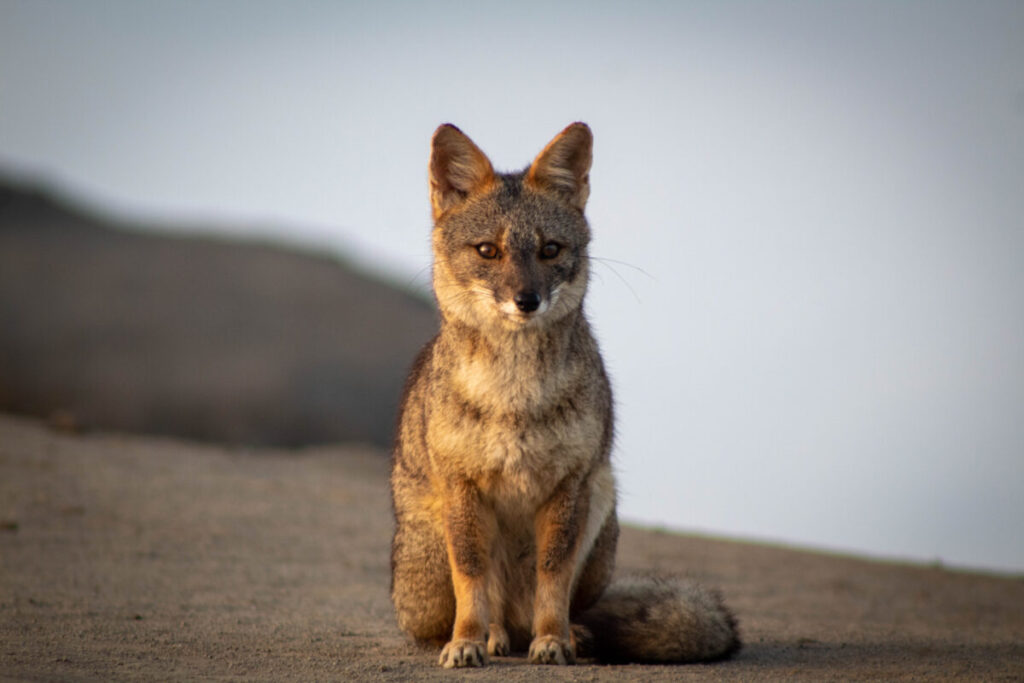
Sechuran Fox Appearance

The Sechuran fox is distinguished by its sandy to grayish-brown fur, which provides effective camouflage in its arid habitat. Its slender physique and pointed muzzle set it apart from other canid species, while its large ears aid in thermoregulation and acute hearing. The Sechuran fox’s bushy tail, often tipped with white, serves as an important tool for maintaining balance and signaling within the species.

Distribution

The Sechuran fox is predominantly found in the arid environments of southwestern Ecuador and western Peru, particularly in the Sechura desert. This species has also been observed at elevations ranging from sea level to higher altitudes, showcasing its adaptability to varying terrains. However, due to habitat loss, the Sechuran fox is listed as Near Threatened by the IUCN, emphasizing the need for conservation efforts to protect its diminishing habitats.

Habitat Preferences

Sechuran Fox Habitat

The Sechuran fox thrives in arid and coastal desert ecosystems, demonstrating remarkable resilience in the face of harsh environmental conditions. Its ability to adapt to these challenging habitats is attributed to its versatile omnivorous diet and behavioral flexibility. The species’ survival is intricately linked to the preservation of its unique habitat, highlighting the importance of safeguarding these ecosystems to ensure the well-being of the Sechuran fox population.

By shedding light on the distinctive characteristics, distribution, and habitat preferences of the Sechuran fox, we can deepen our understanding of this remarkable species and strengthen our commitment to its conservation.

This comprehensive species profile aims to contribute to the ongoing efforts in wildlife conservation and education, fostering a greater appreciation for the diverse and extraordinary creatures that share our planet.

Facts About Sechuran fox

  • The Sechuran fox (Lycalopex sechurae) is a small South American species of canid closely related to the culpeo.
  • It inhabits the arid coastal deserts of Peru and Ecuador.
  • The Sechuran fox is highly adaptable, living in deserts, dry forests, and on beaches.
  • Its diet is largely dictated by its natural habitat, including invertebrates and both endothermic and ectothermic animals.
  • Adult Sechuran foxes weigh around 8.8 pounds (4.00 kg).
  • Surveys in Piura, Peru, recorded an average of 12.6 foxes per kilometer in a specific area.
  • The maximum longevity of the Sechuran fox in captivity is around 9.9 years.
  • This species is also known as the Peruvian desert fox or the Sechuran zorro.
  • The Sechuran fox is a captivating carnivorous mammal with a unique presence in its habitat.
  • It is a fascinating and distinctive species that contributes to the biodiversity of its native environment.


Scientific Provenance & Verified Sources

Biological taxonomy, conservation status, and physical traits are cross-referenced with authoritative global registers:


Peer-reviewed by Wildlife Science Editors โ€ข Updated for 2026

Explore Other Species Profiles