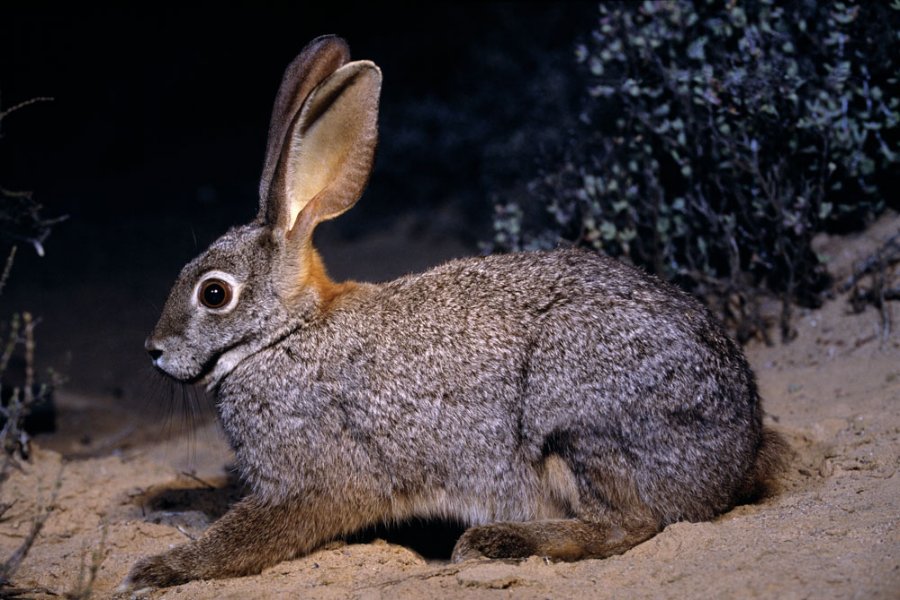
Riverine Rabbit

IUCN Red List Conservation Status


Critically Endangered

LC
NT
VU
EN
CR
EW
EX

Official assessment evaluated in accordance with the IUCN Red List of Threatened Species criteria: Critically Endangered.


Species Quick Facts

Scientific Name
Bunolagus monticularis

Average Lifespan
2-3 years in wild, 4-5 years in captivity

Average Weight
1.2-1.5 kg (2.6-3.3 lbs) – Males: 1.4 kg, Females: 1.2 kg

Average Length
30-38 cm (12-15 inches) – head-body length excluding tail

Overview & Identification

The Riverine rabbit (Bunolagus monticularis) belongs to the order Lagomorpha, family Leporidae, and is the sole species of the monotypic genus Bunolagus. It is endemic to the arid interior of South Africa, confined to a narrow strip of riverโ€‘lined vegetation within the Great Karoo semiโ€‘desert. Its distribution covers less than 5,000โ€ฏkmยฒ, primarily along the upper reaches of the Orange River and its tributaries in the Northern Cape and Western Cape provinces. The species prefers dense, tall grasses and rushes that grow on alluvial soils of seasonal floodplains, where it builds shallow burrows or utilizes abandoned burrows of other mammals. Morphologically, the Riverine rabbit is one of the smallest African leporids, with a compact body, short ears, and a distinctive white patch on the throat. Its cryptic coloration and nocturnal habits make it difficult to detect, contributing to the paucity of reliable field data. The International Union for Conservation of Nature (IUCN) classifies it as Critically Endangered, with recent estimates indicating fewer than 250 mature individuals remaining. Habitat degradation, water extraction, and conversion to agriculture have fragmented its already limited range, while predation by feral cats and introduced mustelids adds further pressure. Conservation actions focus on protecting key floodplain habitats, restoring natural hydrology, and implementing communityโ€‘based monitoring programs to prevent the extinction of this uniquely adapted lagomorph.

Behavior & Social Structure

Riverine rabbits are primarily solitary, with males and females occupying separate home ranges that may overlap only during the brief breeding season. They are nocturnal and crepuscular, emerging at dusk to forage and retreat to burrows before dawn. Homeโ€‘range sizes are small, typically 0.5โ€“1.0โ€ฏkmยฒ for females and up to 1.5โ€ฏkmยฒ for males, reflecting the patchy distribution of suitable riverine vegetation. Individuals mark territories with scent glands located on the cheeks and under the chin, depositing urine and fecal pellets along runways to signal occupancy. Communication is limited to soft thumping of the hind feet and occasional highโ€‘pitched squeals when alarmed. The species exhibits a strong avoidance of open ground, relying on dense cover to evade predators such as feral cats, barn owls, and introduced mongooses. Seasonal movements are minimal; instead, rabbits adjust activity patterns in response to water availability, becoming more active after rainfall when fresh growth appears. Social interactions are restricted to mating, after which adults resume solitary foraging.

Diet & Hunting Patterns

The Riverine rabbit is a strict herbivore that relies on the seasonal productivity of floodplain vegetation. Its diet consists primarily of young shoots, leaves, and seed heads of perennial grasses such as Stipa spp., rushes (Juncus spp.), and sedges (Carex spp.), supplemented by forbs like Asteraceae and occasional succulent stems of Chenopodiaceae. During the dry season, when green material is scarce, individuals increase consumption of woody browse and underground tubers to meet water requirements. An adult consumes roughly 5โ€“7โ€ฏ% of its body mass in fresh plant material each day, equivalent to 60โ€“105โ€ฏg of foliage. Feeding occurs mainly at night to reduce exposure to diurnal predators, and rabbits employ a selective grazing strategy, preferring highโ€‘protein, lowโ€‘fiber parts of plants. Water intake is largely met through the moisture content of consumed vegetation, but rabbits will also drink from shallow pools or damp soil when available. Seasonal fluctuations in food quality and quantity directly influence reproductive timing and body condition.

Reproduction & Life Cycle

Sexual maturity in Riverine rabbits is reached at approximately 8โ€“10โ€ฏmonths for both sexes, although females may not breed until the following year due to limited resource availability. Breeding is closely tied to the rainy season, which triggers a surge in vegetation growth; most litters are born between November and February. The gestation period lasts 28โ€“31โ€ฏdays, after which females give birth to a single offspring in 70โ€ฏ% of cases and twins in the remaining 30โ€ฏ%. Newborns are altricial, weighing about 70โ€ฏg and born blind and hairless. The mother provides exclusive care, nursing the young for 3โ€“4โ€ฏweeks while keeping them concealed in a shallow nest lined with grasses. Juveniles are weaned at around 4โ€ฏweeks and become independent shortly thereafter, though they may remain within the maternal home range for several months. The speciesโ€™ low reproductive output, combined with high juvenile mortality from predation and habitat loss, contributes to its precarious population dynamics.

Threats & Conservation

The IUCN Red List classifies the Riverine rabbit as Critically Endangered, reflecting an estimated decline of more than 80โ€ฏ% over the past three decades. The principal threat is habitat loss driven by agricultural expansion, particularly irrigation and conversion of floodplain grasslands to cropland and livestock grazing. Water extraction for irrigation lowers the water table, reducing the growth of the dense riparian vegetation that the species depends on. Invasive plant species such as Acacia cyclops outcompete native grasses, further degrading habitat quality. Predation pressure has intensified due to the proliferation of feral cats (Felis catus) and introduced mongooses (Herpestes ichneumon), which readily exploit the rabbitโ€™s limited cover. Climate change poses an additional risk by altering rainfall patterns, leading to more frequent droughts that diminish food availability. The current population is estimated at fewer than 250 mature individuals, fragmented into isolated subpopulations with limited gene flow. Conservation measures include the designation of protected floodplain reserves, restoration of natural hydrological regimes, control of invasive vegetation, and communityโ€‘based predator management programs. Ongoing monitoring and research are essential to refine population estimates and assess the effectiveness of interventions.

Interesting Facts

โ€ข It is the only species in the genus Bunolagus.
โ€ข Its range is smaller than the area of a single large city, covering less than 5,000โ€ฏkmยฒ.
โ€ข Riverine rabbits can survive without direct water intake by extracting moisture from succulent plants.
โ€ข They have a remarkably low reproductive rate, often producing only one leveret per year.
โ€ข The species was thought extinct until a small population was rediscovered in 1963.

Description

Riverine Rabbit

The Riverine rabbit, scientifically known as Bunolagus monticularis, stands out as the sole member of its genus due to its unique characteristics that distinguish it from other leporids. This elusive mammal is renowned for being one of the most endangered species in the world, making its conservation of utmost importance.

Appearance
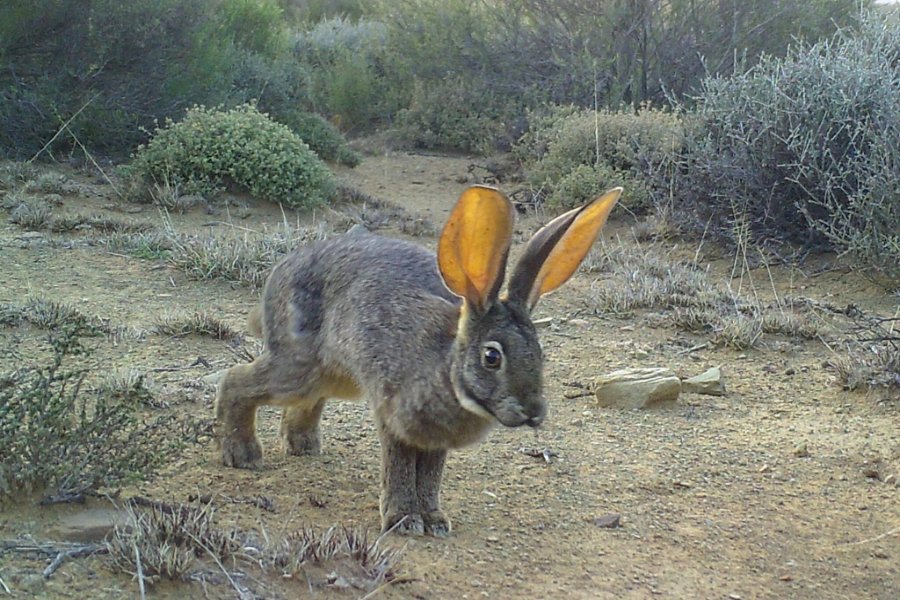
Riverine Rabbit Appearance

The Riverine rabbit is characterized by its compact size and distinct features, including a russet-brown fur coat, relatively short ears, and a prominent white ring around each eye. These distinguishing traits set it apart from other rabbit species, making it easily recognizable.

Distribution

This species is primarily found in the central and southern regions of South Africa. Notably, the Riverine rabbit’s distribution is limited to specific areas, and its population density is confined to the dense riparian vegetation along the seasonal rivers of the Karoo region.

Habitat Preferences

Riverine Rabbit Habitat

The Riverine rabbit thrives in unique ecosystems, favoring dense riparian vegetation along the seasonal rivers of the central and southern Karoo. These habitats provide essential resources for the species, supporting its survival and well-being.

By highlighting the distinctive characteristics, distribution, and habitat preferences of the Riverine Rabbit, it is my hope that this profile will contribute to a greater understanding and appreciation of this remarkable and endangered species.

Facts About Riverine Rabbit

  • The Riverine rabbit (Bunolagus monticularis) is one of the most endangered mammals in the world, with only around 500 living adults, and 1500 overall.
  • According to the IUCN Red List, the total population size of the Riverine rabbit is estimated to be 157-207 mature individuals.
  • This rare, nocturnal and often solitary species can jump very well when alarmed and feeds on shrubs and young grasses.
  • The riverine rabbit has an unusually low breeding rate of only one offspring per year.
  • The most devastating threat to the Riverine rabbit is the loss of its habitat, which is limited to the Karoo region of South Africa.
  • Male Riverine rabbits weigh about 3.3 pounds (1.5 kilograms), while females are slightly heavier.
  • Riverine rabbits have longer ears than most other rabbit species.
  • The Riverine rabbit is also known as the bushman hare or bushman rabbit.
  • This species is classified as Critically Endangered by the IUCN due to habitat loss, predation, and disease.
  • Riverine rabbits are mainly active during the night and are known for their elusive behavior.


Scientific Provenance & Verified Sources

Biological taxonomy, conservation status, and physical traits are cross-referenced with authoritative global registers:


Peer-reviewed by Wildlife Science Editors โ€ข Updated for 2026

Explore Other Species Profiles