IUCN Red List Conservation Status


Least Concern

LC
NT
VU
EN
CR
EW
EX

Official assessment evaluated in accordance with the IUCN Red List of Threatened Species criteria: Least Concern.


Species Quick Facts

Scientific Name
Alcelaphus buselaphus

Average Lifespan
10-12 years in wild, 15-20 years in captivity

Average Weight
120-250 kg (265-551 lbs) – Males: 180 kg, Females: 150 kg

Average Length
180-240 cm (71-94 inches) – head-body length excluding tail

Overview & Identification

The red hartebeest (Alcelaphus buselaphus) is a large African antelope belonging to the family Bovidae and the subfamily Alcelaphinae. It occupies the open savannas, grasslands, and lightly wooded areas of southern Africa, with core populations in Botswana, Namibia, South Africa, Zimbabwe, and parts of Mozambique. Morphologically, the species is distinguished by a reddishโ€‘brown coat, a long, narrow face, and a characteristic dorsal ridge of short, stiff hairs. Males bear curved horns that can reach 70โ€ฏcm, while females have shorter, straighter horns or none at all. The red hartebeest is well adapted to arid environments, possessing efficient waterโ€‘conservation physiology and the ability to travel long distances in search of fresh grazing. Although classified as Least Concern by the IUCN, the species faces localized pressures from habitat conversion, competition with livestock, and illegal hunting. Conservation measures focus on protectedโ€‘area management, sustainable landโ€‘use planning, and communityโ€‘based monitoring to ensure stable population trends across its range.

Behavior & Social Structure

Red hartebeests are primarily diurnal grazers that form small, stable herds consisting of one dominant male, several females, and their offspring. Herd sizes typically range from 5 to 30 individuals, though larger aggregations may form during migration or at water sources. Males establish and defend territories of up to 30โ€ฏkmยฒ using visual displays, horn clashes, and lowโ€‘frequency vocalizations known as “grunt calls.” Females maintain close proximity to the dominant male, but subordinate males may form bachelor groups that roam the periphery of herd territories. The species exhibits strong flight responses; when threatened, individuals can sprint at speeds exceeding 60โ€ฏkm/h and employ a characteristic stotting leap to signal alertness. Communication relies on a repertoire of scent marking, ear positioning, and body postures, allowing individuals to convey dominance, reproductive status, and alarm signals within the herd.

Diet & Hunting Patterns

The red hartebeest is a strict herbivore that specializes in grazing on short, nutritious grasses, particularly species of the genera Digitaria, Panicum, and Themeda. During the dry season, it supplements its diet with browse such as young shoots, leaves, and occasional succulent plants to meet water requirements. An adult consumes roughly 2.5โ€“3.5โ€ฏ% of its body weight in forage daily, equating to 4.5โ€“7โ€ฏkg of biomass. Feeding is primarily conducted in the early morning and late afternoon to avoid midday heat, and individuals employ a selective bite strategy, using their narrow muzzle to clip the most nutrientโ€‘dense parts of the grass blade. Red hartebeests can extract up to 80โ€ฏ% of water from their food, allowing them to survive periods without direct water sources for several days. Their digestive system, a ruminant foregut, efficiently ferments cellulose, producing volatile fatty acids that supply the majority of their energy needs.

Reproduction & Life Cycle

Red hartebeests reach sexual maturity at 2โ€“3โ€ฏyears for females and 3โ€“4โ€ฏyears for males. Breeding is seasonal, peaking during the early rainy season (Octoberโ€“December) when fresh grass is abundant. After a gestation period of approximately 8.5โ€ฏmonths (260โ€ฏdays), a single calf is born, weighing 15โ€“20โ€ฏkg. Calving typically occurs in concealed grass tussocks, and the newborn can stand and nurse within an hour of birth, a vital adaptation to predatorโ€‘rich environments. The mother provides exclusive care for the first 3โ€“4โ€ฏmonths, during which the calf learns grazing techniques and social cues. By six months, juveniles join the herd and begin independent foraging, while the dominant male continues to protect the group. Lifespan reproductive output averages 2โ€“3 calves per female over her lifetime, contributing to the species’ resilience despite environmental pressures.

Threats & Conservation

The IUCN classifies the red hartebeest as Least Concern, with an estimated global population of 250,000โ€“300,000 mature individuals. Nevertheless, regional populations are declining due to habitat loss from agricultural expansion, mining, and infrastructure development, which fragment grazing lands and reduce water availability. Competition with livestock for forage intensifies pressure on marginal habitats, while illegal hunting for meat and trophies contributes to mortality, especially in unprotected areas. Climate change poses an emerging threat by altering rainfall patterns, potentially reducing the quality and extent of preferred grasslands. Conservation actions include expanding protectedโ€‘area networks, implementing communityโ€‘based wildlife management programs, and promoting sustainable grazing practices that balance livestock and wildlife needs. Ongoing monitoring indicates that wellโ€‘managed reserves maintain stable or increasing hartebeest numbers, underscoring the importance of integrated landโ€‘use strategies.

Interesting Facts

โ€ข Red hartebeests can run up to 60โ€ฏkm/h, making them one of the fastest African ungulates.
โ€ข Their distinctive dorsal ridge of stiff hairs helps deflect heat and may aid in visual signaling.
โ€ข They can survive several days without drinking by extracting moisture from succulent grasses.
โ€ข Males use a unique “stotting” leap to display fitness and deter predators.
โ€ข The species’ horns curve outward then inward, forming a characteristic “S” shape used for male combat.

Description

The Red Hartebeest, scientifically known as Alcelaphus buselaphus caama, is a striking antelope species belonging to the Bovidae family. It is characterized by its long, narrow face, distinctive sloping back, and elongated snout. The species is renowned for its exceptional speed and agility, making it a remarkable sight in the grasslands and savannas of Southern Africa.

Appearance
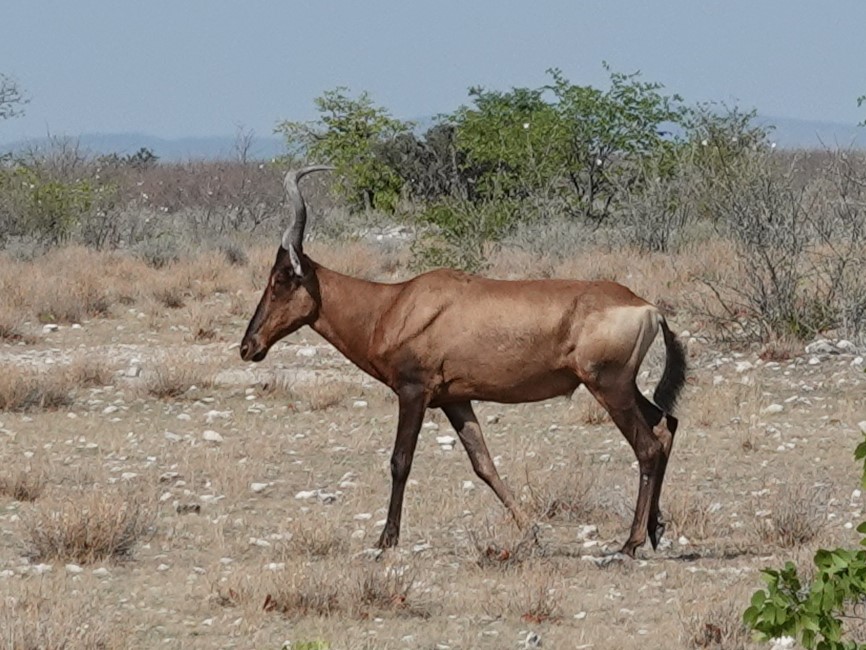
The Red Hartebeest is easily distinguished by its reddish-brown coat, contrasting white markings on the face, legs, and rump, and impressive lyre-shaped horns. These unique features set it apart from other hartebeest species and contribute to its iconic presence in the African landscape.

Distribution

The Red Hartebeest is primarily found in the savannas and grasslands of Southern Africa, with significant populations in countries such as Namibia, South Africa, Botswana, and Zimbabwe. The species’ distribution is characterized by its adaptation to diverse habitats within these regions, showcasing its ability to thrive in varying environmental conditions.

Habitat Preferences
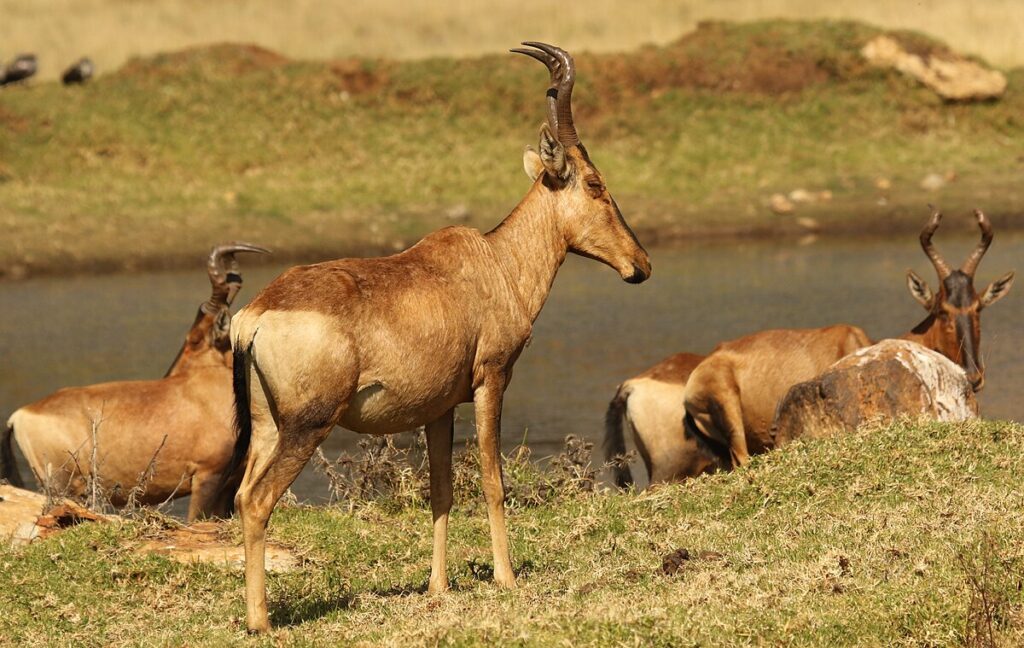
Red Hartebeests are well adapted to open grasslands, sparsely wooded areas, and savannas, where they can utilize their speed and agility to evade predators and forage for food. These ecosystems provide the necessary resources for their survival, including access to water sources and suitable grazing grounds, contributing to their overall well-being and population sustainability.

By encompassing these key aspects, the species profile offers a comprehensive understanding of the Red Hartebeest, highlighting its unique characteristics, distribution, and habitat preferences in the wild.

Facts About Red hartebeest

  • The red hartebeest (Alcelaphus buselaphus caama) is a subspecies of the hartebeest found in Southern Africa.
  • They are characterized by their long, narrow faces and elongated foreheads.
  • Red hartebeests have a shoulder height ranging from 1.1 to 1.5 meters.
  • Their horns are lyre-shaped and can reach lengths of 60-70 cm.
  • These herbivores primarily feed on grasses and herbs.
  • Red hartebeests are known for their speed and agility, capable of reaching speeds of up to 55 km/h.
  • They are found in South Africa, Namibia, Botswana, and Angola.
  • The global population of red hartebeests is estimated to be more than 130,000 individuals in the wild.
  • Red hartebeests are closely related to the tsessebe and the topi.
  • The subspecies Alcelaphus buselaphus caama is listed as Least Concern on the IUCN Red List.


Scientific Provenance & Verified Sources

Biological taxonomy, conservation status, and physical traits are cross-referenced with authoritative global registers:


Peer-reviewed by Wildlife Science Editors โ€ข Updated for 2026

Explore Other Species Profiles