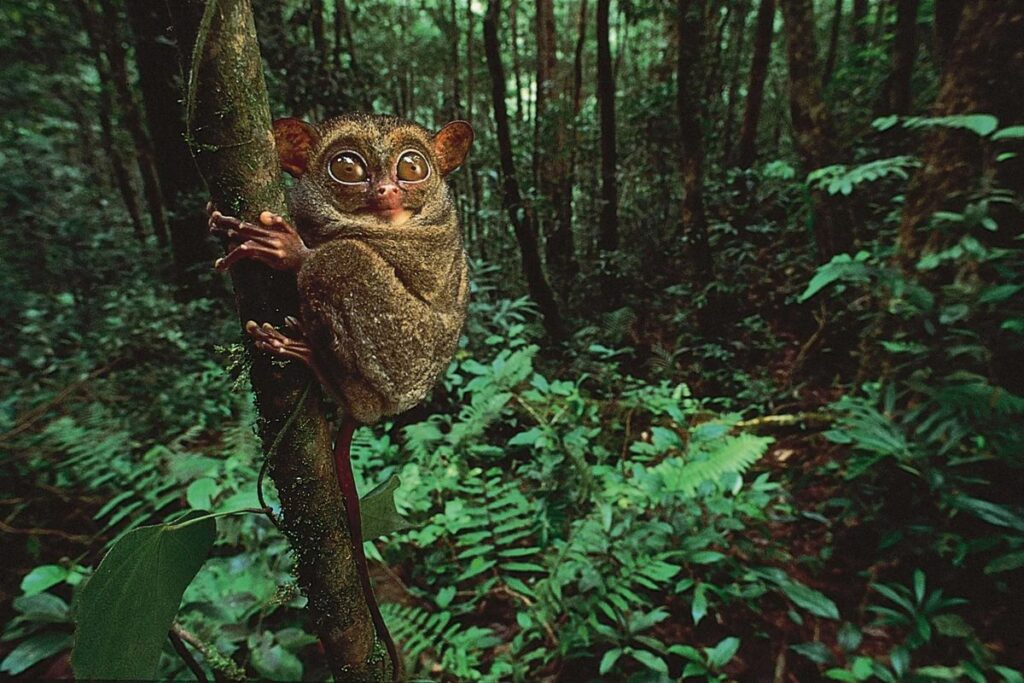
Pygmy Tarsier

IUCN Red List Conservation Status


Data Deficient

This species has no threat category on the IUCN Red List scale (status: Data Deficient), so no threat level is shown.


Species Quick Facts

Scientific Name
Tarsius pumilus

Average Lifespan
Estimated 12-20 years, based on related tarsier species (species-specific data undocumented)

Average Weight
Males: 48.1-50.1 g (1.7-1.8 oz), Females: 52.0-57.5 g (1.8-2.0 oz)

Average Length
Head-body 95-105 mm (3.7-4.1 in)

Overview & Identification

The pygmy tarsier is a tiny nocturnal primate that lives only in the cold, mossy cloud forests of central Sulawesi, Indonesia, above about 1,800 metres. The smallest of all tarsiers, it weighs only around 50 to 57 grams and has enormous eyes and long hind limbs for leaping between branches. Long thought extinct, it was rediscovered alive in 2008 and feeds mainly on insects and other small prey.

Behavior & Social Structure

The pygmy tarsier (Tarsius pumilus) is a nocturnal primate inhabiting the high-elevation mossy forests of the central Sulawesi mountains in Indonesia, typically found at elevations between 1,800 and 2,200 meters, higher than any other tarsier species. Long presumed extinct after no confirmed sightings for nearly 90 years, it was rediscovered alive in 2008 by a research team led by Sharon Gursky-Doyen on Mount Rore Katimbo. Unlike lowland tarsiers, pygmy tarsiers have been observed with reduced toe pads, likely an adaptation to climbing on mossy, water-laden bark rather than smooth surfaces, and their claw-like nails (rather than typical primate nails) provide additional grip in this specialized habitat.

Social organization in T. pumilus appears to follow the general tarsiid pattern of small family groups, though data remain limited due to the species’ rarity and remote habitat. Observations suggest pair-bonded or small multi-male/multi-female groupings that forage independently at night before regrouping at shared sleeping sites during the day. Vocal communication includes high-frequency calls that may extend into the ultrasonic range, a trait documented in related tarsier species and hypothesized to reduce predator detection while facilitating group cohesion and duet calling between mates.

Home ranges are believed to be small, constrained by the limited availability of suitable high-altitude forest, and territoriality is likely maintained through scent marking using specialized glands, a common tarsiid behavior. Their enormous eyes, immobile within the skull, are compensated by a unique adaptation, the ability to rotate the head nearly 180 degrees, allowing for exceptional nocturnal visual scanning while remaining still to avoid detection by predators.

Diet & Hunting Patterns

As an obligate insectivore, the pygmy tarsier relies entirely on animal prey, primarily beetles, moths, crickets, cicadas, and other arthropods found within its cool, moss-covered forest habitat. Unlike most primates, tarsiers are the only entirely carnivorous primates, consuming no plant matter whatsoever. Foraging occurs via a sit-and-wait ambush strategy combined with active searching, using their exceptional low-light vision and acute hearing to detect prey movement on branches, in leaf litter, and within moss mats characteristic of their elfin forest habitat.

Their powerful hind limbs enable explosive vertical leaps exceeding 40 times their body length, allowing them to spring onto flying or fleeing insects with remarkable accuracy. Metabolically, tarsiers exhibit high energy turnover relative to body size, necessitating frequent small feeding bouts throughout the night. Water is obtained primarily through prey consumption and licking moisture from leaves and moss, reducing dependency on standing water sources in their high-altitude environment. Seasonal dietary shifts are not well documented for this rarely observed species, though insect availability in tropical montane forests remains comparatively stable year-round.

Reproduction & Life Cycle

Detailed reproductive data specific to Tarsius pumilus remain scarce due to the extreme difficulty of studying this elusive, high-altitude species; much of what is inferred draws from closely related tarsier species such as Tarsius spectrumgurskyae and Tarsius tarsier. Breeding is believed to occur without a strict seasonal restriction, though births may be timed to coincide with peak insect abundance. Tarsiers generally exhibit a monogamous or loosely polygynous mating system, with pairs or small family units sharing sleeping sites.

Gestation in tarsiers typically lasts around six months, unusually long for such a small-bodied mammal, and results in the birth of a single, highly precocial offspring. Newborns are born with open eyes and are capable of clinging to branches within hours of birth, an adaptation critical for survival in a habitat where falls could be fatal. Mothers carry infants in their mouths during early foraging bouts and park them on secure branches while hunting, a common tarsiid maternal strategy. Weaning likely occurs by two to three months of age, with sexual maturity reached around one year, consistent with patterns observed in other small nocturnal tarsiers.

Threats & Conservation

The primary threat to Tarsius pumilus is habitat degradation and deforestation across central Sulawesi, driven by agricultural expansion, illegal logging, and mining activities encroaching upon montane forest zones. Because this species is restricted to a narrow high-elevation ecological niche, it has minimal capacity to shift range in response to habitat loss, making it particularly vulnerable to even localized disturbances. Climate change poses an emerging concern, as rising temperatures may force upward habitat compression, effectively shrinking the already limited montane forest zones this species depends upon.

Natural predators likely include nocturnal raptors, snakes, and civets, though specific predation data for this species is lacking. Human-wildlife conflict is minimal given the remoteness of its habitat, though the species faces indirect pressure from ecotourism development and forest access roads. Currently classified as Data Deficient by the IUCN due to insufficient population and distribution data, T. pumilus benefits from partial protection within Lore Lindu National Park, where ongoing surveys by primatologists aim to establish reliable population estimates and inform future conservation status reassessment.

Interesting Facts

  • The “Lazarus Primate”: Pygmy tarsiers were believed extinct for nearly 90 years until their dramatic rediscovery alive in 2008 on Mount Rore Katimbo, Sulawesi.
  • Highest-Altitude Tarsier: This species inhabits elevations up to 2,200 meters, far higher than any other tarsier, in cold, mossy cloud forest ecosystems.
  • Clawed Fingers: Unlike other tarsiers with flattened nails, T. pumilus has claw-like nails on most digits, an adaptation for gripping wet, mossy bark.
  • Enormous Relative Eye Size: Tarsiers have the largest eyes relative to body size of any mammal; each eyeball is roughly the size of their entire brain.
  • Exclusively Carnivorous Primates: Tarsiers, including this species, are the only primates on Earth that eat solely animal prey, with no fruit or vegetation in their diet.
  • Ultrasonic Communication: Related tarsier species communicate using calls in the ultrasonic frequency range, likely to evade predator detection.
  • Extreme Leaping Ability: Powerful hindlimbs allow tarsiers to leap over 40 times their own body length to capture prey mid-air.

Description

Pygmy Tarsier

The pygmy tarsier, scientifically known as Tarsius pumilus, is a fascinating nocturnal primate found in the central Sulawesi region of Indonesia. Also referred to as the mountain tarsier or the lesser spectral tarsier, this diminutive primate possesses unique characteristics that distinguish it from other species within the Tarsius genus.

Appearance

Pygmy Tarsier Appearance

The pygmy tarsier is notably small in size, with a body length of approximately 10 centimeters and a distinctive long, bushy tail. Its large eyes are adapted for night vision, and its ears are remarkably large in proportion to its head. These physical features, along with its dense fur, contribute to its remarkable ability to thrive in the montane cloud forests of central Sulawesi.

Distribution

The pygmy tarsier is endemic to the montane cloud forests of central Sulawesi, Indonesia, where it inhabits altitudes ranging from 1800 to 2200 meters. The species’ distribution is limited to this specific region, and its population density is influenced by the availability of suitable habitats within this area.

Habitat Preferences

Pygmy Tarsier Habitat

Pygmy tarsiers thrive in montane cloud forests characterized by lower vegetative species diversity compared to lowland tropical forests. These environments provide the necessary cover and resources for the species to forage and navigate during its nocturnal activities. The unique ecosystem of the central Sulawesi Mountains supports the survival and well-being of the pygmy tarsier, showcasing the species’ remarkable adaptation to its specialized habitat.

As a conservation scientist and advocate for wildlife preservation, it is crucial to recognize the significance of protecting the unique habitats that sustain the pygmy tarsier and other endemic species. By understanding the intricate relationship between species and their environments, we can work towards ensuring the long-term survival of these remarkable creatures.

By shining a light on the remarkable pygmy tarsier, we can inspire a deeper appreciation for the diverse array of species that contribute to the rich tapestry of life on our planet.

Facts About Pygmy Tarsier

  • The Pygmy Tarsier (Tarsius pumilus) is one of the smallest primates in the world, weighing around 2 ounces.
  • They are nocturnal creatures, primarily active during the night.
  • Pygmy Tarsiers are endemic to the mossy cloud forests of central Sulawesi, Indonesia, found at altitudes of 1,800–2,200 meters.
  • These primates are solitary animals and are known to be very elusive.
  • Their diet mainly consists of insects and arthropods, making them carnivorous primates.
  • Pygmy Tarsiers have large eyes, which are adapted to their nocturnal lifestyle.
  • The species was once thought to be extinct until it was rediscovered in 2008 after a 85-year absence.
  • They have a unique grooming claw, which sets them apart from other primates.
  • The Pygmy Tarsier has a distinctive call, which is used for communication and locating mates.
  • Conservation efforts are crucial for the survival of the Pygmy Tarsier due to their limited habitat and small population size.


Scientific Provenance & Verified Sources

Biological taxonomy, conservation status, and physical traits are cross-referenced with authoritative global registers:


Peer-reviewed by Wildlife Science Editors • Updated for 2026

Explore Other Species Profiles