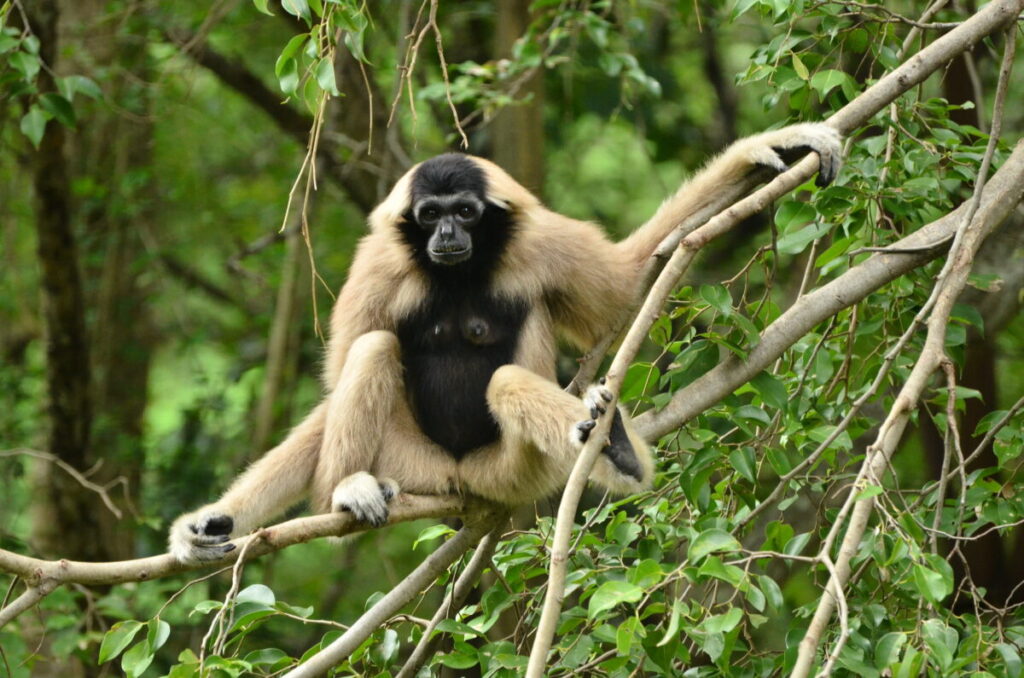
Pileated Gibbon

IUCN Red List Conservation Status


Endangered

LC
NT
VU
EN
CR
EW
EX

Official assessment evaluated in accordance with the IUCN Red List of Threatened Species criteria: Endangered.


Species Quick Facts

Scientific Name
Hylobates pileatus

Average Lifespan
25-30 years in wild, 35-40 years in captivity

Average Weight
4.5-7.5 kg (10-16.5 lbs) – Males: 5.5-7.5 kg, Females: 4.5-6.5 kg

Average Length
45-55 cm (18-22 inches) – head-body length excluding tail

Overview & Identification

The pileated gibbon is a small ape native to the forests of Thailand, Cambodia, and Laos. Males are black while females are pale, both bearing a cap-like crest of hair that gives the species its name. Highly arboreal, it swings through the canopy by its long arms and sings loud duetting calls.

Behavior & Social Structure

Pileated gibbons live in stable, monogamous family units consisting of a breeding pair and their offspring, which may remain with the parents for several years before dispersing. The groups are highly territorial; each pair defends a home range of 20โ€“30โ€ฏha in lowland forest and up to 50โ€ฏha in mountainous terrain. Territory is marked by scentโ€‘gland rubbing and reinforced through regular vocal duets that can be heard for several kilometers. These duets, performed at dawn and dusk, consist of a maleโ€™s deep, resonant hoots followed by the femaleโ€™s higherโ€‘pitched wails, serving both to advertise the pairโ€™s presence and to deter rivals. The gibbons are diurnal and spend most of their waking hours brachiating between canopy branches, rarely descending to the ground. Social grooming strengthens pair bonds, while play is common among juveniles. Daily movement averages 1โ€“2โ€ฏkm of travel, and individuals maintain a strict arboreal lifestyle, relying on the continuity of the forest canopy for foraging and predator avoidance.

Diet & Hunting Patterns

Pileated gibbons are primarily frugivorous, with fruit comprising 60โ€“70โ€ฏ% of their daily intake, especially figs (Ficus spp.), mangoes, and berries. Leaves, young shoots, and flowers supplement the diet, accounting for 20โ€“30โ€ฏ% and providing essential proteins and minerals during periods of fruit scarcity. Insects such as caterpillars, beetles, and ants make up the remaining 5โ€“10โ€ฏ% and are opportunistically captured during foraging bouts. An adult gibbon consumes roughly 1.5โ€“2โ€ฏkg of food per day, selecting ripe, highโ€‘energy items that can be quickly processed while brachiating. Foraging occurs mainly in the upper canopy (15โ€“30โ€ฏm above ground), where individuals move silently along lianas, using keen eyesight to locate fruiting trees. Seasonal fluctuations in fruit availability drive dietary flexibility; during lean months, gibbons increase leaf consumption and may travel longer distances to locate fruiting patches, demonstrating remarkable adaptability to changing forest resources.

Reproduction & Life Cycle

Sexual maturity in pileated gibbons is reached at about 5โ€“7โ€ฏyears for females and 6โ€“8โ€ฏyears for males. Breeding is not strictly seasonal, but peaks often occur during the rainy season when fruit abundance is highest, providing ample nutrition for lactating females. After a gestation period of approximately 242โ€ฏdays (about 8โ€ฏmonths), a single infant is born; twins are rare. Newborns weigh around 400โ€“500โ€ฏg and cling to the motherโ€™s belly for the first 2โ€“3โ€ฏmonths before transitioning to riding on the fatherโ€™s back. Maternal care is intensive, with the mother nursing the infant for 12โ€“18โ€ฏmonths while both parents provide protection and grooming. Juveniles are weaned at about 18โ€ฏmonths but remain within the natal group for 4โ€“5โ€ฏyears, learning essential foraging and locomotor skills. Interโ€‘birth intervals typically span 2โ€“3โ€ฏyears, allowing the pair to invest heavily in each offspringโ€™s survival.

Threats & Conservation

The IUCN Red List classifies the pileated gibbon as Endangered, with an estimated total population of 10,000โ€“15,000 mature individuals, a figure that has declined by more than 30โ€ฏ% over the past three generations. The principal threats are habitat loss and fragmentation caused by illegal logging, conversion of forest to oilโ€‘palm plantations, and expanding agricultural settlements. Hunting for meat and the illegal pet trade further exacerbate declines, particularly in remote border regions where enforcement is weak. Road development fragments remaining forest blocks, isolating populations and reducing genetic exchange. Conservation actions include the establishment of protected areas such as Thailandโ€™s Khao Yai National Park and Vietnamโ€™s Cat Tien National Park, communityโ€‘based forest monitoring, and antiโ€‘poaching patrols. Captive breeding programs in several zoos aim to maintain a genetic reservoir, while ecotourism initiatives provide economic incentives for local communities to preserve gibbon habitats. Ongoing research monitors population trends and habitat connectivity to inform adaptive management strategies.

Interesting Facts

โ€ข – wp:heading –>
โ€ข block-heading”>Description

โ€ข – /wp:heading –>
โ€ข – wp:image {“id”:32818,”sizeSlug”:”large”,”linkDestination”:”none”,”align”:”center”} –>
โ€ข block-image aligncenter size-large”>Pileated Gibbon

Description

Pileated Gibbon

The Pileated gibbon, scientifically known as Hylobates pileatus, belongs to the gibbon family, Hylobatidae. These primates exhibit sexual dimorphism in fur coloration, with males sporting a purely black fur, while females display a white-grey colored fur with only the belly and head being black. Pileated gibbons are known for their agile and arboreal lifestyle, spending most of their time in trees.

Appearance

Pileated Gibbon Appearance

The distinctive feature of the Pileated gibbon is its sexual dimorphism in fur coloration, setting it apart from other gibbon species. This unique characteristic makes it easily identifiable in its natural habitat. The contrast between the black fur of the males and the white-grey fur of the females is a remarkable aspect of their appearance.

Distribution

The range of the Pileated gibbon includes eastern Thailand, western Cambodia, and southwest Laos. Their distribution is relatively limited, particularly in Laos, resulting in fewer Pileated gibbons inhabiting this region. Notably, the population density of Pileated gibbons varies within their range, with specific areas exhibiting higher or lower concentrations of these primates.

Habitat Preferences
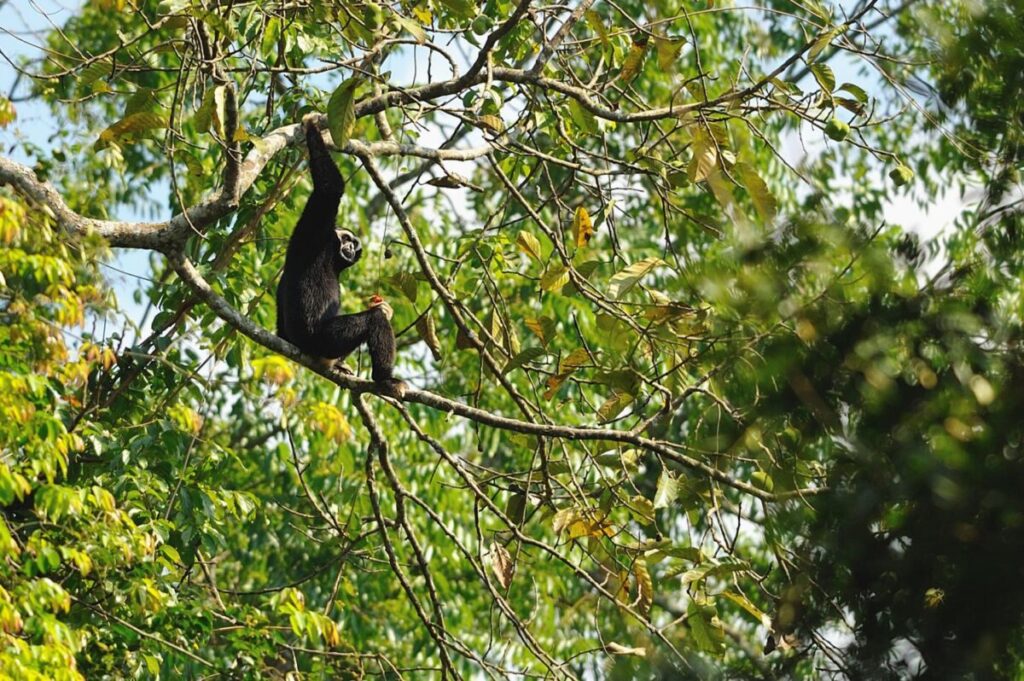
Pileated Gibbon Habitat

Pileated gibbons are predominantly found in forested areas, thriving in diverse ecosystems such as tropical and subtropical rainforests. These environments provide the essential elements for their survival, including suitable food sources and secure habitats for nesting and resting. The presence of tall trees and a dense canopy is crucial for their arboreal lifestyle, enabling them to move swiftly through the forest canopy and maintain their characteristic agility.

Overall, the Pileated gibbon’s unique appearance, limited distribution, and habitat preferences make it a fascinating species to study and conserve, highlighting the importance of preserving its natural habitats for the well-being of this remarkable primate.

Facts About Pileated gibbon

  • The Pileated gibbon (Hylobates pileatus) has a head-and-body length ranging from 450 to 640 mm.
  • These gibbons weigh between 4 to 8 kg.
  • Pileated gibbons are arboreal and diurnal primates.
  • They have sexual dimorphism in fur coloration, with males having purely black fur and females having white-grey colored fur.
  • Pileated gibbons have slender torsos, long arms, and ischial callosities.
  • Their diet consists mostly of fruits (71%), flowers (15%), and young shoots (2%).
  • The gestation period for Pileated gibbons is approximately 228 days.
  • They are found in a wide variety of primary forest habitats.
  • Pileated gibbons reach sexual maturity at around 1,825 days.
  • The estimated population of Pileated gibbons is around 35,000 individuals.


Scientific Provenance & Verified Sources

Biological taxonomy, conservation status, and physical traits are cross-referenced with authoritative global registers:


Peer-reviewed by Wildlife Science Editors โ€ข Updated for 2026

Explore Other Species Profiles