
Description

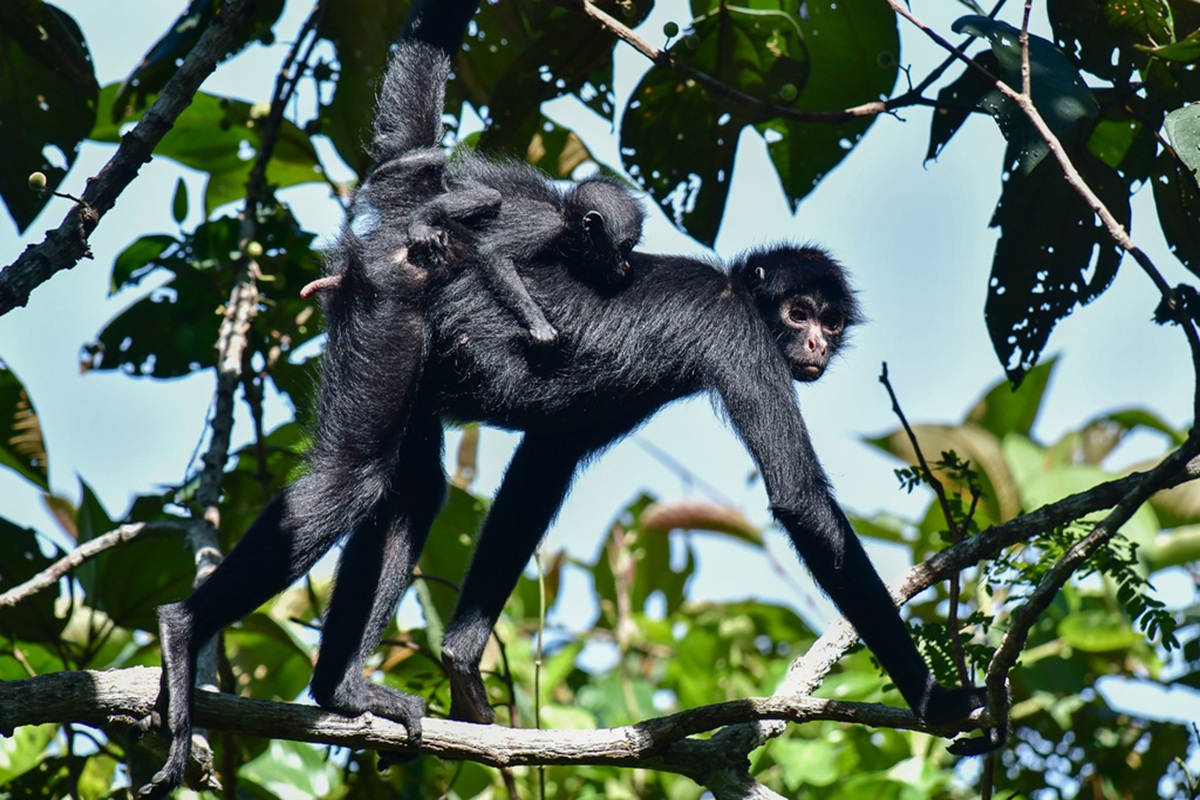
The Peruvian spider monkey, scientifically known as Ateles chamek, is also referred to as the black-faced black spider monkey. This species is a member of the spider monkey family and is characterized by its long, slender limbs, prehensile tail, and a striking black face. They are relatively large among spider monkeys, measuring approximately 60 centimeters (2 feet) in length. Peruvian spider monkeys are known for their agility and adeptness in navigating the forest canopy, where they spend the majority of their time.
Appearance

The Peruvian spider monkey is easily distinguishable by its glossy black fur and a distinctively dark face. Their slender, agile build and long, powerful tail enable them to move swiftly through the treetops. Their prehensile tail acts as an extra limb, aiding them in grasping branches and foraging for food. This species has a unique and captivating appearance, making it an iconic resident of the South American rainforests.
Distribution
The Peruvian spider monkey is primarily found in the lowland forests of Peru, as well as in regions of Brazil and Bolivia. Their range extends across the western Amazon rainforest, encompassing areas of northeastern Peru, northern Bolivia, and parts of western Brazil. Despite their broad distribution, the population density of Peruvian spider monkeys faces threats due to habitat loss and human encroachment.
Habitat Preferences

Peruvian spider monkeys thrive in diverse tropical rainforest ecosystems, where they predominantly inhabit the forest canopy and sub-canopy layers. These monkeys are well-adapted to a life high up in the trees, utilizing their agility and strong limbs to navigate the complex forest environment. Their diet mainly consists of fruits, leaves, nuts, seeds, and occasionally arachnids and insects, which are readily available in their forest habitat.
The survival and well-being of the Peruvian spider monkey are intricately linked to the preservation of its forest home. As arboreal creatures, they rely on the rich biodiversity and interconnectedness of the rainforest for food sources, shelter, and social interactions within their groups.
This comprehensive species profile provides a detailed insight into the unique characteristics, appearance, distribution, and habitat preferences of the Peruvian Spider Monkey, shedding light on the importance of conserving this remarkable species and its forest habitat.
Facts About Peruvian Spider Monkey
- The Peruvian Spider Monkey, also known as Ateles chamek, is found in areas of Peru, Brazil, and Bolivia.
- This species is highly frugivorous, with fruit accounting for around 85% of their diet.
- Peruvian Spider Monkeys have an average lifespan of 20-48 years.
- They are known for their distinctive black face, which gives them their alternative common name, the Black-faced Black Spider Monkey.
- The adult weight of the Chamek spider monkey is around 13.228 lbs (6.00 kg), with a birth weight of approximately 1.019 lbs (462 g).
- Peruvian Spider Monkeys are part of the Ateles genus and are recognized as one of the seven species of spider monkeys.
- They primarily inhabit tropical rainforests and are highly skilled at brachiation, using their long arms to swing through the trees.
- The species is classified as “Vulnerable” on the IUCN Red List due to habitat loss and hunting.
- Peruvian Spider Monkeys live in social groups called troops, which can consist of up to 35 individuals.
- These monkeys play a crucial role in seed dispersal, contributing to the health and diversity of their forest habitats.


