Northern Olingo

IUCN Red List Conservation Status


Least Concern

LC
NT
VU
EN
CR
EW
EX

Official assessment evaluated in accordance with the IUCN Red List of Threatened Species criteria: Least Concern.


Species Quick Facts

Scientific Name
Bassaricyon neblina

Average Lifespan
5-7 years in wild, 10-12 years in captivity

Average Weight
0.9-1.2 kg (2.0-2.6 lbs) – Males: 1.1 kg, Females: 0.9 kg

Average Length
40-50 cm (15.7-19.7 inches) – head-body length excluding tail

Overview & Identification

The northern olingo (Bassaricyon neblina) is a small, arboreal carnivore belonging to the family Procyonidae, which also includes raccoons and coatis. First described by Thomas in 1909, it is one of four recognized olingo species and occupies the humid montane forests of the northern Andes. Its range extends from the western slopes of Colombia through Ecuador and into northern Peru, with isolated records in southern Bolivia. The species prefers primary cloud forest at elevations of 1,500โ€“3,000โ€ฏm, where dense canopy and abundant epiphytes provide both shelter and foraging opportunities. Adults have a sleek, russetโ€‘brown coat, a long bushy tail that is slightly shorter than the headโ€‘body length, and a distinctive dark facial mask. Unlike the more nocturnal kinkajou, the northern olingo is most active during the night but may also be crepuscular. It is listed as Least Concern by the IUCN because of its relatively wide distribution, although local populations are declining due to habitat fragmentation. Conservation efforts focus on protecting highโ€‘elevation forest corridors and monitoring the impacts of mining and agricultural expansion.

Behavior & Social Structure

Northern olings are primarily solitary, with adult males maintaining overlapping home ranges that intersect those of several females. They are nocturnal and arboreal, spending most of their active period navigating the midโ€‘ to upper canopy using a semiโ€‘prehensile tail for balance. Territories are marked with scent glands located on the chest and anal region, and individuals communicate through a repertoire of highโ€‘pitched whistles, chirps, and occasional growls. Homeโ€‘range sizes vary with habitat quality, ranging from 0.5โ€ฏkmยฒ in dense primary forest to over 2โ€ฏkmยฒ in fragmented patches. While they rarely descend to the ground, they will cross small gaps or use lianas to move between trees. Social interactions are limited to brief mating encounters and occasional motherโ€‘offspring contact; otherwise, individuals avoid direct contact, reducing competition for food resources.

Diet & Hunting Patterns

The northern olingo is an opportunistic omnivore with a strong preference for fruit, especially figs, berries, and small drupes that are abundant in cloud forests. Fruit can comprise up to 60โ€ฏ% of its diet during peak fruiting periods, providing essential carbohydrates and water. The remaining intake consists of insects (beetles, moth larvae), small vertebrates (rodents, birds, treeโ€‘frogs), and occasional nectar from epiphytic flowers. Foraging is primarily arboreal; individuals use their sharp incisors and retractable claws to peel fruit skins and extract insects from bark crevices. They are known to cache surplus fruit in leaf litter or on branch forks, a behavior that aids survival during leaner months. Daily food consumption averages 150โ€“250โ€ฏg, varying with body size, reproductive status, and seasonal resource availability.

Reproduction & Life Cycle

Northern olingos reach sexual maturity at about 18โ€ฏmonths for females and 24โ€ฏmonths for males. Breeding can occur throughout the year but peaks during the rainy season (Aprilโ€“June), when fruit abundance is highest. After a gestation period of roughly 63โ€ฏdays, females give birth to a single offspring, occasionally a second, in a concealed nest built of leaves and moss high in the canopy. Neonates are born blind and hairless, weighing about 120โ€ฏg, and cling to the motherโ€™s belly for the first two weeks. The mother provides all parental care, nursing the young for up to three months while gradually introducing solid foods such as insects and fruit. Juveniles become independent at around six months but may remain within the motherโ€™s range for several additional months before dispersing to establish their own territories.

Threats & Conservation

The IUCN classifies the northern olingo as Least Concern, yet its populations are experiencing a slow decline driven by habitat loss and fragmentation. Deforestation for cattle ranching, coffee plantations, and illegal gold mining removes large tracts of the highโ€‘elevation cloud forest that the species depends on for shelter and food. Road construction and expanding human settlements further isolate forest patches, limiting dispersal and increasing vulnerability to inbreeding. Although the species tolerates some secondary forest, it avoids heavily disturbed areas, making it a useful indicator of forest integrity. Current estimates suggest a total population of 20,000โ€“30,000 mature individuals, with a decreasing trend of roughly 10โ€ฏ% over the past decade. Conservation actions include protecting existing cloudโ€‘forest reserves, promoting sustainable agroforestry, and conducting systematic surveys to refine population assessments.

Interesting Facts

โ€ข The northern olingoโ€™s tail is semiโ€‘prehensile, allowing it to grasp branches while climbing.
โ€ข It can rotate its hind feet outward up to 180ยฐ, enhancing its ability to cling to vertical surfaces.
โ€ข Unlike many carnivores, it has a relatively low metabolic rate, enabling it to survive periods of fruit scarcity.
โ€ข Its vocal repertoire includes a distinctive โ€œbarkโ€‘likeโ€ call used during territorial disputes.
โ€ข Genetic studies show that northern olingos diverged from their southern relatives about 1.5โ€ฏmillion years ago.

The northern olingo, scientifically known as Bassaricyon gabbii, is a fascinating tree-dwelling mammal belonging to the family Procyonidae. This elusive creature is also referred to as the bushy-tailed olingo and is the most commonly observed species within its genus.

Description

Northern Olingo

The northern olingo is characterized by its slender, agile build and bushy tail, which aids in its arboreal lifestyle. With a keen sense of balance and dexterity, this species navigates the forest canopy with remarkable agility. Its nocturnal nature and excellent climbing abilities make it well-adapted to its arboreal habitat.

Appearance
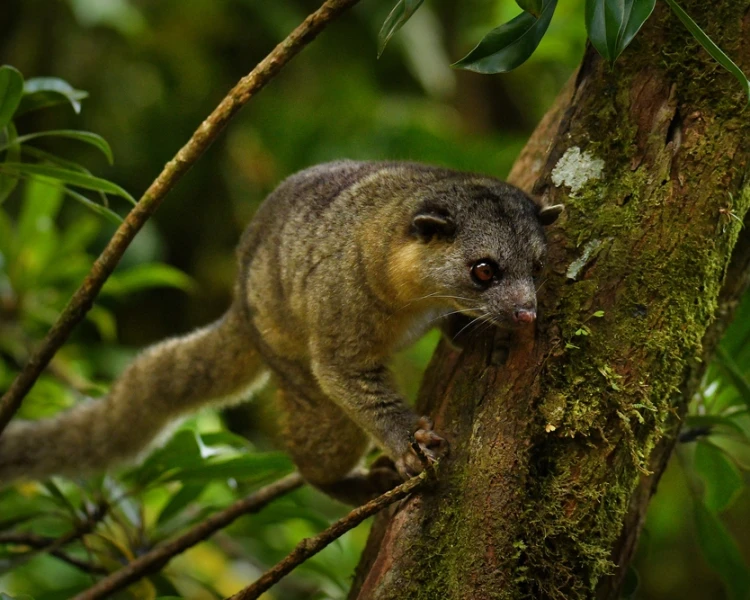
Northern Olingo Appearance

Distinctive features of the northern olingo include its slender body, long tail, and soft, grayish fur. Its large, expressive eyes and pointed snout contribute to its endearing appearance. These characteristics set it apart from other members of the Procyonidae family, such as raccoons and kinkajous.

Distribution

The northern olingo is primarily found in the heavily forested regions of Central America, including areas of Nicaragua, Honduras, Costa Rica, and Panama. While its distribution is widespread within these countries, the species may exhibit localized abundance in certain regions, reflecting its adaptability to diverse forest ecosystems.

Habitat Preferences

Northern Olingo Habitat

The northern olingo thrives in montane and tropical moist forests, demonstrating a preference for elevated habitats ranging from sea level to approximately 3,300 feet. Its arboreal lifestyle is intricately linked to the forest environment, where it finds ample opportunities for foraging, shelter, and reproduction. The species’ reliance on these forest ecosystems underscores the importance of conservation efforts to preserve its natural habitat and ensure its continued well-being.

With its unique characteristics and specialized habitat requirements, the northern olingo serves as a compelling example of the remarkable diversity and adaptability of wildlife in Central America’s rich and biodiverse ecosystems.

Facts About Northern olingo

  • The Northern olingo (Bassaricyon gabbii) is a procyonid species found in Central and South America.
  • These small, arboreal mammals have a lifespan of around 7 to 10 years in the wild.
  • Northern olingos primarily feed on fruit, but they also consume insects, small mammals, and birds.
  • They are solitary animals and are mostly active at night, making them nocturnal creatures.
  • Northern olingos have a unique appearance with a slender body, long tail, and large eyes.
  • Their habitat includes tropical and cloud forests, where they spend most of their time in the trees.
  • The population size of Northern olingos is currently stable, and they are not considered to be endangered.
  • These animals play a crucial role in seed dispersal within their forest habitats.
  • Northern olingos are known for their agility and adeptness at navigating through the forest canopy.
  • They are relatively elusive and not commonly seen, adding to their mystique and allure.


Scientific Provenance & Verified Sources

Biological taxonomy, conservation status, and physical traits are cross-referenced with authoritative global registers:


Peer-reviewed by Wildlife Science Editors โ€ข Updated for 2026

Explore Other Species Profiles