North American Least Shrew

IUCN Red List Conservation Status


Least Concern

LC
NT
VU
EN
CR
EW
EX

Official assessment evaluated in accordance with the IUCN Red List of Threatened Species criteria: Least Concern.


Species Quick Facts

Scientific Name
Cryptotis parva

Average Lifespan
About 1 year in the wild; up to 2.6-3.5 years in captivity

Average Weight
3-6 g (0.1-0.2 oz), mean ~4.5 g

Average Length
6.4-8.4 cm (2.5-3.3 inches) body length

Overview & Identification

The North American least shrew is one of the smallest mammals on the continent, found across the eastern United States and into Central America. Despite its tiny size it is a voracious predator of insects, worms, and other invertebrates. Unusually social for a shrew, it sometimes shares nests and may cooperate in raising young.

Behavior & Social Structure

The least shrew (Cryptotis parva) is active both day and night but shows peak activity during crepuscular hours, alternating short bursts of activity with brief rest periods due to an extremely high metabolic rate. Unlike most solitary shrew species, Cryptotis parva is notably gregarious, often forming small social groups that share nests, particularly during colder months when communal nesting improves thermoregulation and energy conservation. Multiple individuals, including adults of both sexes, may occupy the same nest simultaneously, a rare trait among soricids.

Communication relies heavily on tactile cues, high-frequency vocalizations (some approaching ultrasonic ranges), and chemical scent marking via specialized flank and ventral glands used for individual recognition and possibly reproductive signaling. Home ranges are small, typically under 0.5 acres, reflecting the dense prey base of their grassland and old-field habitats. While not strongly territorial, dominance hierarchies can form within communal nests, especially regarding food resources. Their small size and secretive, tunneling lifestyle in leaf litter and shallow burrows serve as key predator-avoidance adaptations.

Diet & Hunting Patterns

As a true insectivore, the least shrew consumes a wide variety of invertebrates including beetles, crickets, grasshoppers, caterpillars, earthworms, slugs, snails, and occasionally small vertebrates such as salamanders. Foraging occurs continuously in short intervals due to a metabolism requiring near-constant caloric intake—individuals may consume up to 60–100% of their own body weight in food daily. Prey is located primarily through tactile and olfactory cues, as shrews have poor eyesight, and captured prey is subdued using rapid biting motions aided by mildly toxic saliva that helps immobilize larger invertebrates.

Seasonal shifts in diet reflect prey availability, with softer-bodied insects favored in warmer months and increased reliance on stored fat reserves and slower-moving invertebrates during colder periods. Water is obtained both through direct drinking when available and via moisture content in prey, making them moderately dependent on humid microhabitats such as leaf litter, grass thatch, and moist soil layers to prevent desiccation.

Reproduction & Life Cycle

Breeding occurs primarily from spring through early autumn, with peak activity in warmer months, and mating systems tend toward polygyny or promiscuity, as multiple males may compete for access to receptive females within communal habitats. Gestation lasts approximately 21–23 days, and females may produce multiple litters per year, each containing 2–7 (commonly 4–6) altricial young that are born blind, hairless, and highly dependent on maternal care.

Maternal care is intensive, with mothers nursing, grooming, and thermoregulating pups within nests constructed from grasses or leaf litter. Weaning typically occurs around 21 days post-birth, and juveniles reach sexual maturity remarkably quickly—often within 6 to 8 weeks—allowing for rapid population turnover characteristic of small-bodied, short-lived mammals.

Threats & Conservation

The least shrew faces localized threats primarily from habitat degradation, agricultural intensification, and loss of old-field and grassland ecosystems due to urban development and land-use conversion. While not currently threatened at a population level, fragmentation of suitable habitat can isolate local populations and reduce genetic connectivity. Pesticide use in agricultural areas may also indirectly reduce prey availability and introduce bioaccumulative toxins into shrew diets.

Natural predators include owls, hawks, snakes, foxes, weasels, and domestic cats, with high predation pressure balanced by the species’ rapid reproductive rate. Climate variability affecting invertebrate prey populations poses an emerging concern, though the species’ adaptability across diverse habitats provides resilience. No dedicated conservation programs currently target Cryptotis parva specifically, as its “Least Concern” status under the IUCN reflects broad distribution, ecological flexibility, and stable population trends across its North American range.

Interesting Facts

  • One of North America’s Smallest Mammals: Adults typically weigh only 4–6 grams, making them among the tiniest terrestrial mammals on the continent.
  • Extreme Metabolic Rate: Their heart rate can exceed 800 beats per minute, necessitating near-continuous feeding to sustain their energy demands.
  • Mildly Venomous Saliva: Like several shrew species, Cryptotis parva produces saliva containing neurotoxic compounds that help subdue larger or more resistant prey.
  • Communal Nesting Behavior: Unlike most solitary shrews, least shrews frequently share nests with multiple individuals, an uncommon social adaptation in Soricidae.
  • Rapid Reproductive Cycle: Females can reach sexual maturity in under two months, enabling swift population recovery after environmental disturbances.
  • Poor Eyesight, Exceptional Touch: Their vibrissae (whiskers) and tactile sensitivity compensate for extremely limited vision in dense vegetation and subterranean spaces.
  • Ecological Pest Control: By consuming large quantities of insects and agricultural pests, least shrews play a valuable role in natural pest suppression within grassland ecosystems.

Description

North American Least Shrew

The North American least shrew, scientifically known as Cryptotis parva, is one of the smallest mammals, typically growing to be only up to 3 inches long. It is characterized by a long pointed snout and a tail that never exceeds twice the length of its hind foot. The dense fur coat of the least shrew is typically dark brown to grayish-brown, providing insulation and protection in its natural habitat.

Appearance
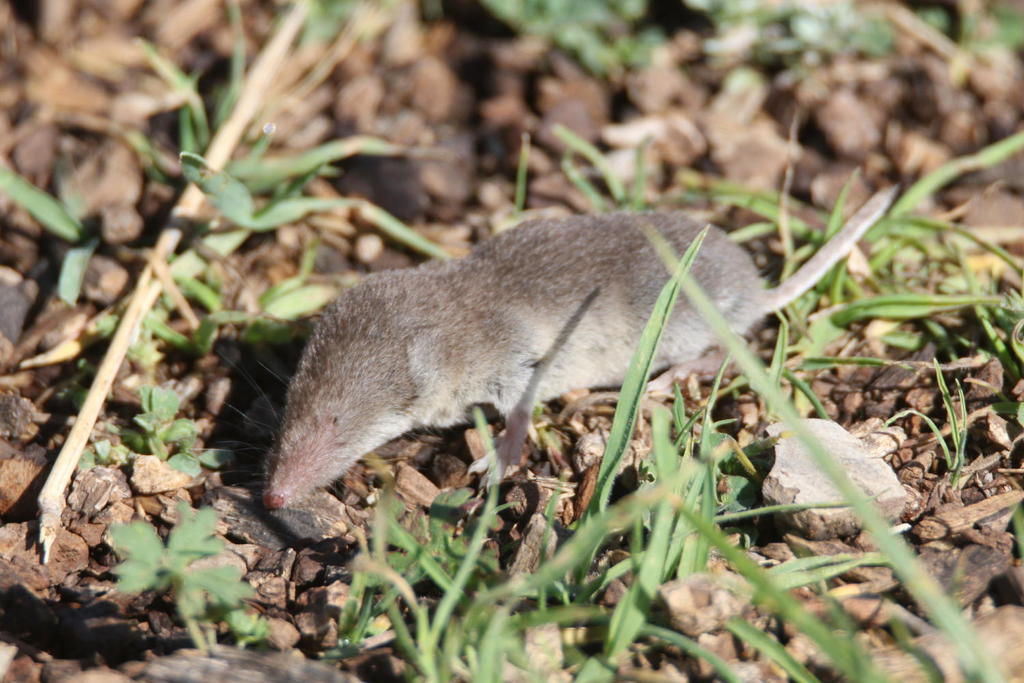
North American Least Shrew Appearance

This diminutive mammal possesses several distinguishing features that set it apart from similar species. Its small size, long pointed snout, and relatively short tail are key identifiers. The least shrew’s inconspicuous ears and tiny eyes further contribute to its unique appearance.

Distribution

The North American least shrew is found throughout much of the eastern United States, ranging from New York south to Georgia, and as far west as eastern Texas. It also extends into parts of Canada, including southern Ontario. This species has a wide and northern distribution, making it one of the most widely spread members of its genus.

Habitat Preferences

North American Least Shrew Habitat

The least shrew exhibits a preference for open areas such as fields, meadows, and grassy cover with scattered brush. It is often found in a variety of ecosystems, including wetlands, grasslands, and agricultural areas. These environments provide the necessary cover and resources to support the survival and well-being of the North American least shrew.

By providing a comprehensive overview of the North American least shrew, this profile aims to increase awareness of this remarkable species and promote its conservation in its natural habitats.

Facts About North American least shrew

  • The North American least shrew (Cryptotis parva) is one of the smallest mammals, growing to be only up to 3 inches long.
  • It has a long pointed snout and a very short tail.
  • The least shrew is one of the smallest of Michigan’s shrews, with a body length of 2.5 to 3.3 inches and a short tail.
  • They have a home range of about 0.20 hectares.
  • The average lifespan of the North American least shrew in the wild is 1 year, while in captivity it is 2.6 years.
  • The North American least shrew has a range mass of 3 to 6 grams.
  • The soft, short fur of the North American least shrew is dark brown.
  • It is a member of the shrew family Soricidae, which includes some of the smallest members of the animal kingdom.
  • The North American least shrew has tiny, black eyes and concealed ears.
  • The average basal metabolic rate of the North American least shrew is 0.164 W.


Scientific Provenance & Verified Sources

Biological taxonomy, conservation status, and physical traits are cross-referenced with authoritative global registers:


Peer-reviewed by Wildlife Science Editors • Updated for 2026

Explore Other Species Profiles