IUCN Red List Conservation Status


Endangered

LC
NT
VU
EN
CR
EW
EX

Official assessment evaluated in accordance with the IUCN Red List of Threatened Species criteria: Endangered.


Species Quick Facts

Scientific Name
Martes gwatkinsii

Average Lifespan
5-7 years in wild, 10-12 years in captivity

Average Weight
1.5-2.5 kg (3.3-5.5 lbs) – Males: 2.0 kg, Females: 1.5 kg

Average Length
38-45 cm (15-18 inches) – head-body length excluding tail

Overview & Identification

The Nilgiri marten (Martes gwatkinsii) is a mediumโ€‘sized mustelid endemic to the montane forests of the Western Ghats in southern India. Classified within the family Mustelidae, it is the only marten species confined to the Indian subcontinent. Its distribution is fragmented across the Nilgiri Hills, Anamalai, and the higher reaches of the Palani and Cardamom ranges, occupying elevations between 1,200 and 2,600 meters. The species prefers sholaโ€‘grassland mosaics, evergreen montane forest, and bamboo thickets, where dense understory provides cover for its secretive lifestyle. The coat is a rich reddishโ€‘brown with a lighter throat patch and a long, bushy tail that aids balance on steep slopes. The Nilgiri marten is listed as Endangered on the IUCN Red List due to its restricted range, low population density, and ongoing habitat degradation. Conservation actions focus on habitat protection, connectivity corridors, and communityโ€‘based monitoring programs.

Behavior & Social Structure

Nilgiri martens are primarily solitary, with individuals maintaining exclusive home ranges that can exceed 30 kmยฒ for males and 20 kmยฒ for females. They are crepuscular, most active at dawn and dusk, but will also forage during the night when prey is abundant. Territorial marking is achieved through scent glands on the anal region and by rubbing the body against branches. Communication includes a series of chirps, growls, and tailโ€‘slaps that convey alarm or reproductive readiness. While generally reclusive, they are agile climbers and can traverse steep terrain and dense undergrowth with ease, using both arboreal and terrestrial pathways to locate food and avoid predators.

Diet & Hunting Patterns

The Nilgiri marten is an opportunistic omnivore with a strong carnivorous bias. Its diet comprises small mammals such as rodents and shrews, groundโ€‘nesting birds, amphibians, reptiles, and a variety of invertebrates including beetles and termites. Seasonal fruiting bodies of figs, berries, and the seeds of bamboo shoots supplement protein intake, especially during lean periods. Studies of scat analysis in the Anamalai Hills indicate that mammals constitute about 55% of dietary volume, birds 20%, insects 15%, and fruit 10%. The species employs both active huntingโ€”pursuing prey on the forest floorโ€”and ambush tactics, using its keen sense of smell to locate hidden food sources.

Reproduction & Life Cycle

Sexual maturity is reached at about 18โ€‘24 months for both sexes. Breeding occurs from November to March, coinciding with the postโ€‘monsoon abundance of prey. After a gestation period of roughly 9โ€‘10 weeks, females give birth to litters of one to three kits, usually in wellโ€‘concealed nests made of leaves and moss within rock crevices or dense thickets. The kits are altricial, opening their eyes at about 10 days and beginning to explore the nest after three weeks. Maternal care is intensive; the mother provides all nourishment and teaches hunting skills until the young are independent at 8โ€‘10 months. Juveniles disperse to establish their own territories by the following year.

Threats & Conservation

The Nilgiri marten is classified as Endangered, with an estimated 2,500โ€‘3,000 mature individuals remaining. Primary threats include habitat loss and fragmentation caused by tea and coffee plantations, timber extraction, and infrastructure development that disrupts the sholaโ€‘grassland mosaic. Road mortality is a growing concern as new highways cut through previously isolated forest blocks. Illegal hunting for fur and retaliatory killing due to perceived livestock predation, though rare, add to mortality pressures. Climate change threatens the highโ€‘elevation habitats by altering precipitation patterns, potentially reducing suitable forest cover. Conservation initiatives focus on expanding protected area networks, restoring habitat corridors, and engaging local communities in monitoring and antiโ€‘poaching efforts.

Interesting Facts

โ€ข The Nilgiri marten is the only marten species endemic to the Indian subcontinent.
โ€ข It has a semiโ€‘retractable claw on each foot, aiding its grip on steep, mossโ€‘covered rocks.
โ€ข Unlike many mustelids, it can tolerate relatively high altitudes up to 2,600โ€ฏm.
โ€ข Its coat color provides camouflage against the reddishโ€‘brown leaf litter of shola forests.
โ€ข Genetic studies suggest it diverged from its closest relatives around 2.5 million years ago, coinciding with the uplift of the Western Ghats.

The Nilgiri marten, scientifically known as Martes gwatkinsii, is a remarkable small carnivorous mammal that holds the distinction of being the only marten species native to southern India. This elusive creature inhabits the hills of the Nilgiris and parts of the Western Ghats, where it plays a pivotal role in the delicate balance of its ecosystem. With a population estimated to be around a thousand individuals, the Nilgiri marten is classified as Vulnerable on the IUCN Red List, underscoring the urgent need for conservation efforts to protect this unique species.

Description

The Nilgiri marten is characterized by its slender body, pointed face, and bushy tail, which contribute to its agile and arboreal nature. Its fur is typically a rich dark brown, with a distinctive throat patch that can range from pale orange to yellow. This species exhibits solitary behavior and is known for its adept climbing and hunting abilities, making it a formidable predator within its habitat.

Appearance
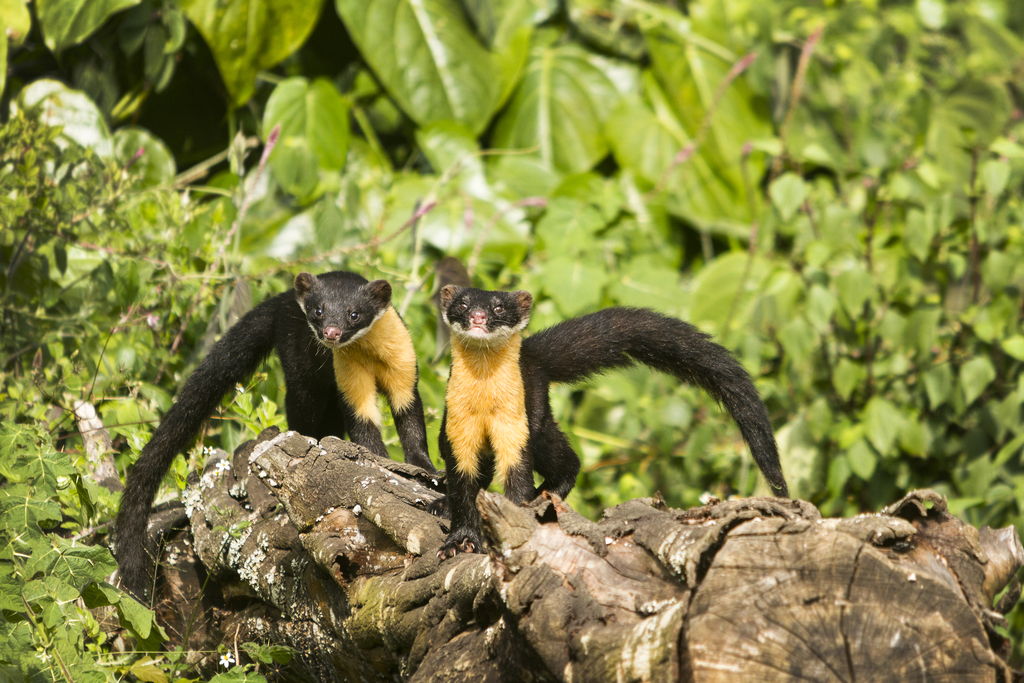
One of the most distinguishing features of the Nilgiri marten is its sleek, elongated body, which sets it apart from other carnivorous mammals in the region. Its agile build and sharp, pointed facial features make it well-suited for navigating the dense vegetation of its forested habitat. The vibrant throat patch serves as a striking visual identifier, adding to the allure of this enigmatic species.

Distribution

The Nilgiri marten is endemic to the Western Ghats mountain range of southern India, with its range extending from the Travancore Kerala and Nilgiris to Kodagu and the Charmadi Ghats in Karnataka. This limited distribution underscores the species’ vulnerability and the importance of safeguarding its habitat to ensure its long-term survival. The population density of the Nilgiri marten reflects the challenges it faces, with approximately a thousand individuals remaining in the wild.

Habitat Preferences

The Nilgiri marten primarily inhabits the shola grasslands and high-altitude evergreen forests of the Western Ghats, utilizing the diverse vegetation and topography to fulfill its ecological niche. These ecosystems provide the necessary resources for the marten’s survival, including suitable denning sites, prey availability, and protective cover. The unique habitat preferences of the Nilgiri marten underscore its status as an indicator species for the conservation of the Western Ghats biodiversity.

As a conservation scientist and advocate for wildlife preservation, it is imperative to recognize the ecological significance of the Nilgiri marten and work towards ensuring the sustainability of its natural habitat. By understanding and promoting the conservation of this captivating species, we contribute to the broader goal of safeguarding the biodiversity and ecological integrity of the Western Ghats.

Facts About Nilgiri Marten

  • The Nilgiri marten (Martes gwatkinsii) is the only marten species native to southern India.
  • It is a rare and insufficiently studied mustelid found in the Western Ghats, with a population of just 1000 individuals.
  • Nilgiri martens are endemic to the Western Ghats mountain range of southern India.
  • They prefer habitats such as evergreen forests, montane forests, grassland mosaics, acacia, and coffee plantations.
  • The unique creature finds its habitat nestled amidst the verdant hills of the Nilgiris and certain regions of the Western Ghats.
  • Around 62 percent of the habitat of the Nilgiri marten is under threat from development, posing a risk to their survival.
  • They have been detected more in higher altitudes, with 45% of encounters sighted at these elevations.
  • Nilgiri martens are small carnivorous mammals with dark brown fur and a bushy tail.
  • They are known for their elusive nature, making them challenging to study and understand fully.
  • The conservation of Nilgiri martens is crucial to preserving the biodiversity of the Western Ghats.


Scientific Provenance & Verified Sources

Biological taxonomy, conservation status, and physical traits are cross-referenced with authoritative global registers:


Peer-reviewed by Wildlife Science Editors โ€ข Updated for 2026

Explore Other Species Profiles