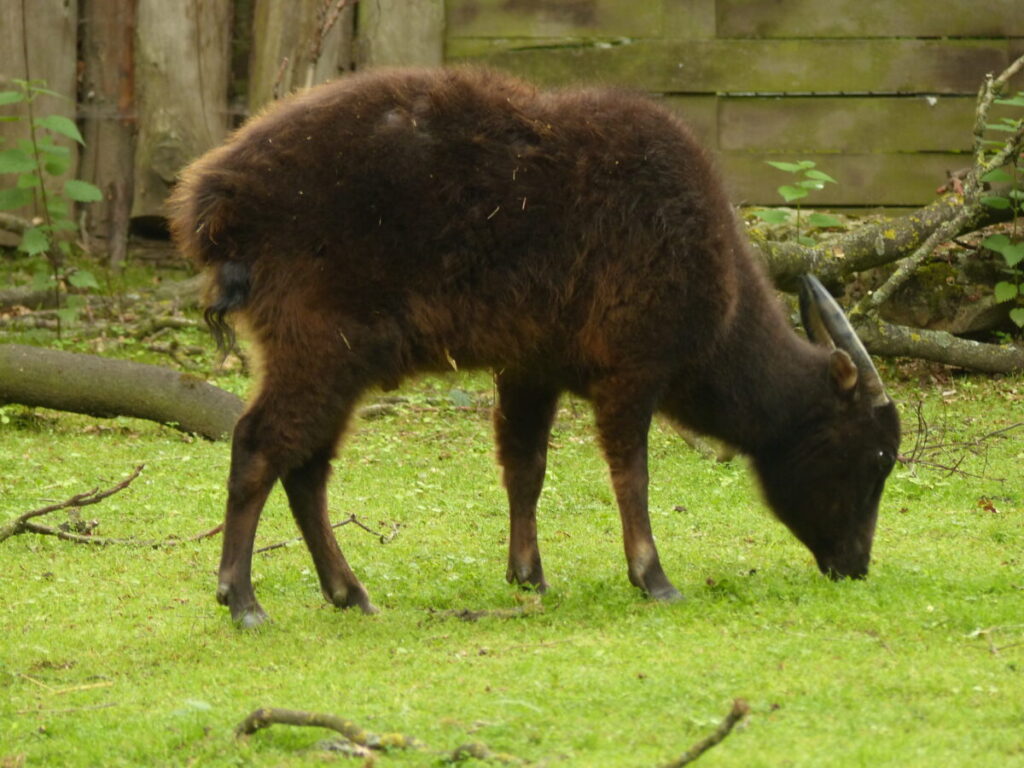
Mountain Anoa

IUCN Red List Conservation Status


Endangered

LC
NT
VU
EN
CR
EW
EX

Official assessment evaluated in accordance with the IUCN Red List of Threatened Species criteria: Endangered.


Species Quick Facts

Scientific Name
Bubalus quarlesi

Average Lifespan
15-20 years in wild, 20-25 years in captivity

Average Weight
150-300 kg (330-660 lbs) – Males: 250 kg, Females: 200 kg

Average Length
120-150 cm (47-59 inches) – head-body length excluding tail

Overview & Identification

The Mountain Anoa (Bubalus quarlesi) is a small, forest-dwelling bovid endemic to the central highlands of Sulawesi, Indonesia. Belonging to the family Bovidae and subfamily Bovinae, it is one of two recognized anoa species, the other being the Lowland Anoa. Mountain Anoa inhabit montane and subโ€‘montane forests between 1,500 and 2,600 meters elevation, preferring dense understory with abundant water sources. They possess a compact body, short, backwardโ€‘curving horns, and a shaggy, dark brown to black coat that provides camouflage in the dim forest light. Their hooves are adapted for soft, uneven terrain, and they display a distinctive, lowโ€‘frequency bellow used for communication. The species is listed as Endangered on the IUCN Red List due to a combination of habitat fragmentation, hunting pressure, and a limited distribution that makes populations highly vulnerable to stochastic events.

Behavior & Social Structure

Mountain Anoa are primarily crepuscular, becoming most active at dawn and dusk when they forage and move between feeding sites. They are generally solitary or found in small family groups of up to three individuals, with adult females often accompanied by their dependent calves. Males are more solitary, establishing overlapping territories that they mark with scent glands and occasional horn rubbing on trees. Communication includes low-frequency vocalizations, body postures, and scent marking, which help maintain spacing and reduce direct conflict. Their home ranges are relatively small, typically 1โ€“3 kmยฒ, reflecting the high resource density of montane forests. When threatened, they rely on dense vegetation for concealment rather than flight, and they can exhibit aggressive horn displays if cornered.

Diet & Hunting Patterns

Mountain Anoa are strict herbivores that browse on a wide variety of forest vegetation. Their diet includes young leaves, shoots, fruits, bark, and occasional grasses found in clearings. Seasonal variation influences food choice; during the wet season they consume abundant fruit and tender foliage, while in the dry season they rely more on bark and mature leaves. Anoa have a relatively low daily intake, consuming about 2โ€“3% of their body weight (5โ€“9 kg) in fresh matter. They use their prehensile lips to selectively graze and often feed near water sources where nutrientโ€‘rich plants grow. Their feeding strategy minimizes competition with larger ungulates, as they can exploit dense understory that is inaccessible to bigger herbivores.

Reproduction & Life Cycle

Mountain Anoa reach sexual maturity at about 2.5โ€“3 years for females and 3โ€“4 years for males. Breeding occurs yearโ€‘round but peaks during the rainy season when food is abundant. After a gestation period of 285โ€“295 days, females give birth to a single calf, which weighs approximately 15โ€“20 kg at birth. Twins are extremely rare. Calves are hidden in dense vegetation for the first 2โ€“3 weeks, nursing frequently and gaining weight rapidly. Maternal care lasts up to 12 months, after which the juvenile becomes independent but may remain within the mother’s range for several years. Reproductive rates are low, with females typically producing one offspring every 2โ€“3 years, contributing to the species’ vulnerability.

Threats & Conservation

The Mountain Anoa is classified as Endangered by the IUCN, with an estimated total population of 1,500โ€“2,500 mature individuals. Primary threats include habitat loss due to logging, agricultural expansion, and mining activities that fragment the montane forest. Illegal hunting for meat and traditional use of horns further reduces numbers, especially in remote villages. Small, isolated populations are susceptible to inbreeding depression and disease outbreaks, such as bovine tuberculosis, which can spread from domestic cattle. Climate change poses an additional risk by altering the distribution of suitable highโ€‘elevation habitats. Conservation actions involve protectedโ€‘area management, antiโ€‘poaching patrols, community education, and potential captiveโ€‘breeding programs to bolster genetic diversity.

Interesting Facts

โ€ข The Mountain Anoa is one of the world’s smallest bovids, standing only about 70 cm at the shoulder.
โ€ข Its horns curve backward and can grow up to 30 cm, a unique feature among Asian bovids.
โ€ข Unlike many large ungulates, Anoa can navigate steep, rocky slopes with ease due to their compact build.
โ€ข The species was only formally described in 1983, highlighting how little is known about Sulawesi’s endemic mammals.
โ€ข Mountain Anoa have a low reproductive rate, producing a single calf every 2โ€“3 years, which makes population recovery slow.

Description

Mountain Anoa

The mountain anoa, scientifically known as Bubalus quarlesi, is a remarkable species belonging to the subgenus Bubalus and is endemic to the island of Sulawesi in Indonesia. This intriguing mammal, colloquially referred to as the dwarf buffalo and sapiutan, possesses a unique combination of characteristics that distinguish it from other species within the Bubalus genus.

Appearance

Mountain Anoa Appearance

The mountain anoa is characterized by its compact size, with adults typically standing at around 75-80 cm at the shoulder. Both males and females display impressive, ridged horns, with those of the males being thicker and more prominent. Their dark brown to black fur, combined with a stocky build, sets them apart from their lowland anoa counterparts, making them a distinctive and captivating species within the Bovidae family.

Distribution

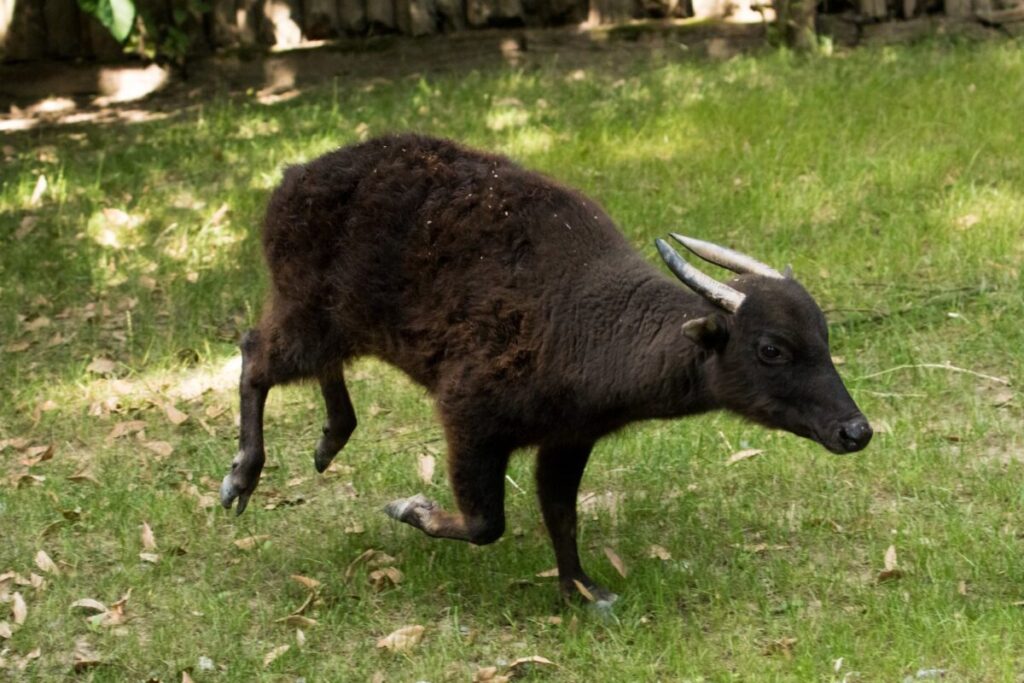
Mountain anoas are primarily found in the undisturbed rainforests of Sulawesi, Indonesia. They exhibit a preference for habitats with dense understory vegetation and are often located near permanent water sources. Their distribution is limited to specific regions within Sulawesi, and their population density is notably affected by human activity and habitat encroachment.

Habitat Preferences
Mountain Anoa Habitat

These fascinating creatures thrive in montane forest environments, where the dense vegetation and proximity to water sources provide them with the ideal conditions for survival. Their preference for undisturbed habitats underscores the importance of conservation efforts aimed at preserving these critical ecosystems, which are integral to the well-being of the mountain anoa population.

As a renowned conservation scientist, I am deeply committed to raising awareness about the conservation needs of the mountain anoa and advocating for the protection of its natural habitat. By shedding light on the unique characteristics, distribution, and habitat preferences of this species, I hope to inspire a collective effort to safeguard the future of the mountain anoa and contribute to the preservation of biodiversity on Sulawesi.

Facts About Mountain Anoa

  • The Mountain Anoa (Bubalus quarlesi) is the smallest of the wild cattle, with a height of about 70 cm at the shoulder.
  • They are native to Asia and are primarily found in undisturbed montane forests.
  • Mountain Anoas have a woolly coat that is dark brown or black in color.
  • These miniature water buffalo weigh between 150 and 300 kg.
  • The population size of the Mountain Anoa is estimated to be below 2,500.
  • They are listed as endangered by the IUCN and in CITES Appendix I.
  • The life span of a Mountain Anoa ranges from 20 to 30 years.
  • They have a round and barrel-shaped body, with slender legs.
  • Mountain Anoas are similar in appearance to deer, despite being a species of wild cattle.
  • Their habitat consists of undisturbed rainforests, where they thrive.


Scientific Provenance & Verified Sources

Biological taxonomy, conservation status, and physical traits are cross-referenced with authoritative global registers:


Peer-reviewed by Wildlife Science Editors โ€ข Updated for 2026

Explore Other Species Profiles