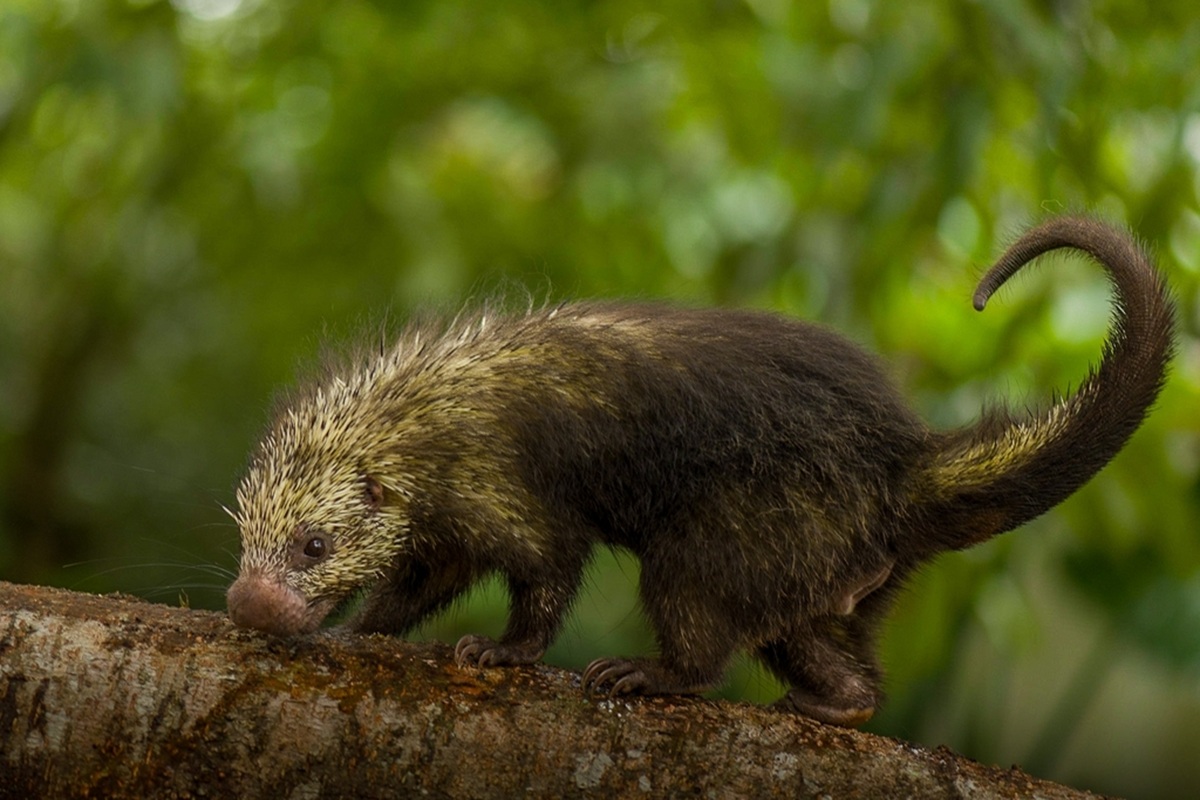
Mexican hairy dwarf porcupine

IUCN Red List Conservation Status


Least Concern

LC
NT
VU
EN
CR
EW
EX

Official assessment evaluated in accordance with the IUCN Red List of Threatened Species criteria: Least Concern.


Species Quick Facts

Scientific Name
Coendou mexicanus

Average Lifespan
7-9 years in wild

Average Weight
1.5-2.5 kg (3.3-5.5 lbs), up to 2.6 kg (5.7 lbs) maximum

Average Length
Head-body 320-457 mm (12.6-18 in), tail 200-358 mm (8-14 in)

Overview & Identification

The Mexican hairy dwarf porcupine is a tree-dwelling rodent ranging from Mexico through Central America to western Panama. It has a coat of sharp spines partly hidden by long guard hairs and a strong prehensile tail used to grip branches as it climbs. Nocturnal and slow-moving, it feeds on fruit, seeds, leaves, and bark in the forest canopy.

Behavior & Social Structure

The Mexican hairy dwarf porcupine (Coendou mexicanus) is a strictly nocturnal and highly arboreal rodent, spending the daylight hours curled up in tree hollows, dense vine tangles, or thick canopy foliage, and emerging after dusk to forage. Its activity is closely tied to the structure of the forest canopy, and individuals use a slow, deliberate climbing gait combined with a prehensile tail to move confidently through branches, rarely descending to the forest floor except to cross gaps between trees. This arboreal lifestyle reduces exposure to terrestrial predators and allows the species to exploit a specialized dietary niche unavailable to ground-dwelling herbivores.

Socially, this porcupine is solitary for most of the year, with adults maintaining individual home ranges that overlap only during the breeding season or briefly when females travel with dependent young. Communication is limited but includes low-frequency grunts, whines, and squeaking vocalizations, along with scent marking via urine and glandular secretions to signal reproductive status and delineate space to conspecifics. Tactile communication is most evident between mothers and offspring, who maintain close contact while riding on the mother’s back or clinging nearby during early development.

Home ranges are relatively small, generally restricted to a few hectares of contiguous forest, and are not aggressively defended as true territories but rather used flexibly depending on resource availability. When threatened, the species relies on its dense coat of sharp, barbed quills—interspersed with softer underfur—as a passive defense, along with defensive postures that present the quilled back and tail to a potential predator rather than active aggression.

Diet & Hunting Patterns

As an obligate herbivore, Coendou mexicanus forages primarily at night in the mid- to upper canopy, consuming a varied diet of leaves, unripe and ripe fruits, flowers, buds, bark, and occasionally seeds. It shows a preference for figs (Ficus spp.), as well as various legumes and other fruiting canopy trees common in tropical and subtropical moist forests from Mexico through Panama. Foraging is slow and methodical, with the porcupine using its strong claws and prehensile tail to anchor itself while manipulating vegetation with its forepaws and gnawing with robust, continuously growing incisors.

Metabolically, the species is well adapted to a low-energy, fiber-rich diet, exhibiting a reduced metabolic rate typical of folivorous and frugivorous arboreal mammals, which helps conserve energy given the relatively low caloric yield of leaves and bark compared to animal prey. Dietary composition shifts seasonally in response to fruiting cycles, with greater reliance on foliage and bark during dry periods when fruit availability declines. The species obtains most of its water requirements from the moisture content of its food, reducing the need to descend to ground-level water sources and further reinforcing its canopy-restricted lifestyle.

Reproduction & Life Cycle

Breeding in the Mexican hairy dwarf porcupine is not sharply seasonal across its range, though reproductive activity appears to peak during the wetter months when food resources are more abundant. The species is generally considered promiscuous to polygynous, with males seeking out receptive females over relatively short encounters rather than forming lasting pair bonds. Gestation is comparatively long for a rodent of its size, lasting approximately 195–210 days, reflecting the precocial nature of newborn New World porcupines.

Females typically give birth to a single offspring (occasionally twins), which is born well-developed, with open eyes, a full coat including soft quills that harden within days, and the ability to climb almost immediately. Maternal care is intensive but relatively brief, with weaning occurring at around 10–14 weeks of age, though the juvenile may remain associated with the mother’s home range for several additional months. Sexual maturity is reached at approximately 1.5 to 2 years of age, consistent with the slow life-history strategy typical of erethizontid porcupines.

Threats & Conservation

The primary threat facing Coendou mexicanus is habitat loss and fragmentation driven by deforestation for agriculture, cattle ranching, and expanding human settlements throughout its range in Mexico, Central America, and into Panama. As a forest-canopy specialist, this species is particularly vulnerable to the loss of continuous forest cover, which restricts its ability to move between suitable habitat patches and can isolate populations, reducing genetic exchange. Illegal logging and land conversion in biodiversity hotspots such as the Lacandon Jungle and parts of Central America’s remaining tropical forests continue to erode available habitat, even though the species is not currently classified as threatened.

Natural predators include large owls, arboreal snakes, felids such as ocelots and margays, and occasionally raptors capable of taking juveniles, though its quills provide substantial defense against most predation attempts. Human-wildlife conflict is minimal, as the species poses no threat to crops or livestock, though localized hunting for bushmeat or perceived pest control occurs in some rural communities. The IUCN currently lists the species as Least Concern due to its wide distribution and presumed large population, but conservation groups emphasize the importance of maintaining forest connectivity through protected areas and community-based conservation initiatives across its Mesoamerican range to prevent future declines.

Interesting Facts

  • Prehensile Tail Anchor: Unlike Old World porcupines, Coendou mexicanus possesses a prehensile tail that acts as a fifth limb, allowing it to grip branches securely while foraging high in the canopy.
  • Soft-Landing Quills: Newborns are born with soft, flexible quills that harden within just a few days after birth, protecting the mother during delivery while still allowing the infant to develop defensive armor quickly.
  • Nocturnal Canopy Specialist: This species spends nearly its entire life above the forest floor, rarely if ever descending to the ground, making it one of the most strictly arboreal rodents in the Americas.
  • Quiet Quill Defense: Unlike popular myth, porcupines cannot shoot their quills; instead, the barbed quills detach easily upon contact and embed in a predator’s skin as a passive deterrent.
  • Slow Reproductive Strategy: With a gestation period exceeding six months for a single offspring, this species exhibits one of the slowest reproductive rates among rodents, prioritizing offspring quality over quantity.
  • Fig Tree Affinity: The species plays a role in seed dispersal for various canopy fruit trees, particularly figs, making it an important, if under-recognized, agent of forest regeneration.
  • Taxonomic Reassignment: Formerly classified under the genus Sphiggurus, molecular studies led taxonomists to reclassify this species into Coendou, reflecting its closer evolutionary relationship to other prehensile-tailed porcupines.

Description

Mexican hairy dwarf porcupine

The Mexican hairy dwarf porcupine, scientifically known as Coendou mexicanus, is a fascinating species of rodent belonging to the family Erethizontidae. These small, slow-moving creatures are primarily frugivorous and folivorous, and are often observed foraging in the forest canopy. Mexican hairy dwarf porcupines are relatively docile and possess a distinctive appearance characterized by their dense, shaggy fur and sharp, barbed quills.

Appearance

Mexican hairy dwarf porcupine Appearance

The Mexican hairy dwarf porcupine is easily distinguishable by its unique physical traits. It boasts a coat of thick, coarse fur that ranges from black to light brown, complemented by striking yellow quills that provide effective protection against potential predators. These quills, which cover the animal’s body except for its face, underbelly, and the soles of its feet, serve as a formidable defense mechanism.

Distribution

This species is found in various countries in Central America, including Costa Rica, El Salvador, Guatemala, Honduras, Panama, Mexico, Nicaragua, and Belize. The Mexican hairy dwarf porcupine inhabits a range of diverse habitats within these regions, showcasing its adaptability and resilience in different ecosystems.

Habitat Preferences

Mexican hairy dwarf porcupine Habitat

Mexican hairy dwarf porcupines favor high elevation forests, where they thrive amidst the lush vegetation and diverse flora. These arboreal creatures are well-suited to forested environments, utilizing their adept climbing skills to navigate the canopy in search of fruits, leaves, and other plant matter that form the core of their diet. The presence of suitable trees and ample vegetation is crucial for supporting their survival and overall well-being.

By shedding light on the unique characteristics, appearance, distribution, and habitat preferences of the Mexican hairy dwarf porcupine, we can deepen our understanding of this remarkable species and further our efforts in wildlife conservation and education.

Facts About Mexican hairy dwarf porcupine

  • The Mexican hairy dwarf porcupine (Coendou mexicanus) is a relatively docile and slow animal, often seen foraging in the forest canopy (source: Animal Diversity Web).
  • It is frugivorous and folivorous, meaning it primarily consumes fruits and leaves (source: Animal Diversity Web).
  • The Mexican hairy dwarf porcupine is also known as the Mexican tree porcupine (source: iNaturalist).
  • This species is found in Costa Rica (source: iNaturalist).
  • The Mexican hairy dwarf porcupine can weigh up to 2.5 kg as an adult and has fur that ranges from black to light brown, with yellow quills (source: Alturas Wildlife Sanctuary).
  • It is listed as threatened in the Mexican regulations (source: ResearchGate).
  • The Mexican hairy dwarf porcupine belongs to the family Erethizontidae (source: iNaturalist).
  • This species has a relatively long lifespan (source: Animalia Bio).
  • It has a wide distribution and habitat range (source: Animalia Bio).
  • The Mexican hairy dwarf porcupine is listed in CITES Appendix III (source: Encyclopedia of Life).


Scientific Provenance & Verified Sources

Biological taxonomy, conservation status, and physical traits are cross-referenced with authoritative global registers:


Peer-reviewed by Wildlife Science Editors • Updated for 2026

Explore Other Species Profiles