Maned Rat

IUCN Red List Conservation Status


Least Concern

LC
NT
VU
EN
CR
EW
EX

Official assessment evaluated in accordance with the IUCN Red List of Threatened Species criteria: Least Concern.


Species Quick Facts

Scientific Name
Lophiomys imhausi

Average Lifespan
5-7 years in wild, 8-10 years in captivity

Average Weight
1.5-2.5 kg (3.3-5.5 lbs) – Males: 2.2 kg, Females: 1.8 kg

Average Length
30-45 cm (12-18 inches) – head-body length excluding tail

Overview & Identification

The maned rat (Lophiomys imhausi), commonly called the African crested rat, belongs to the family Nesomyidae, subfamily Dendromurinae. It inhabits the moist montane forests, forestโ€‘savanna mosaics, and rocky outcrops of the Albertine Rift, spanning eastern Democratic Republic of Congo, western Uganda, Rwanda, and northโ€‘western Tanzania. Adults are among the largest African rodents, reaching up to 2.5โ€ฏkg and a headโ€‘body length of 45โ€ฏcm. Their most striking feature is a dense crest of stiff, keratinized hairs that can be erected when threatened, exposing a bright orangeโ€‘red mantle that contains toxic secretions derived from the plant Acokanthera. The rat actively applies these secretions to its fur, creating a chemical defence that deters predators. The species is listed as Least Concern by the IUCN, but its fragmented distribution and dependence on specific forest habitats make it vulnerable to ongoing deforestation and agricultural expansion.

Behavior & Social Structure

Maned rats are primarily nocturnal and solitary, establishing individual home ranges that may overlap marginally with those of neighboring conspecifics. Homeโ€‘range sizes average 0.5โ€“1.2โ€ฏkmยฒ, with individuals defending core areas through scent marking and vocalizations. They are adept climbers, using their strong forelimbs to navigate tree trunks and rocky crevices. Communication relies on a repertoire of lowโ€‘frequency grunts, hisses, and tailโ€‘slaps against the substrate, especially during territorial disputes or when a predator is detected. Though generally solitary, motherโ€‘offspring bonds persist for up to three months after weaning, during which juveniles learn foraging techniques and the application of toxic secretions to their fur.

Diet & Hunting Patterns

The maned rat is an opportunistic omnivore with a strong insectivorous component. Its diet comprises up to 60โ€ฏ% insects (beetles, termites, orthopterans), 25โ€ฏ% fruits and seeds (figs, berries, palm nuts), and 15โ€ฏ% tubers, roots, and occasional small vertebrates such as lizards. Foraging occurs on the forest floor and in low vegetation, where individuals use their sensitive whiskers and keen sense of smell to locate prey. They practice cacheโ€‘building, burying excess tubers for later consumption during dry periods. Seasonal shifts are pronounced: during the wet season, fruit intake rises, while in the dry season the reliance on insects and underground storage organs increases. The species also ingests the toxic bark of Acokanthera spp., which is later sequestered in specialized skin glands for defensive use.

Reproduction & Life Cycle

Sexual maturity is reached at 10โ€“12โ€ฏmonths for both sexes. Breeding occurs yearโ€‘round but peaks during the rainy season (Aprilโ€“June), when food resources are abundant. After a gestation period of approximately 100โ€ฏdays, females give birth to litters of 1โ€“3 wellโ€‘developed pups. Neonates are altricial, blind and hairless, and rely entirely on maternal milk for the first 4โ€“5โ€ฏweeks. The mother constructs a shallow nest of dry leaves and moss within a rock crevice or dense shrub. Pups are weaned at about 45โ€ฏdays and begin to explore the environment under maternal supervision. Juveniles acquire the ability to harvest and apply plant toxins to their fur by 8โ€ฏweeks, a critical skill for adult defence. Sexual receptivity resumes in females after a 3โ€‘month lactational amenorrhea.

Threats & Conservation

The IUCN classifies the maned rat as Least Concern, yet the species faces several escalating threats. Habitat loss due to logging, mining, and conversion of forest to agriculture has reduced suitable range by an estimated 15โ€ฏ% over the past two decades. Fragmentation isolates populations, limiting gene flow and increasing vulnerability to stochastic events. Although not a primary target of hunting, incidental capture in snares set for larger mammals occurs in some regions. Climate change may alter the phenology of key food plants, potentially disrupting the seasonal availability of insects and fruits. Current population estimates suggest a total of 30,000โ€“45,000 mature individuals, with a declining trend. Conservation actions include protecting remaining montane forest blocks, promoting communityโ€‘based forest management, and monitoring population dynamics through cameraโ€‘trap surveys.

Interesting Facts

โ€ข The maned rat is the only known mammal that deliberately applies plantโ€‘derived toxins to its fur for defence.
โ€ข Its crest of stiff hairs can be erected like a porcupine’s quills, exposing the toxic mantle.
โ€ข It obtains the toxin primarily from the bark of the poisonous shrub Acokanthera schimperi.
โ€ข Despite its size, the species can squeeze through gaps as narrow as 5โ€ฏcm, aiding escape from predators.
โ€ข Juvenile maned rats learn the toxinโ€‘application technique by observing their mothers, a rare example of cultural transmission in rodents.

Description

Maned Rat

The Maned rat, scientifically known as Lophiomys imhausi, is a remarkable African rodent distinguished by its long, coarse fur and a bushy tail, giving it a superficial resemblance to a porcupine. This unique species is the world’s only known poisonous rodent, utilizing a fascinating defense mechanism by borrowing toxins from plants to fend off predators.

Appearance
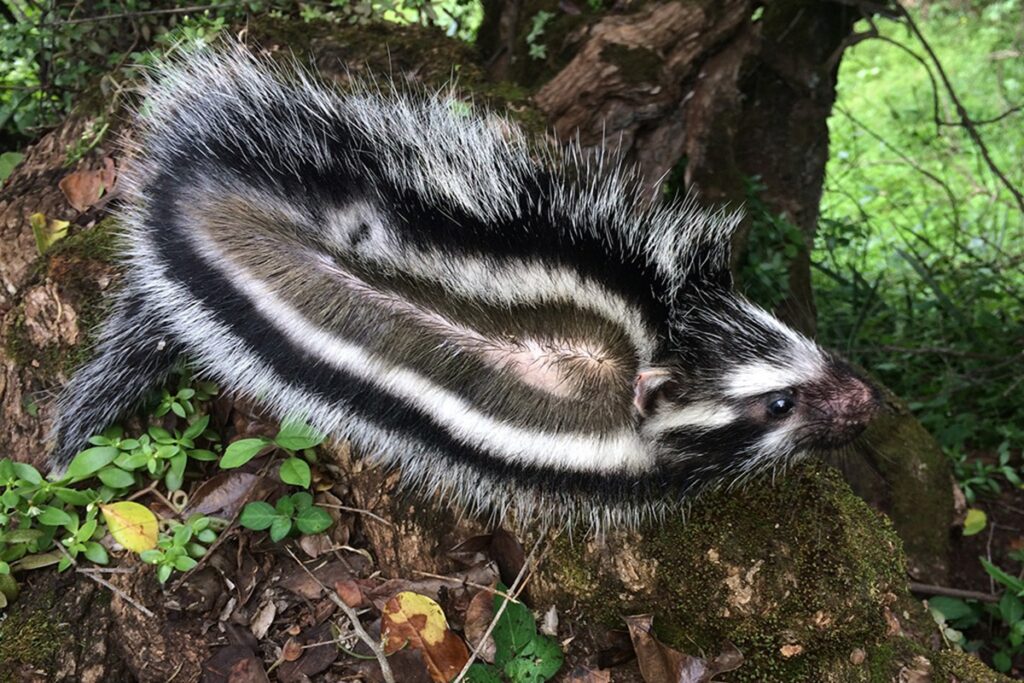
Maned Rat Appearance

The Maned rat is easily identifiable by its long, shaggy coat and distinctive bushy tail, setting it apart from other rodent species. Its appearance bears a striking resemblance to a porcupine, although it lacks the quills characteristic of the latter. The long, coarse fur and impressive tail make the Maned rat a visually captivating and enigmatic species.

Distribution

The Maned rat, Lophiomys imhausi, is predominantly found in eastern Africa, with its range encompassing countries such as Ethiopia, Somalia, Sudan, Tanzania, Uganda, and Kenya. It exhibits a preference for highland forests and woodlands, as well as semi-desert, dry and moist savannas. The distribution of the Maned rat is notable for its adaptation to diverse ecosystems within the region, contributing to its survival and population dynamics.

Habitat

Maned Rat Habitat

The Maned rat thrives in a variety of habitats, including highland forests, woodlands, and semi-desert savannas. These environments provide the necessary resources for the species’ survival, offering shelter, food sources, and suitable conditions for reproduction. The adaptability of the Maned rat to different habitats underscores its ecological resilience and significance within its native range.

This comprehensive species profile provides valuable insights into the unique characteristics, distribution, and habitat preferences of the Maned rat, emphasizing its ecological importance and the need for conservation efforts to ensure its continued existence in the wild.

Facts About Maned Rat

  • The maned rat, also known as the African crested rat, is a nocturnal, long-haired, and bushy-tailed East African rodent.
  • It is the only mammal known to sequester plant toxins, making it unique in its ability to use these toxins for defense.
  • The rodent superficially resembles a porcupine due to its long, mane-like fur.
  • Found in eastern Africa, this large rodent has a distinctive appearance and interesting behavioral traits.
  • The maned rat is endemic to East Africa and is particularly known for its unusual natural history.
  • It is a rabbit-sized rodent that has been the subject of significant research due to its unique characteristics.
  • The species is part of the Old World cricetid subfamily, Lophiomyinae, and consists of just one genus and one species.
  • The maned rat’s habitat includes the highlands of central East Africa, adding to its mystique and allure.
  • Researchers have discovered the secret social lives of these giant poisonous rats, shedding light on their behavior and interactions.
  • The maned rat’s nocturnal habits and adaptations contribute to its intriguing nature and make it a subject of fascination for wildlife enthusiasts and researchers alike.


Scientific Provenance & Verified Sources

Biological taxonomy, conservation status, and physical traits are cross-referenced with authoritative global registers:


Peer-reviewed by Wildlife Science Editors โ€ข Updated for 2026

Explore Other Species Profiles