

Description
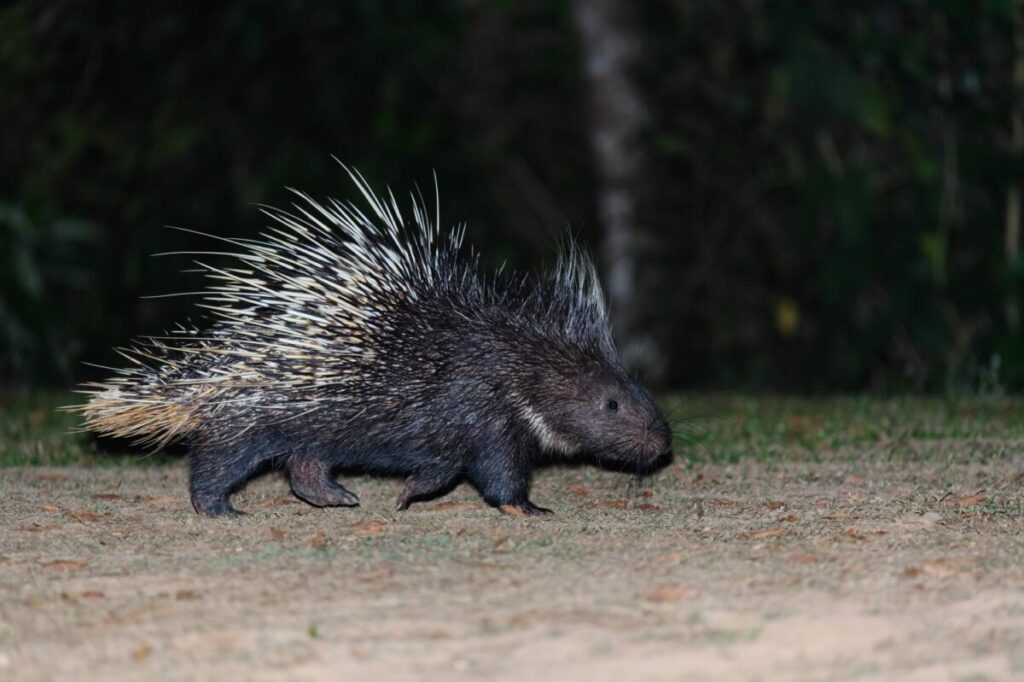
The Malayan porcupine, also known as the Himalayan porcupine, is a remarkable species of rodent belonging to the family Hystricidae. This nocturnal mammal is characterized by its stout body, short legs, and most notably, its coat of sharp, barbed quills that serve as a formidable defense mechanism. The quills, which cover the animal’s back and flanks, can be raised when the porcupine feels threatened, creating a formidable deterrent to potential predators. This species is known for its distinctive appearance and fascinating behavioral adaptations.
Appearance

The Malayan porcupine is larger in size compared to other porcupine species, with hard spines on the upper part of its neck, which distinguishes it from its counterparts. The animal’s quills are a defining feature, ranging in length from 10 to 20 inches, and are interspersed with softer, lighter-colored bristles. These quills are used for defense and are not easily shed, contrary to popular belief. The porcupine’s stout body is covered in dark brown or black fur, and its short legs are equipped with strong claws for digging and foraging.
Distribution
This species is found in various regions of South and Southeast Asia, with three extant subspecies identified within this range. The Malayan porcupine’s distribution spans countries such as India, Nepal, Bhutan, Bangladesh, Myanmar, Thailand, Laos, Cambodia, Vietnam, Malaysia, Indonesia, and the Philippines. It is known to inhabit a diverse range of habitats, from primary and secondary forests to cultivated areas, plantations, and open areas near forests. The adaptability of the Malayan porcupine to a variety of environments contributes to its widespread presence across the region.
Habitat Preferences

The Malayan porcupine exhibits a versatile nature in terms of habitat preferences. It thrives in various forest types, including primary and secondary forests, as well as in scrubby, open areas near forests. The species has also been observed in agricultural areas, although it requires suitable cover and shelter for its survival. The ability of the Malayan porcupine to inhabit diverse ecosystems reflects its adaptability and resourcefulness in securing suitable environments for foraging, shelter, and reproduction.
This comprehensive species profile offers valuable insights into the unique characteristics, distribution, and habitat preferences of the Malayan porcupine, shedding light on its significance within the ecosystems of South and Southeast Asia.
Facts About Malayan Porcupine
- The Malayan porcupine, also known as the Himalayan porcupine, is a species of rodent in the family Hystricidae.
- It is one of the largest species of porcupine, weighing up to 18 lbs and reaching lengths of up to 2.74 feet.
- This species has hard spines on the upper part of its neck, resembling a mane.
- Malayan porcupines have a relatively long lifespan, with individuals living up to 27 years in captivity.
- They are primarily nocturnal, being most active during the night.
- The gestation period for Malayan porcupines is approximately 112 days.
- Malayan porcupines are herbivores, feeding on a variety of plant materials including roots, bulbs, and fruits.
- They are found in a wide range of habitats including forests, scrublands, and agricultural areas across South and Southeast Asia.
- Malayan porcupines are known for their characteristic defense mechanism of raising and rattling their quills when threatened.
- This species plays an important role in its ecosystem by controlling vegetation through its herbivorous diet.


