Lowland Anoa

IUCN Red List Conservation Status


Endangered

LC
NT
VU
EN
CR
EW
EX

Official assessment evaluated in accordance with the IUCN Red List of Threatened Species criteria: Endangered.


Species Quick Facts

Scientific Name
Bubalus depressus

Average Lifespan
15-20 years in wild, 20-25 years in captivity

Average Weight
250-350 kg (550-770 lbs) – Males: 300 kg, Females: 250 kg

Average Length
120-150 cm (47-59 inches) – head-body length excluding tail

Overview & Identification

The lowland anoa (Bubalus depressus) is one of two dwarf buffalo species endemic to the island of Sulawesi, Indonesia. Belonging to the family Bovidae, subfamily Bovinae, it is the smallest member of the buffalo lineage, standing only 70โ€“100โ€ฏcm at the shoulder and weighing up to 350โ€ฏkg. Its compact body is covered by a coarse, dark brown to black coat that becomes lighter on the flanks, and both sexes possess short, backwardโ€‘curving horns that rarely exceed 30โ€ฏcm. Lowland anoa inhabit the islandโ€™s lowland tropical rainforests, peat swamps, and riverine floodplains below 1โ€ฏ500โ€ฏm, preferring dense understory where they can browse on foliage and avoid predators. The species is strictly nocturnal to crepuscular, moving silently through thick vegetation. Because of its limited distribution and specialized habitat, the lowland anoa is listed as Endangered on the IUCN Red List. Ongoing deforestation for timber, oilโ€‘palm plantations, and mining, combined with illegal hunting for meat and hide, have reduced its population to an estimated 2โ€ฏ500โ€“5โ€ฏ000 mature individuals. Conservation actions include protectedโ€‘area designation, communityโ€‘based antiโ€‘poaching patrols, and captiveโ€‘breeding programs aimed at bolstering wild numbers.

Behavior & Social Structure

Lowland anoa are generally solitary or form small, fluid groups of two to five individuals, usually consisting of a dominant male, one or more females, and their offspring. They are most active at dawn and dusk, using the cover of low light to feed and travel. Home ranges are modest, typically 2โ€“5โ€ฏkmยฒ for females and up to 10โ€ฏkmยฒ for males, and overlap only minimally with neighboring groups. Communication relies on a repertoire of low grunts, snorts, and a distinctive โ€œbarkโ€ produced when alarmed, as well as scent marking from preorbital glands. Territorial disputes are rare; instead, individuals maintain spacing through visual cues and occasional horn displays. When threatened, anoa retreat into dense thickets or wade into water, where their compact size and strong swimming ability provide refuge.

Diet & Hunting Patterns

The lowland anoa is a strict herbivore, browsing primarily on young leaves, shoots, fruits, and bark of understory trees such as figs (Ficus spp.), palms (Borassus spp.), and dipterocarps. In swampy areas they also graze on aquatic grasses and sedges. An individual consumes roughly 5โ€“7โ€ฏ% of its body weight daily, equivalent to 15โ€“25โ€ฏkg of vegetation. Feeding is performed both on the ground and while wading in shallow water, where the animal can reach submerged foliage. Seasonal fluctuations in fruit availability lead anoa to shift their diet toward more fibrous leaves during the dry season. They use their prehensile lips and sharp incisors to strip foliage, and their short horns are not used for feeding but for occasional digging of roots.

Reproduction & Life Cycle

Sexual maturity is reached at about 2.5โ€ฏyears for females and 3โ€ฏyears for males. Breeding occurs yearโ€‘round but peaks during the rainy season (Novemberโ€“April), when food is abundant. The gestation period lasts 285โ€“295โ€ฏdays, after which a single calf is born; twins are exceptionally rare. Newborns weigh 15โ€“20โ€ฏkg and are able to stand within an hour. The mother hides the calf in thick vegetation for the first few weeks, nursing it twice daily. Calves remain with their mothers for 12โ€“18โ€ฏmonths, gradually joining the adult group as they mature. Females reproduce every 2โ€“3โ€ฏyears, and the speciesโ€™ low reproductive rate contributes to its vulnerability.

Threats & Conservation

The IUCN classifies the lowland anoa as Endangered, with an estimated 2โ€ฏ500โ€“5โ€ฏ000 mature individuals remaining in the wild. The principal threats are habitat loss and fragmentation caused by illegal logging, conversion of forest to oilโ€‘palm and cocoa plantations, and expanding mining operations. Hunting for meat, hide, and traditional medicine adds direct mortality, especially in remote villages where enforcement is weak. Small, isolated populations suffer from inbreeding depression and reduced genetic diversity. Climate change threatens the peatโ€‘swamp habitats by increasing fire frequency. Conservation measures include expanding protectedโ€‘area networks on Sulawesi, strengthening antiโ€‘poaching patrols, and supporting communityโ€‘based sustainable livelihood programs. Captiveโ€‘breeding programs in Indonesian zoos aim to maintain a genetic reservoir for potential reโ€‘introduction.

Interesting Facts

โ€ข The lowland anoa is the smallest living buffalo, standing only about 1โ€ฏmeter tall at the shoulder.
โ€ข Its horns curve backward and are usually no longer than 30โ€ฏcm, unlike the long, upwardโ€‘curving horns of larger buffalo.
โ€ข Anoa can swim well and often cross rivers to reach new feeding grounds.
โ€ข Despite being a bovine, the lowland anoa has a preorbital gland that it uses for scent marking.
โ€ข It is one of only two dwarf buffalo species in the world, the other being the mountain anoa (Bubalus quarlesi).

Description

Lowland Anoa

The Lowland Anoa, also known as the dwarf buffalo and sapiutan, is a captivating species belonging to the subgenus Bubalus. It is one of two species endemic to the island of Sulawesi in Indonesia, with the other being the mountain anoa (Bubalus quarlesi). The Lowland Anoa is renowned for its unique characteristics and vital role in the ecosystem of its native habitat.

Appearance
Lowland Anoa Appearance

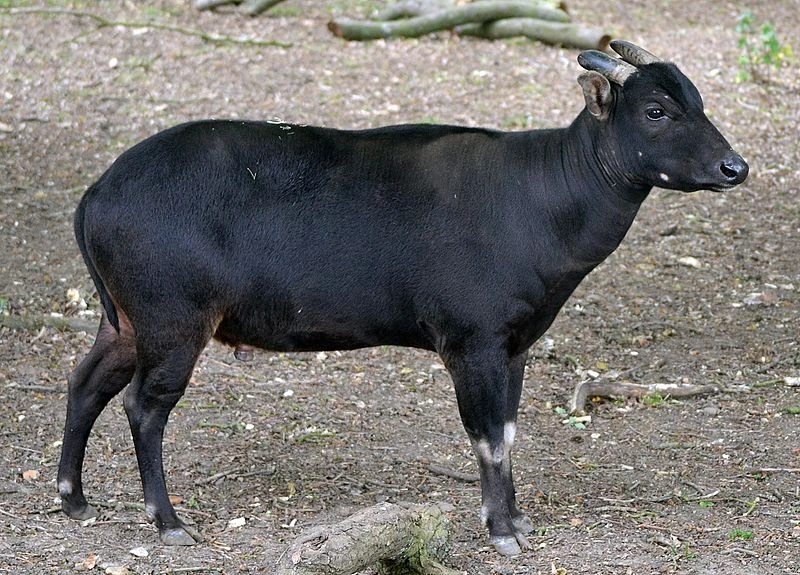
The Lowland Anoa is distinguished by its diminutive stature, making it one of the smallest wild cattle species in the world. It exhibits a robust build with short, sturdy legs and a deep chest. The species is adorned with a dark brown to black coat, often featuring lighter patches on the face and legs. The impressive, backward-curving horns of the male Lowland Anoa are a notable feature, adding to its distinctive appearance.

Distribution

The Lowland Anoa is exclusively found on the island of Sulawesi, primarily inhabiting the lowland forests and swamps of this region. Its distribution is limited to specific areas within Indonesia, making it a species of significant conservation concern. The population density of the Lowland Anoa is notable for its localized nature, with efforts focused on preserving its presence in its natural habitat.

Habitat Preferences

Lowland Anoa Habitat

Lowland Anoa thrives in the lush lowland forests and swamps of Sulawesi, relying on these unique ecosystems for sustenance and shelter. The species demonstrates a remarkable adaptation to its habitat, utilizing dense vegetation for cover and navigating the challenging terrain with agility. These environments provide essential resources for the survival and well-being of the Lowland Anoa, highlighting the critical importance of preserving its natural habitat.

This comprehensive species profile offers a glimpse into the captivating world of the Lowland Anoa, emphasizing the need for conservation efforts to safeguard its future and the biodiversity of Sulawesi.

Facts About Lowland Anoa

  • The lowland anoa (Bubalus depressicornis) is a small bovid, standing barely over 90 cm (35 in) at the shoulder.
  • Both live in undisturbed rainforest, and are essentially miniature water buffalo.
  • The population of lowland anoas is estimated to be less than 5000 mature individuals.
  • Lowland anoas are not known to have a specific breeding season.
  • They are similar in appearance to a deer, weighing 150โ€“300 kg (330โ€“660 lb).
  • The female lowland anoas become sexually mature at approximately 2 years of age.
  • The life span of lowland anoas is 20-30 years.
  • They are listed as endangered by the IUCN.
  • The lowland anoa is usually solitary, living in lowland forests.
  • The rate of decline of the lowland anoa population is believed to be greater than 20% over two generations.


Scientific Provenance & Verified Sources

Biological taxonomy, conservation status, and physical traits are cross-referenced with authoritative global registers:


Peer-reviewed by Wildlife Science Editors โ€ข Updated for 2026

Explore Other Species Profiles