

Description of Linnaeus’s Two-Toed Sloth

The Linnaeus’s Two-Toed Sloth, scientifically known as Choloepus didactylus, is a remarkable mammal renowned for its slow and deliberate movements. This species is characterized by its unique adaptations to arboreal life, including a slow metabolism and specialized limb structure that allows it to hang upside down from tree branches for extended periods.
Appearance

Linnaeus’s Two-Toed Sloth is easily distinguishable by its shaggy, coarse fur, which varies in color from light to dark brown. Its name is derived from the two toes on its front limbs, which set it apart from the three-toed sloth species. This sloth’s face is marked by a distinct mask-like pattern around the eyes, adding to its distinctive appearance.
Distribution
The Linnaeus’s Two-Toed Sloth is native to South America, with a range that includes Venezuela, the Guyanas, Colombia, Ecuador, Peru, and Brazil north of the Amazon River. This species inhabits the lush canopies of tropical and subtropical forests within these regions. Although widespread, it is essential to monitor its population density and distribution due to habitat loss and other environmental threats.
Habitat Preferences
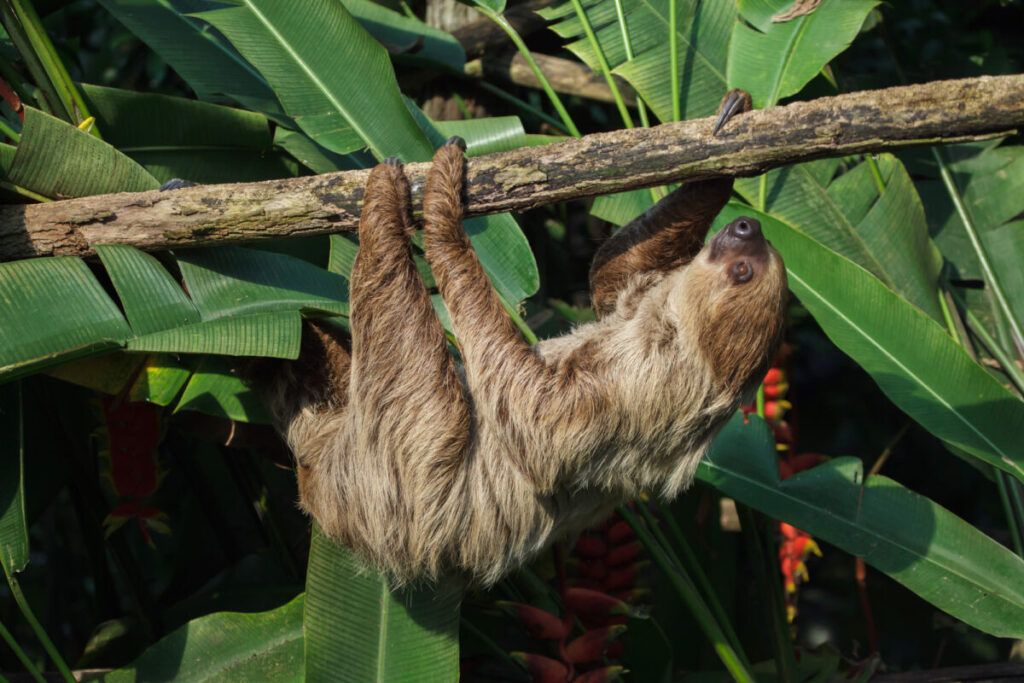
Linnaeus’s Two-Toed Sloth thrives in a variety of forested ecosystems, including lowland rainforests and montane cloud forests. It is primarily arboreal, spending the majority of its life in the canopy, where it feeds on leaves, shoots, and fruits. The sloth’s specialized diet and slow metabolism are well-suited to the nutrient-poor foliage found in its habitat.
This species profile offers a comprehensive overview of the Linnaeus’s Two-Toed Sloth, highlighting its unique characteristics, distribution, and habitat preferences. It serves as a valuable resource for those interested in wildlife conservation and education.
Facts About Linnaeus’s Two-Toed Sloth
- Linnaeus’s Two-Toed Sloth (Choloepus didactylus) is roughly 21 to 29 inches in length.
- They weigh between 9 to 17 pounds.
- The species is native to the Neotropics.
- Linnaeus’s Two-Toed Sloths have been called the slowest animals on earth.
- They belong to the family Megalonychidae.
- The genus name “Choloepus” is derived from the Greek for “injured-footed” due to their slow movement.
- Linnaeus’s Two-Toed Sloths have a body length of 58 to 70 centimeters.
- They have a strong-ly curved claw on each ungual phalange.
- There are two living species of two-fingered sloths, including Hoffmann’s two-toed sloth (Choloepus hoffmanni).
- The IUCN Red List status of Choloepus didactylus is “Least Concern.”


