Lichtenstein’s Hartebeest

IUCN Red List Conservation Status


Least Concern

LC
NT
VU
EN
CR
EW
EX

Official assessment evaluated in accordance with the IUCN Red List of Threatened Species criteria: Least Concern.


Species Quick Facts

Scientific Name
Alcelaphus lichtensteinii

Average Lifespan
10-15 years in wild, 18-20 years in captivity

Average Weight
250-300 kg (550-660 lbs) – Males: 280 kg, Females: 210 kg

Average Length
210-250 cm (83-98 inches) – head-body length excluding tail

Overview & Identification

Lichtenstein’s hartebeest (Alcelaphus lichtensteinii) is a large African antelope belonging to the family Bovidae, subfamily Alcelaphinae. It inhabits the open savannas, grasslands, and lightly wooded areas of East Africa, with a distribution that includes Ethiopia, Kenya, Tanzania, Sudan, and Uganda. The species is distinguished by a sleek, reddish‑brown coat, a striking white facial stripe, and long, slightly curved horns that rise from the top of the head and sweep outward. Males are larger and possess a more robust horn structure than females. Lichtenstein’s hartebeest prefers well‑drained, short‑grass plains where it can rely on its exceptional speed and keen eyesight to evade predators. Although the IUCN classifies it as Least Concern, localized populations have declined due to habitat conversion and competition with livestock. Conservation measures focus on protected‑area management and monitoring of hunting pressures.

Behavior & Social Structure

Lichtenstein’s hartebeest forms mixed herds of 10–30 individuals, typically led by a dominant female and her offspring. Adult males are territorial, maintaining small home ranges that they defend through visual displays, horn clashes, and scent marking from preorbital glands. The species is diurnal, feeding primarily in the early morning and late afternoon when temperatures are lower. Herds move seasonally in response to rainfall patterns, tracking the growth of fresh grasses. Communication includes low‑frequency alarm calls that alert the group to predators such as lions and hyenas, as well as visual signals like head tossing and horn flashing during male contests. Social bonds are reinforced through mutual grooming and synchronized movement, which enhances vigilance and predator detection.

Diet & Hunting Patterns

Lichtenstein’s hartebeest is a strict grazer, feeding almost exclusively on short, nutritious grasses such as Themeda triandra, Digitaria spp., and Cynodon dactylon. During the dry season, it supplements its diet with forbs, herbs, and occasional browse to meet its protein requirements. An adult consumes roughly 2–3% of its body weight in dry matter each day, equating to 5–8 kg of vegetation. Feeding occurs primarily during the cooler hours of dawn and dusk, reducing water loss and heat stress. The species possesses a highly efficient rumen that ferments fibrous plant material, allowing it to extract maximal nutrients from low‑quality forage. Water intake is moderate; hartebeest can survive several days without direct water sources by obtaining moisture from succulent grasses, but they regularly visit waterholes when available.

Reproduction & Life Cycle

Females reach sexual maturity at 2–3 years, while males become reproductively active around 3–4 years. Breeding is closely tied to the onset of the rainy season (April–June in East Africa), ensuring abundant forage for lactating females. The gestation period lasts approximately 8.5 months (260–270 days), after which a single calf is born. Newborns weigh about 25 kg and are hidden in tall grass for the first 2–3 weeks to avoid predation. The mother nurses the calf for 4–6 months, after which it joins the herd and begins grazing. Calves attain independence at around 9 months and reach full size by 2.5 years. Longevity in the wild averages 10–15 years, with occasional individuals living beyond 20 years in protected reserves.

Threats & Conservation

The IUCN lists Lichtenstein’s hartebeest as Least Concern, estimating a total population of roughly 150,000–200,000 mature individuals across its range. However, the species faces several growing threats. Habitat loss due to agricultural expansion, road construction, and human settlement fragments the open grasslands essential for grazing. Competition with domestic livestock reduces available forage and can lead to overgrazing. Illegal hunting for meat and trophies persists in some regions, despite legal protections. Disease transmission from livestock, particularly foot‑and‑mouth disease, poses additional mortality risks. Climate change may alter rainfall patterns, affecting grass growth cycles and water availability. Conservation actions include maintaining large, contiguous protected areas, implementing anti‑poaching patrols, and promoting community‑based livestock management to mitigate competition.

Interesting Facts

• The horns of Lichtenstein’s hartebeest curve outward then forward, forming a distinctive “C” shape that aids in male combat.
• Their white facial stripe runs from the eye to the muzzle, providing a visual cue for herd cohesion.
• Hartebeest can run at speeds up to 80 km/h (50 mph), making them one of the fastest antelopes.
• They possess a specialized dental pad that allows efficient grazing of short, tough grasses.
• Unlike many antelopes, hartebeest have a relatively low water requirement and can survive prolonged dry periods by extracting moisture from their diet.

Lichtenstein’s hartebeest, scientifically known as Alcelaphus buselaphus lichtensteinii, is a remarkable subspecies of the hartebeest antelope found in the savannahs and floodplains of Southeastern-Central Africa. This subspecies is sometimes classified as a unique species, Sigmoceros lichtensteinii, due to its distinct characteristics and behavior.

Description
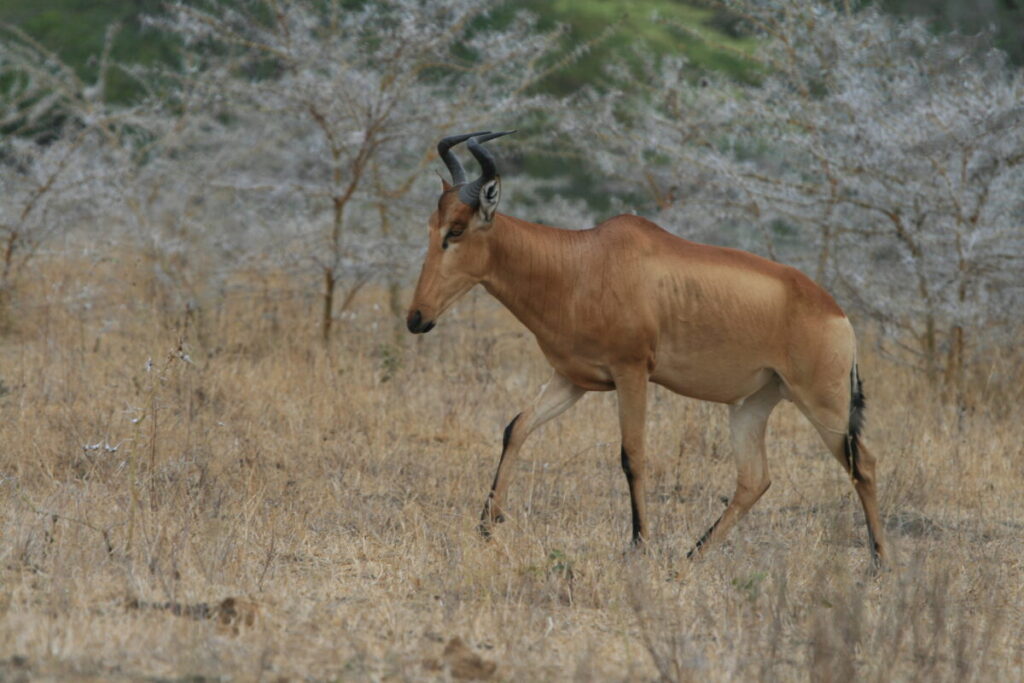
Lichtenstein’s Hartebeest

Lichtenstein’s hartebeest is characterized by its elongated, narrow face and long, lyre-shaped horns. Its coat is fawn-colored with a slightly lighter underbelly, and it features a dark dorsal stripe running along its back. This antelope is renowned for its remarkable agility and speed, making it a fascinating species to observe in its natural habitat.

Appearance

Lichtenstein’s Hartebeest Appearance

Distinctive features of Lichtenstein’s hartebeest include its unique lyre-shaped horns and elongated face, setting it apart from other hartebeest subspecies. The coloring of its coat, coupled with the dark dorsal stripe, further distinguishes it from similar species in its range.

Distribution

Lichtenstein’s hartebeest primarily inhabits the savannahs and floodplains of Southeastern-Central Africa, with notable populations found in countries such as Malawi, Tanzania, South Africa, Zambia, and small parts of Zimbabwe. Its distribution is closely linked to the availability of suitable habitat and adequate water sources, influencing its population density and range.

Habitat Preferences

Lichtenstein’s Hartebeest Habitat

This subspecies thrives in open habitats such as acacia savannas and grassland-woodland ecotones. These environments provide the necessary resources for foraging, breeding, and seeking refuge from predators. Lichtenstein’s hartebeest demonstrates a preference for areas with adequate drinking water, further influencing its distribution and habitat selection.

Overall, Lichtenstein’s hartebeest is a captivating species with unique characteristics and specific habitat requirements, making it a significant focus for wildlife conservation efforts in the region.

Facts About Lichtenstein’s hartebeest

  • Lichtenstein’s hartebeest (Alcelaphus buselaphus lichtensteinii) is a savannah- and floodplain-dwelling antelope found in southern Central Africa.
  • They are herbivores, primarily feeding on grass shoots and leaves.
  • The average weight of Lichtenstein’s hartebeest ranges from 157-204kg (346-450lb).
  • These antelopes are known for their distinctive appearance and long, lyre-shaped horns.
  • Lichtenstein’s hartebeest have a unique mating behavior, involving courtship displays and vocalizations.
  • Their population is estimated to be relatively small, with only about 50 individuals occurring in the Kruger National Park in South Africa.
  • The species is listed on the Red List of South African Species, indicating a conservation concern.
  • Lichtenstein’s hartebeest are adapted to living in diverse habitats, including floodplains and tropical savannas.
  • They are known for their agility and speed, making them capable of swift movements in their natural environment.
  • Lichtenstein’s hartebeest play a crucial role in the ecosystem as a part of the herbivore community, contributing to the balance of their habitat.


Scientific Provenance & Verified Sources

Biological taxonomy, conservation status, and physical traits are cross-referenced with authoritative global registers:


Peer-reviewed by Wildlife Science Editors • Updated for 2026

Explore Other Species Profiles