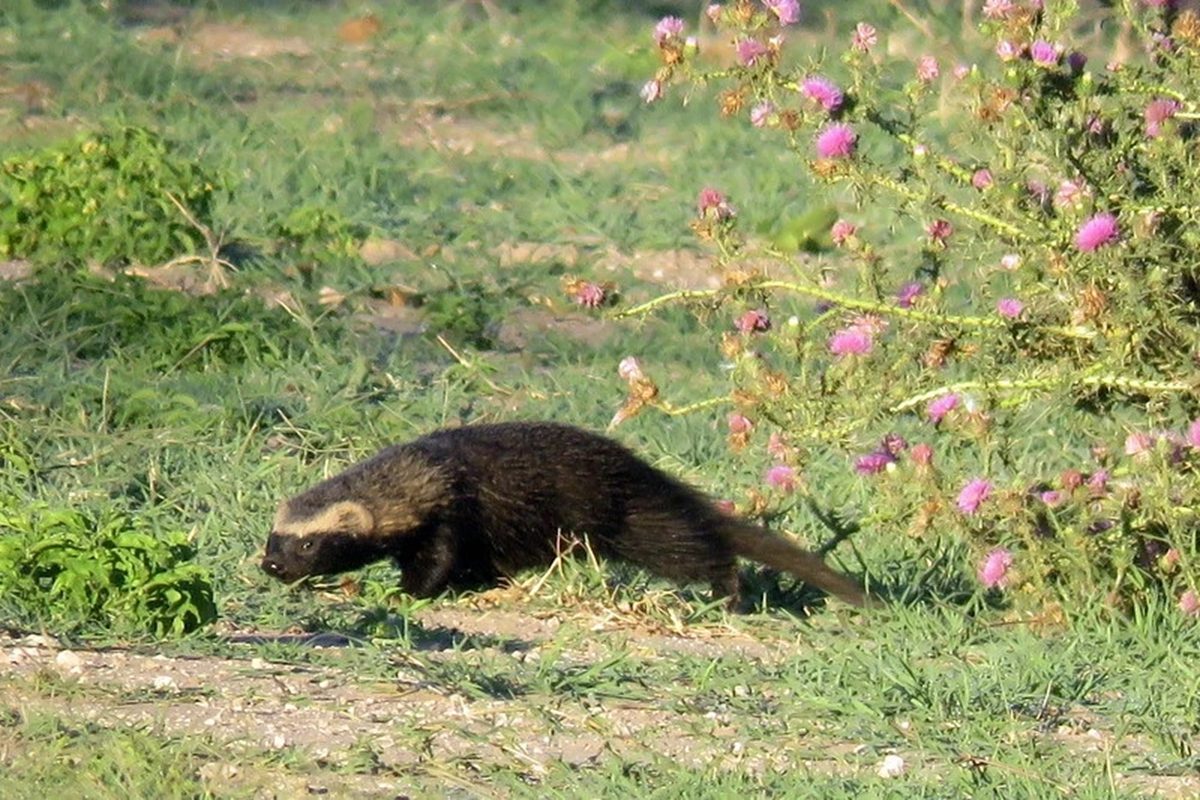
Lesser Grison

IUCN Red List Conservation Status


Least Concern

LC
NT
VU
EN
CR
EW
EX

Official assessment evaluated in accordance with the IUCN Red List of Threatened Species criteria: Least Concern.


Species Quick Facts

Scientific Name
Galictis cuja

Average Lifespan
5-7 years in wild, 10-12 years in captivity

Average Weight
1.5-2.5 kg (3.3-5.5 lbs) – Males: 2.2 kg, Females: 1.8 kg

Average Length
35-45 cm (14-18 inches) – head-body length excluding tail

Overview & Identification

The Lesser Grison (Galictis cuja) is a small mustelid belonging to the family Mustelidae. It inhabits a broad swath of South America, ranging from the Pampas of Argentina and Uruguay through the Chaco of Paraguay and Bolivia to the Atlantic forests of Brazil. Adaptable to open grasslands, savannas, shrubโ€‘steppe, and forest edges, it prefers areas with dense ground cover where it can hunt and hide. Adults measure 35โ€“45โ€ฏcm in headโ€‘body length, with a 15โ€“20โ€ฏcm tail, and weigh between 1.5 and 2.5โ€ฏkg. Their sleek, elongated bodies are covered in coarse, reddishโ€‘brown fur marked by a distinctive dark mask across the eyes and a lighter throat patch. The species is listed as Least Concern by the IUCN due to its wide distribution and presumed large population, although local declines have been noted where habitat conversion is intense. Its secretive nature and nocturnal habits make it difficult to study, but recent cameraโ€‘trap surveys have clarified its ecological role as a midโ€‘level predator controlling rodent and small vertebrate populations.

Behavior & Social Structure

Lesser Grisons are primarily solitary hunters, maintaining exclusive territories that can span up to 5โ€ฏkmยฒ for males and slightly less for females. They are crepuscular to nocturnal, becoming most active at dusk and dawn, though individuals may be seen hunting during daylight in open habitats. Scent marking with anal gland secretions and occasional vocalizationsโ€”sharp barks, hisses, and chirpsโ€”facilitate communication between neighboring individuals, especially during the breeding season. Homeโ€‘range fidelity is high; individuals patrol their boundaries nightly, leaving scent trails along game paths and burrow entrances. While generally solitary, temporary pair bonds form during mating, and mothers care for their young alone until weaning. Their agility and swift, zigโ€‘zag running enable them to chase prey into dense cover, and they are capable swimmers, occasionally foraging along riverbanks.

Diet & Hunting Patterns

The Lesser Grison is a strict carnivore, preying on a wide array of small vertebrates. Its diet is dominated by rodents such as grass mice (Akodon spp.) and guineaโ€‘pig relatives (Cavia spp.), which can constitute up to 60โ€ฏ% of stomach contents in some studies. It also captures birds, especially groundโ€‘nesting species like tinamous, as well as reptiles (lizards, small snakes) and amphibians (frogs). Invertebrates, particularly large insects and beetle larvae, are taken opportunistically, especially during the dry season when vertebrate prey is scarce. Hunting is primarily ambushโ€‘based; the grison uses its keen hearing and scent to locate prey, then darts from cover, delivering a rapid bite to the neck or head. Daily food intake averages 150โ€‘250โ€ฏg, roughly 10โ€‘15โ€ฏ% of body weight, and individuals may consume up to 30โ€ฏ% of their body mass when prey is abundant. Seasonal shifts in diet reflect local prey cycles, with a higher proportion of reptiles in the warmer months.

Reproduction & Life Cycle

Sexual maturity is reached at about 10โ€‘12 months for both sexes. Breeding in the Southern Hemisphere typically occurs from August to October, coinciding with the spring increase in prey abundance. After a gestation period of 35โ€‘45 days, females give birth to litters of 1โ€‘4 kits, with an average of 2โ€‘3. The neonates are born blind and covered in a fine grayish coat, weighing roughly 70โ€ฏg. They remain in the den for the first 10โ€‘12 days, during which the mother provides all care. By three weeks, kits begin to explore the den perimeter, and at eight weeks they are weaned and start learning hunting techniques. Juveniles become independent by four months, though they may linger near the motherโ€™s range for several weeks. Reproductive output can be influenced by prey availability, with females in richer habitats producing larger litters.

Threats & Conservation

The IUCN classifies the Lesser Grison as Least Concern, citing its extensive range and presumed large population. Nevertheless, localized threats are emerging. Agricultural expansion and conversion of native grasslands to soy and cattle pastures fragment habitats, reducing suitable hunting grounds and increasing exposure to road mortality. In some regions, grisons are persecuted as livestock predators, though documented predation on domestic animals is rare. Illegal trapping for the fur trade, while not a major industry, still occurs in parts of Brazil and Argentina. Climate change may alter the distribution of key prey species, potentially affecting reproductive success. Population surveys suggest a modest decline of 5โ€‘10โ€ฏ% over the past three decades in heavily modified landscapes, but overall numbers remain stable at an estimated 500,000โ€“800,000 mature individuals across their range.

Interesting Facts

โ€ข โ€ข The Lesser Grison can swim across rivers up to 30โ€ฏm wide while hunting aquatic prey.
โ€ข โ€ข Its anal gland secretions have a pungent odor used for both territorial marking and predator deterrence.
โ€ข โ€ข Unlike many mustelids, it has a relatively short tail (15โ€‘20โ€ฏcm) that aids balance during rapid chases.
โ€ข โ€ข Cameraโ€‘trap footage has captured the species raiding chicken coops, though such incidents are infrequent.
โ€ข โ€ข Genetic studies show the Lesser Grison diverged from its close relative, the Greater Grison (Galictis vittata), around 2.5โ€ฏmillion years ago.

Description

Lesser Grison

The Lesser grison, scientifically known as Galictis cuja, is a remarkable species of mustelid native to South America. Its common name ‘grison’ is derived from the French language, meaning “gray,” reflecting the mammal’s distinctive gray fur.

Appearance

Lesser Grison Appearance

The Lesser grison is characterized by its sleek, gray fur, with a white or yellowish patch on the throat and chest. It has a slender body, short legs, and a long tail, distinguishing it from other species within the mustelid family.

Distribution

The Lesser grison is found throughout most of southern South America, including countries such as Brazil, Argentina, Paraguay, and Uruguay. It occupies a wide range of habitats, from the arid Chaco to wet forests and Andean regions, showcasing its adaptability and resilience.

Habitat Preferences

Lesser Grison Habitat

The Lesser grison thrives in diverse ecosystems, including grasslands, forests, and open areas, often near water sources. Its ability to inhabit a variety of environments highlights its ecological flexibility and capacity to coexist with diverse flora and fauna.

As a conservation scientist dedicated to the preservation of wildlife, it is crucial to recognize the significance of the Lesser grison’s role within its natural habitat and advocate for measures to safeguard its continued existence.

Facts About Lesser Grison

  • The Lesser Grison (Galictis cuja) can be found in a wide range of habitats, from the arid Chaco to areas with extensive vegetation (source: Animal Diversity Web).
  • They have a body length ranging from 27 to 52 cm (10.6 to 20.5 inches) (source: Animalia.bio).
  • The weight of the Lesser Grison ranges from 1 to 2.5 kg (2.2 to 5.5 lbs) (source: Animalia.bio).
  • The species has a life span of 7-10 years (source: Animalia.bio).
  • The Lesser Grison is one of the least-known mustelids in the Neotropics despite its broad range across South America (source: SciELO).
  • It has a thin and elongated body, characteristic of the least known mustelids of the Americas (source: PubMed Central).
  • The species belongs to the Mustelidae family and is known for its intelligence (source: Onรงafari).
  • The Lesser Grison has a long body, narrow chest, short tail, and short legs (source: The Website of Everything).
  • This species is a representative of the Mustelidae family and is native to South America (source: iNaturalist).
  • Geographic variation in skull morphology has been observed in the Lesser Grison (source: PubMed Central).


Scientific Provenance & Verified Sources

Biological taxonomy, conservation status, and physical traits are cross-referenced with authoritative global registers:


Peer-reviewed by Wildlife Science Editors โ€ข Updated for 2026

Explore Other Species Profiles