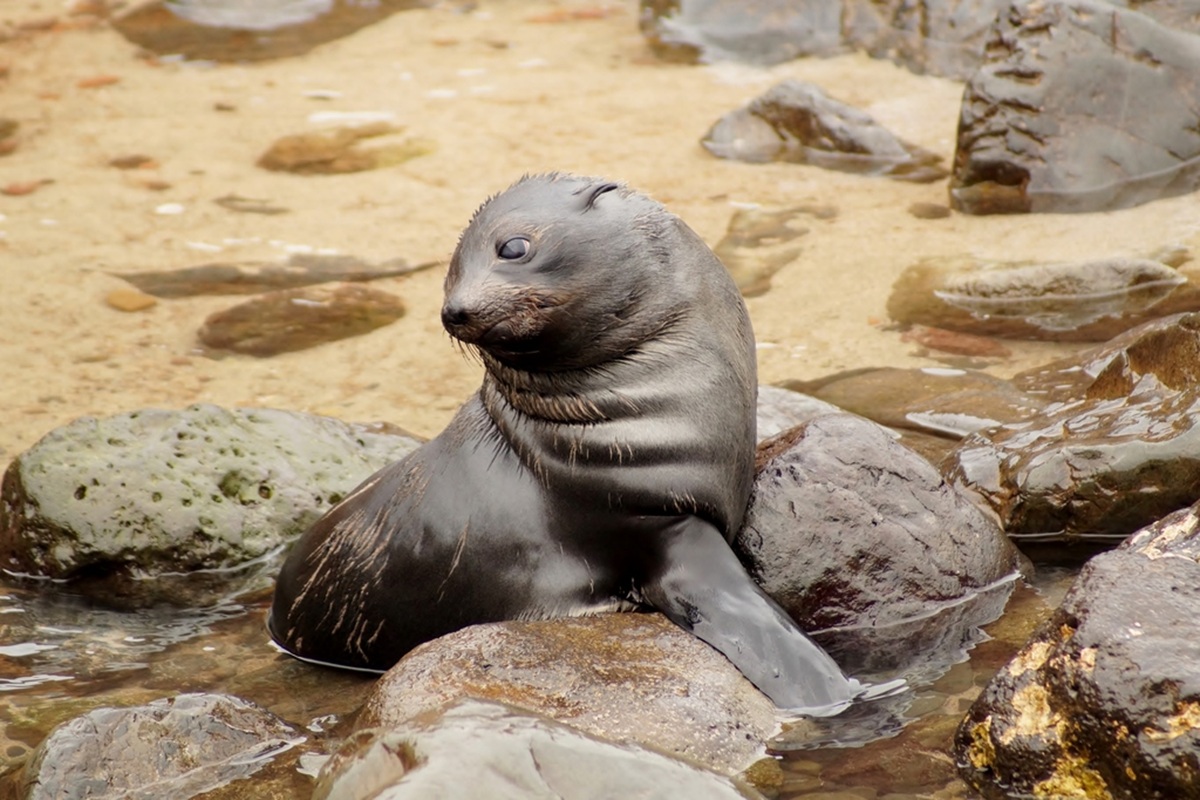
Juan Fernández Fur Seal

IUCN Red List Conservation Status


Endangered

LC
NT
VU
EN
CR
EW
EX

Official assessment evaluated in accordance with the IUCN Red List of Threatened Species criteria: Endangered.


Species Quick Facts

Scientific Name
Arctocephalus philippii

Average Lifespan
15-20 years in wild, up to 30 years in captivity

Average Weight
30-250 kg (66-550 lbs) – Males: 150-250 kg, Females: 30-70 kg

Average Length
150-200 cm (59-79 inches) – head-body length excluding tail

Overview & Identification

The Juan Fernández fur seal (Arctocephalus philippii) belongs to the order Carnivora, family Otariidae. Endemic to the Juan Fernández Archipelago off the coast of Chile, it occupies a very restricted range of less than 200 km² of oceanic islands. The species prefers rocky, wave‑washed shorelines and offshore islands where it forms dense breeding colonies during the austral winter. Adults display extreme sexual dimorphism: males are up to eight times heavier than females and develop a pronounced sagittal crest and a thick, dark brown coat, while females are smaller, lighter‑colored, and more agile in the water. Their dense underfur provides insulation in the cool Humboldt Current waters. Historically hunted for pelts, the population declined dramatically in the 19th century, but recent protection has allowed a modest recovery. The IUCN classifies the seal as Endangered, reflecting its limited distribution and ongoing threats. Conservation actions include marine protected areas around the islands, strict fishery regulations, and long‑term population monitoring.

Behavior & Social Structure

Juan Fernández fur seals are highly social and form large, noisy colonies that can number several thousand individuals during the breeding season (June‑August). Males establish harems of up to 30 females and aggressively defend territories on the shoreline, using vocal barks, growls, and visual displays such as dorsal‑fin slaps. Outside the breeding period, seals are more dispersed, foraging individually or in small groups over the continental shelf. They are primarily diurnal, spending daylight hours hauled out to rest, molt, and socialize, and retreat to the sea at night to feed. Communication relies on a repertoire of vocalizations—grunts, whistles, and high‑pitched squeaks—plus scent marking from sebaceous glands on the chest and flippers. Juveniles practice play‑fighting, which helps develop the motor skills needed for later territorial battles.

Diet & Hunting Patterns

Juan Fernández fur seals are strict carnivores, feeding primarily on pelagic fish such as sardines (Sardinops sagax), anchovies (Engraulis mordax), and mackerel (Scomber japonicus). Squid species, especially those of the genus Ommastrephes, and occasional octopus are also important components of the diet. Foraging trips can extend up to 100 km from the islands, with dives reaching depths of 150–200 meters. Seals employ a combination of pursuit diving and opportunistic surface feeding, often coordinating with conspecifics to herd schools of fish. Daily intake averages 5–7% of body mass, with females increasing consumption during lactation to support milk production. Seasonal variations in prey availability, driven by the Humboldt Current, influence foraging success and may affect reproductive output.

Reproduction & Life Cycle

Females reach sexual maturity at 3–4 years, while males typically do not acquire breeding status until 4–5 years, after a period of peripheral roaming and fighting. The breeding season peaks in July, when females give birth after an 11‑month gestation to a single pup weighing 5–7 kg. Pups are nursed for 6–7 weeks, during which mothers fast on land, relying on stored blubber. After weaning, juveniles are weaned and quickly learn to swim and dive, joining foraging trips with older seals. Males establish and defend territories for several weeks, using vocalizations and physical displays to deter rivals. Successful males may sire up to 30 pups per season, while most females reproduce annually. The high degree of polygyny results in a skewed sex ratio among breeding adults, with many younger males remaining non‑breeders for several years.

Threats & Conservation

The IUCN lists the Juan Fernández fur seal as Endangered, with an estimated total population of 12,000–14,000 individuals (2020 assessment). Historical over‑hunting reduced numbers to fewer than 1,000 in the early 20th century, and although protection has allowed recovery, several threats persist. Bycatch in commercial long‑line and trawl fisheries poses a significant mortality risk, especially during the breeding season when seals forage near the islands. Competition with fisheries for the same pelagic fish reduces prey availability, potentially limiting pup growth and survival. Climate change impacts the Humboldt Current, altering prey distribution and abundance. Introduced predators such as rats and feral cats on some islands threaten pups and eggs. Conservation measures include the designation of the Juan Fernández Marine Protected Area, strict regulation of fisheries within 50 km of the islands, and ongoing population monitoring by Chilean authorities and NGOs.

Interesting Facts

• The Juan Fernández fur seal is one of the world’s most geographically restricted pinniped species, found only on three small islands.
• Males can weigh up to 250 kg, making them one of the heaviest otariids relative to their body size.
• Their dense underfur was historically prized for its softness, leading to intensive 19th‑century hunting.
• Pups are born with a black coat that molts to a silvery‑gray pelage within a few months.
• Despite their limited range, they can dive deeper than 200 meters and travel over 100 km to forage.

Description

Juan Fernández Fur Seal

The Juan Fernández fur seal, scientifically known as Arctocephalus philippii, is a small and robust fur seal species. Adult males typically measure 1.5-2.1 meters in length and weigh about 140 kilograms. They are recognized as the second smallest of the fur seals, with the Galápagos fur seal being the only species smaller than them. Their bodies are short and robust, covered in brown pelage, and they have distinctive features that set them apart from other fur seals.

Appearance

Juan Fernández Fur Seal Appearance

Juan Fernández fur seals have a unique appearance characterized by their short and robust bodies, brown pelage, and distinctive facial features. Their small size, in comparison to other fur seals, makes them easily distinguishable. Adult males have a length of 1.5-2.1 meters and weigh around 140 kilograms, while females are slightly smaller. Their physical characteristics make them well-adapted to their marine environment and contribute to their distinctiveness as a species.

Distribution

The Juan Fernández fur seal is found exclusively along the Pacific Coast of South America, particularly on the Juan Fernández Islands. These islands, located off the coast of Chile, serve as the primary habitat for this species. The population density of Juan Fernández fur seals is notable in this region, with specific patterns observed in their distribution across the islands. Conservation efforts are crucial in maintaining the balance of their population and preserving their natural habitat.

Habitat Preferences

Juan Fernández Fur Seal Habitat

Juan Fernández fur seals thrive in rocky, volcanic shorelines with boulders, grottos, overhangs, and caves. These coastal ecosystems provide the seals with suitable breeding grounds and access to their primary food sources. The seals are generalist predators, feeding mostly on shallow reefs near the shore, and occasionally swimming out to coldwater currents to feed. Protecting these coastal habitats is essential for ensuring the survival and well-being of the Juan Fernández fur seal population.

Facts About Juan Fern√°ndez fur seal

  • Adult male Juan Fernandez fur seals measure 1.5-2.1m in length and weigh about 140kg.
  • They breed once yearly, with mating occurring from November to December.
  • The average number of offspring for Juan Fernandez fur seals is 1.
  • These seals are generalist predators, feeding mostly on shallow reefs near the shore.
  • They are found only on the Pacific Coast of South America.
  • Juan Fernandez fur seals were hunted to the brink of extinction by sealers trading pelts in China.
  • They are the second smallest of the fur seals, second only to the Galápagos fur seal.
  • Juan Fernandez fur seals are found in rocky, volcanic shorelines with boulders, grottos, overhangs, and caves.
  • They feed on squid, various fishes, and lobsters.
  • Territorial males are a characteristic of Juan Fernandez fur seals.


Scientific Provenance & Verified Sources

Biological taxonomy, conservation status, and physical traits are cross-referenced with authoritative global registers:


Peer-reviewed by Wildlife Science Editors • Updated for 2026

Explore Other Species Profiles