IUCN Red List Conservation Status


Least Concern

LC
NT
VU
EN
CR
EW
EX

Official assessment evaluated in accordance with the IUCN Red List of Threatened Species criteria: Least Concern.


Species Quick Facts

Scientific Name
Mustela itatsi

Average Lifespan
1-2 years in wild, 3-5 years in captivity

Average Weight
0.4-0.9 kg (0.9-2.0 lbs) – Males: 0.6 kg, Females: 0.5 kg

Average Length
18-27 cm (7-10.6 inches) – head-body length excluding tail

Overview & Identification

The Japanese weasel (Mustela itatsi) is a small mustelid endemic to the Japanese archipelago. Classified in the family Mustelidae, it belongs to the genus Mustela, which also includes the European weasel (M. nivalis) and the Siberian weasel (M. sibirica). Its distribution covers the main islands of Honshu, Shikoku, Kyushu, and parts of Hokkaido, as well as several smaller islands such as the Oki and Amami groups. The species inhabits a variety of environments, from temperate deciduous and mixed forests to open grasslands, agricultural fields, and mountainous shrublands up to 2,000โ€ฏm elevation. Seasonal coat colour shifts from a reddishโ€‘brown summer pelage to a darker, almost black winter fur, providing camouflage in snowโ€‘covered habitats. Adults measure 18โ€“27โ€ฏcm in headโ€‘body length, with a 8โ€“12โ€ฏcm tail, and weigh 0.4โ€“0.9โ€ฏkg. The Japanese weasel is an agile predator that relies on keen sight and smell to hunt small vertebrates, and it helps control rodent populations that can damage crops. Although once hunted for its fur, the species has rebounded and is currently assessed as Least Concern by the IUCN, with a stable population estimated in the hundreds of thousands. It is protected under Japanโ€™s Wildlife Protection Law, and conservation efforts focus on preserving forest corridors and reducing pesticide exposure that threatens its prey base.

Behavior & Social Structure

Japanese weasels are primarily solitary hunters, with each adult defending a personal territory that may span 1โ€“3โ€ฏkmยฒ in forested areas and up to 5โ€ฏkmยฒ in open farmland. They are most active at dusk and during the night, though occasional daylight foraging occurs in the summer. Scent marking using anal glands and urine delineates boundaries and communicates reproductive status to neighbors. Vocalizations are limited to short chirps, hisses, and a distinctive rattling alarm call when threatened. Overlap between male and female ranges is minimal except during the brief breeding season, after which individuals retreat to their core areas. Seasonal movements are modest; juveniles disperse 5โ€“15โ€ฏkm from the natal site before establishing their own home range. The species exhibits high metabolic rates, requiring frequent hunting bouts throughout the night to meet energy demands.

Diet & Hunting Patterns

The Japanese weasel is a strict carnivore, preying on a wide array of small vertebrates and invertebrates. Its diet is dominated by rodents such as field mice (Apodemus spp.), voles (Microtus spp.), and shrews (Sorex spp.), which can constitute up to 70โ€ฏ% of stomach contents in winter when other prey are scarce. It also captures groundโ€‘dwelling birds, their eggs, amphibians like Japanese brown frogs (Rana japonica), and occasionally fish and insects during the summer months. Hunting is an active pursuit; the weasel relies on acute olfaction and sharp eyesight to locate prey in leaf litter or burrows, then uses rapid, serpentine movements to subdue it with a bite to the neck. Daily food intake averages 5โ€“10โ€ฏ% of body mass, roughly 20โ€“30โ€ฏg for an adult, and individuals may consume up to 10 prey items per night when prey are abundant. Seasonal fluctuations in prey availability influence foraging range, prompting longer nightly excursions during lean periods.

Reproduction & Life Cycle

Sexual maturity in Japanese weasels is reached at about 10โ€“12โ€ฏmonths for both sexes. Breeding occurs once a year, typically between February and April, when females emit estrus pheromones that attract nearby males. After a short gestation of 28โ€“30โ€ฏdays, the female gives birth to a litter of 3โ€“7 kits in a concealed nest lined with grass and shredded bark. Newborns are altricial, blind and hairless, weighing roughly 5โ€ฏg. The mother nurses the kits for 4โ€“5โ€ฏweeks, during which she remains in the nest and fiercely defends it from intruders. By six weeks, the young begin to explore the surrounding area, practicing hunting skills under the motherโ€™s supervision. Weaning is complete by 8โ€ฏweeks, after which the juveniles become independent and disperse to establish their own territories. Longevity of reproductive females in the wild averages 2โ€“3โ€ฏyears, allowing most individuals to breed only once or twice before succumbing to predation or environmental stresses.

Threats & Conservation

The IUCN classifies the Japanese weasel (Mustela itatsi) as Least Concern, reflecting its relatively wide distribution and stable population trends. Nevertheless, several localized threats persist. Habitat fragmentation caused by urban expansion, road construction, and intensive agriculture reduces the continuity of forest corridors essential for dispersal, leading to isolated subpopulations. Road mortality accounts for an estimated 5โ€“10โ€ฏ% of annual adult deaths in heavily trafficked regions such as the Kanto plain. Pesticide and rodenticide use diminishes prey abundance and can cause secondary poisoning; studies in agricultural districts of Kyushu have recorded liver residues of anticoagulant rodenticides in up to 12โ€ฏ% of captured individuals. Historical trapping for fur has largely ceased, but occasional illegal trapping still occurs in remote mountain areas. Climate change may alter snow cover duration, affecting winter camouflage and hunting efficiency. Current population estimates suggest 500,000โ€“1,000,000 mature individuals, with a slight upward trend in protected forest reserves. Conservation actions focus on preserving habitat connectivity, implementing wildlife crossings, and promoting integrated pest management to safeguard both weasels and their prey.

Interesting Facts

โ€ข The Japanese weasel can change its coat colour from reddishโ€‘brown in summer to almost black in winter, a rare seasonal pelage shift among mustelids.
โ€ข It has one of the highest metabolic rates of any mammal, requiring it to eat up to 10โ€ฏ% of its body weight each night.
โ€ข Despite its small size, it can take prey up to twice its own weight, such as adult field mice.
โ€ข The species was once heavily trapped for its silky fur, but legal protection in the 1970s allowed populations to recover.
โ€ข Japanese weasels are known to cache surplus prey in shallow depressions, a behavior termed โ€œlarder building.โ€

Description

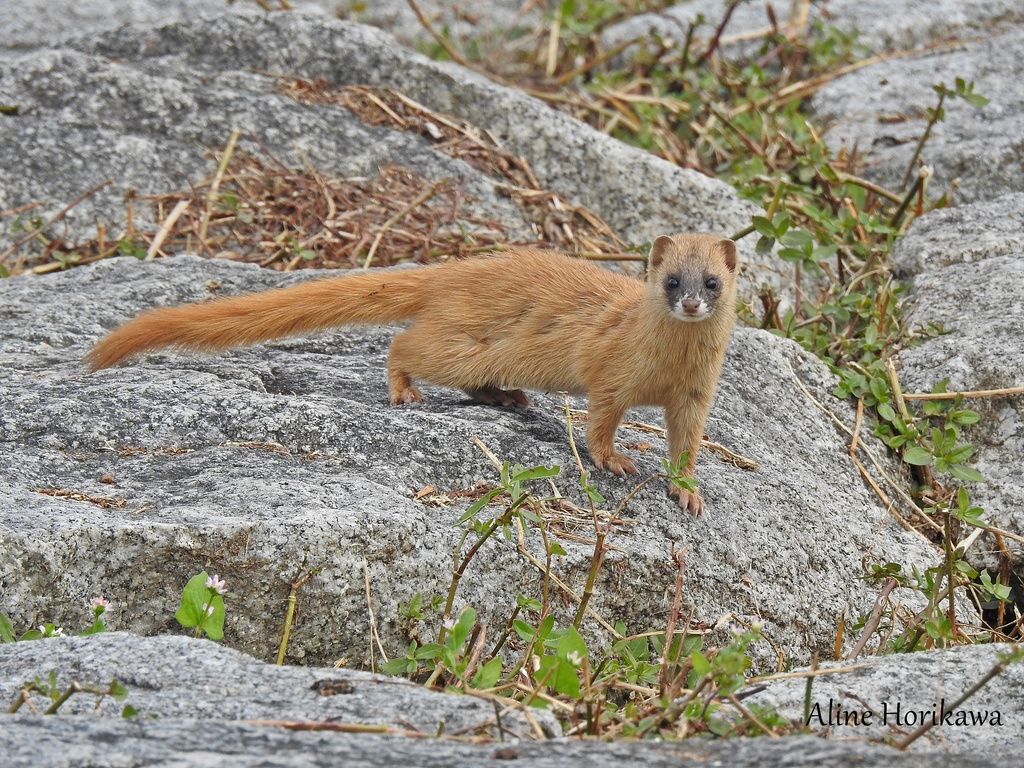
The Japanese weasel, scientifically known as Mustela itatsi, is a carnivorous mammal belonging to the genus Mustela in the family Mustelidae. This sleek and agile creature is characterized by its slender body, short legs, and a long, bushy tail. Known for its keen hunting abilities, the Japanese weasel is an adept predator that plays a vital role in the ecosystem.

Appearance

The Japanese weasel is distinguished by its reddish-brown fur with a creamy white underbelly, giving it a striking appearance. Its small, rounded ears and elongated body set it apart from similar species, such as the Siberian weasel (Mustela sibirica). The Japanese weasel’s distinct coloration and body structure enable it to navigate diverse terrains with agility and stealth.

Distribution

The Japanese weasel is primarily found in Japan, inhabiting various regions including Honshu, Shikoku, and Kyushu. It can also be found in parts of Russia, including Sakhalin Island. Although its population density varies across different regions, the Japanese weasel demonstrates adaptability to a range of habitats, contributing to its widespread distribution.

Habitat Preferences

Japanese weasels thrive in a diverse array of ecosystems, including mountainous areas, forests, grasslands, and shrublands. They are often found near moving water, showcasing an affinity for environments that provide access to prey and shelter. These habitats offer the resources necessary for the Japanese weasel’s survival, supporting its hunting behavior and reproductive success.

Overall, the Japanese weasel’s presence in various ecosystems underscores its resilience and adaptability, highlighting its significance in maintaining ecological balance.

Facts About Japanese Weasel

  • The Japanese weasel (Mustela itatsi) is a carnivorous mammal belonging to the genus Mustela in the family Mustelidae.
  • They are native to Japan, occurring on the islands of Honshลซ, Kyลซshลซ, and Shikoku, and have been introduced to Hokkaidล and the Ryukyu Islands to control rodents.
  • Japanese weasels generally breed once yearly, although second litters may occur in years with abundant food resources.
  • Their numbers are decreasing, and they are listed as near threatened by the IUCN.
  • The average weight of a Japanese weasel can be up to 14.10 ounces, and their length can reach up to 14 inches.
  • They are associated with various habitats across Japan, including grasslands, forests, villages, and suburbs.
  • The scientific name for the Japanese weasel is Mustela itatsi.
  • They are also known by their Japanese name “Nihon itachi.”
  • Japanese weasels are fairly small mammals in the mustelid family.
  • The breeding season for Japanese weasels occurs from early spring to early summer.


Scientific Provenance & Verified Sources

Biological taxonomy, conservation status, and physical traits are cross-referenced with authoritative global registers:


Peer-reviewed by Wildlife Science Editors โ€ข Updated for 2026

Explore Other Species Profiles