Jamaican Fruit Bat

IUCN Red List Conservation Status


Least Concern

LC
NT
VU
EN
CR
EW
EX

Official assessment evaluated in accordance with the IUCN Red List of Threatened Species criteria: Least Concern.


Species Quick Facts

Scientific Name
Artibeus jamaicensis

Average Lifespan
5-7 years in wild, 10-12 years in captivity

Average Weight
0.025-0.045 kg (0.055-0.099 lbs) – Males: 0.035 kg, Females: 0.040 kg

Average Length
8-10 cm (3.1-3.9 inches) – head-body length excluding tail

Overview & Identification

The Jamaican fruit bat (Artibeus jamaicensis) is a mediumโ€‘sized leafโ€‘nosed bat belonging to the family Phyllostomidae within the order Chiroptera. It inhabits the Caribbean islands, the southern tip of Florida, and extends through Central and northern South America, including countries such as Mexico, Colombia, Brazil, and the Guianas. This species prefers tropical and subtropical forests, mangrove swamps, and agricultural landscapes where fruiting trees are abundant. Adults possess a distinctive broad noseleaf, large rounded ears, and a short, hairโ€‘covered tail that is often concealed within the fur. Fur coloration ranges from grayโ€‘brown to reddishโ€‘brown, providing camouflage among foliage. The batโ€™s wings are long and narrow, enabling agile flight in cluttered environments. As a frugivore, it plays a crucial role in seed dispersal for many plant species, especially figs (Ficus spp.) and other pioneer trees. The IUCN classifies Artibeus jamaicensis as Least Concern due to its wide distribution and presumed large population, although localized threats persist. Its adaptability to humanโ€‘modified habitats and ability to roost in caves, tree hollows, and buildings contribute to its resilience.

Behavior & Social Structure

Jamaican fruit bats are highly social mammals that form colonies ranging from a few dozen to several hundred individuals. Roosts are typically located in caves, hollow trees, abandoned buildings, and under bridges, where bats cluster tightly during daylight hours. The species is strictly nocturnal; it emerges at dusk to forage, navigating with a combination of echolocation calls (frequencyโ€‘modulated sweeps around 45โ€“55โ€ฏkHz) and keen vision. Home ranges are relatively small, often less than 5โ€ฏkmยฒ, and individuals exhibit fidelity to foraging sites rich in fruiting trees. Communication within colonies includes a repertoire of social calls used to maintain group cohesion, signal alarm, and coordinate movement. Males may defend temporary perches during the breeding season, but overall the social structure is fluid, with frequent roost switching that reduces parasite buildup and predation risk.

Diet & Hunting Patterns

The Jamaican fruit bat is primarily frugivorous, relying on a diet composed of softโ€‘fleshed fruits such as figs (Ficus spp.), mangoes (Mangifera indica), bananas (Musa spp.), and various tropical berries. Fruit pulp provides essential carbohydrates, while seeds and skins supply lipids and micronutrients. Occasionally, the bat supplements its intake with nectar from flowering vines and small insects, especially when fruit availability declines. Foraging occurs in the forest canopy and edge habitats, where individuals use echolocation to locate fruiting branches and then employ a precise bite to pluck ripe fruits. An adult consumes roughly 5โ€“10โ€ฏ% of its body mass per night, translating to 1.5โ€“3โ€ฏg of fruit. By discarding seeds in their feces, these bats serve as vital seed dispersers, facilitating forest regeneration across their range.

Reproduction & Life Cycle

Females reach sexual maturity at approximately 10โ€“12โ€ฏmonths of age, while males mature slightly later. Breeding in Artibeus jamaicensis is seasonal in most parts of its range, typically coinciding with the peak fruiting period between May and August, although some tropical populations breed yearโ€‘round. After a gestation of 112โ€“120โ€ฏdays, a single pup is born, weighing about 4โ€ฏg. The newborn is altricial, blind and hairless, and is clung to the motherโ€™s ventral fur for warmth. Lactation lasts roughly 6โ€“8โ€ฏweeks, during which the mother returns to the roost nightly to nurse the pup between foraging bouts. Juveniles become volant at about 4โ€ฏweeks and are weaned by 8โ€ฏweeks, after which they disperse to join mixedโ€‘sex foraging groups. Longevity of reproductive females can exceed 8โ€ฏyears in the wild.

Threats & Conservation

The IUCN Red List categorizes Artibeus jamaicensis as Least Concern, reflecting its broad distribution and presumed large, stable population estimated at several million individuals. Nevertheless, the species faces localized pressures that could undermine longโ€‘term viability. Primary threats include deforestation for agriculture, urban expansion, and mining, which reduce the availability of roosting sites and fruiting trees. Pesticide application in agroโ€‘ecosystems can lead to secondary poisoning and diminish insect prey. Human disturbance of cave roosts, often for tourism or guano extraction, can cause colony abandonment. Climate change may alter fruiting phenology, potentially desynchronizing breeding cycles. Conservation actions focus on protecting key habitats, maintaining forest corridors, and monitoring population trends through acoustic surveys.

Interesting Facts

โ€ข One of the few New World bats with a wellโ€‘developed noseleaf used for echolocation.
โ€ข Capable of flying up to 30โ€ฏkm/h in cluttered forest environments.
โ€ข Plays a key role in dispersing seeds of over 30 tropical plant species.
โ€ข Can tolerate a wide range of roosting sites, from natural caves to human structures.
โ€ข Exhibits a unique โ€œwingโ€‘flapโ€ vocalization during social interactions.

Description

Jamaican Fruit Bat

The Jamaican fruit bat, scientifically known as Artibeus jamaicensis, is a remarkable fruit-eating mammal native to Mexico, Central America, northwestern South America, and the Greater and many of the Lesser Antilles. This species is also commonly referred to as the common or Mexican fruit bat. It is an uncommon resident, known for its fascinating ecological role as a frugivorous species.

Appearance

Jamaican Fruit Bat (Artibeus jamaicensis)

The Jamaican fruit bat is characterized by its medium-sized, robust body and a wingspan of approximately 40-50 cm. Its fur is typically dark brown to black in color, with a distinctive glossy sheen. Notably, this bat species is equipped with large, forward-facing eyes and a well-developed sense of smell, which are essential adaptations for its fruit-based diet. These features distinguish it from other bat species and contribute to its unique ecological niche.

Distribution

The Jamaican fruit bat is known to inhabit a wide geographic range, spanning from Mexico through Central America to northwestern South America, as well as the Greater and many of the Lesser Antilles. It can be found in diverse ecosystems within these regions, showcasing its adaptability to various habitats. While it is an uncommon resident in some areas, the species plays a significant role in the ecological balance of the regions it inhabits.

Habitat Preferences
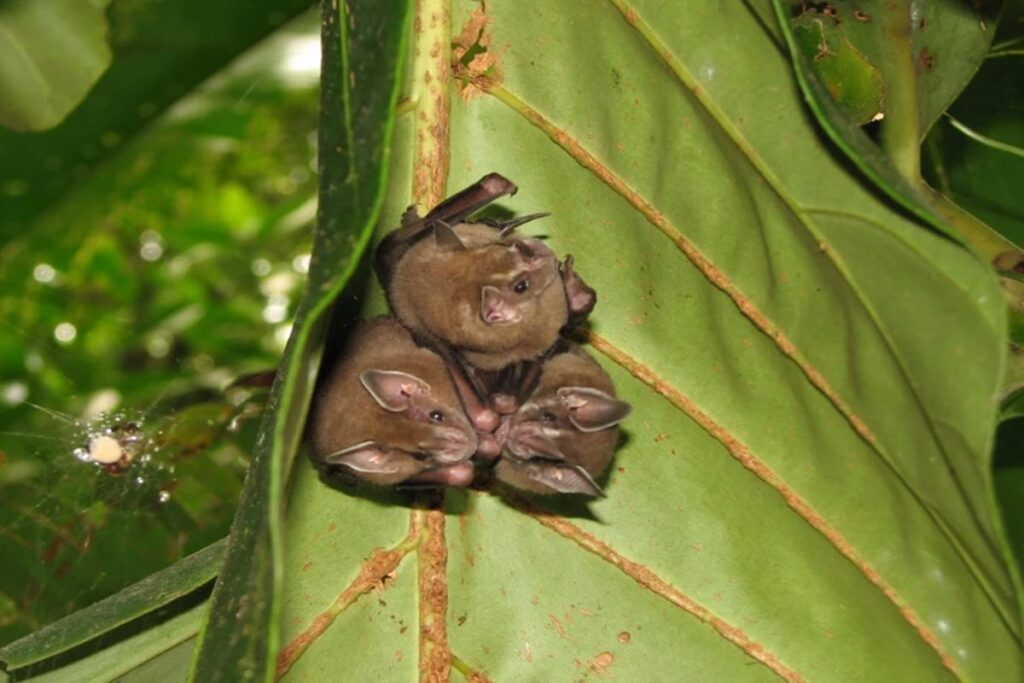
Jamaican Fruit Bat Habitat

This species exhibits a preference for humid and tropical habitats, including rainforests, cloud forests, and drier tropical areas. It is often found roosting in caves, hollow trees, and foliage, utilizing a range of roost sites for shelter and breeding. The Jamaican fruit bat’s ability to adapt to different ecosystems underscores its resilience and capacity to thrive in diverse environments.

Overall, the Jamaican fruit bat, with its distinctive characteristics and broad distribution, is an integral part of the ecosystems it inhabits, contributing to the pollination and dispersal of fruit-bearing plants, thereby playing a crucial role in maintaining ecological balance.

Facts About Jamaican fruit bat

  • The Jamaican fruit-eating bat (Artibeus jamaicensis) primarily feeds on brightly-colored, fragrant fruits like figs, as well as leaves, flowers, pollen, and nectar.
  • They are a medium-sized bat, with a total length of 78โ€“89 mm (3.1โ€“3.5 in) and a wingspan of 96โ€“150 mm (3.8โ€“5.9 in).
  • This species weighs between 40 to 60 grams (1.4 to 2.1 oz).
  • The Jamaican fruit-eating bat is native to Central America and has a range extending from central Mexico to Paraguay and Brazil, including the Bahamas, the Antilles, Trinidad, Tobago, and Key West, Florida.
  • They are classified as narrow space gleaning fruit generalists, but they have a preference for figs.
  • The female Jamaican fruit-eating bat typically bears two clutches.
  • Their fur is velvety, medium-length, and quite thick.
  • The average basal metabolic rate of this species is known to be relatively low.
  • Jamaican fruit-eating bats have a stocky body and a wide, leaf-shaped muzzle with a structure called a nose leaf.
  • Their echolocation calls are well-suited for foraging in dense vegetation and cluttered environments.


Scientific Provenance & Verified Sources

Biological taxonomy, conservation status, and physical traits are cross-referenced with authoritative global registers:


Peer-reviewed by Wildlife Science Editors โ€ข Updated for 2026

Explore Other Species Profiles