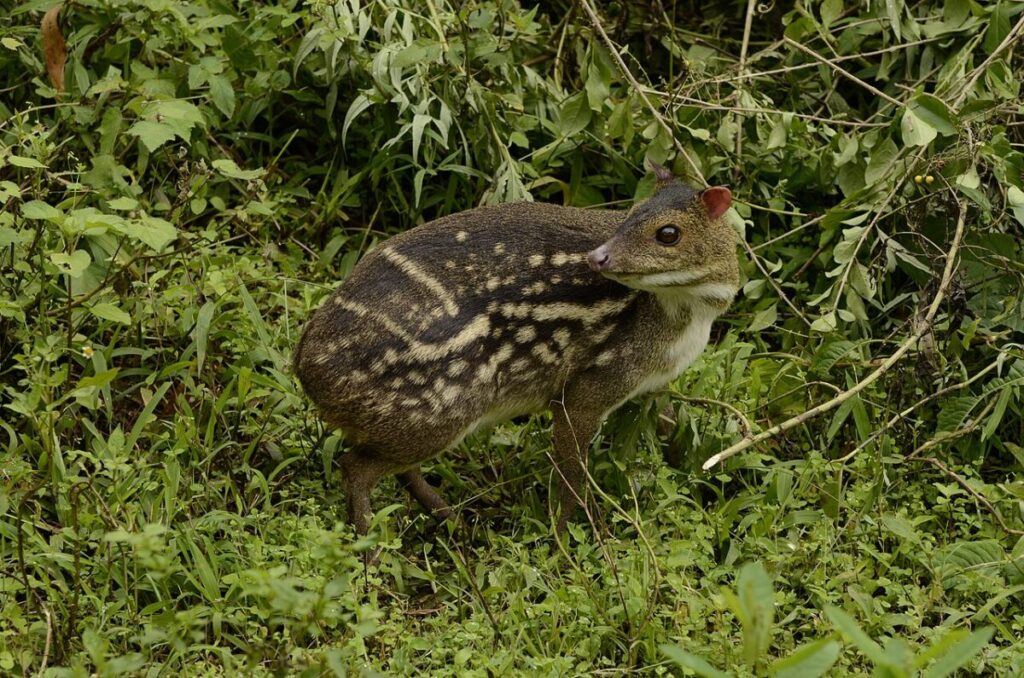
Indian Spotted Chevrotain

IUCN Red List Conservation Status


Least Concern

LC
NT
VU
EN
CR
EW
EX

Official assessment evaluated in accordance with the IUCN Red List of Threatened Species criteria: Least Concern.


Species Quick Facts

Scientific Name
Moschiola indica

Average Lifespan
8-10 years in wild, 12-15 years in captivity

Average Weight
2-4 kg (4.4-8.8 lbs) – Males: 3.0 kg, Females: 2.5 kg

Average Length
45-55 cm (17.7-21.7 inches) – head-body length excluding tail

Overview & Identification

The Indian spotted chevrotain (Moschiola indica) is a small, nocturnal ruminant belonging to the family Tragulidae, the most primitive group of even-toed ungulates. Endemic to the Indian subcontinent, its range extends across the Western Ghats, central Indian forests, the Himalaya foothills, and into Sri Lanka and parts of Bangladesh and Nepal. It inhabits dense tropical evergreen and semiโ€‘evergreen forests, moist deciduous woodlands, and shrubโ€‘dominated undergrowth where thick leaf litter provides cover. Adults weigh only 2โ€“4โ€ฏkg and measure 45โ€“55โ€ฏcm in headโ€‘body length, with a distinctive spotted coat of white or cream spots on a reddishโ€‘brown background, and short, straight horns (tusks) in males. The species is solitary or found in pairs, relying on its cryptic coloration and keen hearing to avoid predators such as leopards, dholes, and large birds of prey. Reproductive output is low, with a single fawn born after a gestation of about 150โ€ฏdays. The Indian spotted chevrotain is classified as Least Concern by the IUCN, but habitat fragmentation and hunting pressure have caused local declines. Ongoing conservation efforts focus on preserving forest corridors and enforcing antiโ€‘poaching regulations to maintain viable populations across its fragmented range.

Behavior & Social Structure

Indian spotted chevrotains are primarily solitary, with adult males maintaining exclusive home ranges that may overlap those of several females. Activity peaks during the crepuscular and nocturnal periods; individuals retreat to dense understory during daylight, emerging at dusk to forage. Territories are marked by scent glands on the throat and preorbital region, and occasional vocalizationsโ€”soft whistles or snortsโ€”communicate alarm or reproductive readiness. Home range sizes vary with habitat quality, ranging from 0.5โ€ฏha in rich evergreen forest to over 2โ€ฏha in degraded scrub. Social interactions are limited to brief courtship bouts and occasional motherโ€‘offspring contact; otherwise, individuals rely on camouflage and acute hearing to detect predators. Seasonal movements are modest, with chevrotains shifting locally in response to fruiting cycles and water availability, but they do not undertake longโ€‘distance migrations.

Diet & Hunting Patterns

The Indian spotted chevrotain is a strict herbivore, browsing on a diverse array of forest floor vegetation. Its diet consists primarily of fresh leaves, shoots, and buds of understory shrubs such as Lantana, Clerodendrum, and various Rubiaceae species. Fruit consumption is opportunistic; seasonal berries of Ficus, Myrtus, and Solanum provide essential carbohydrates and vitamins. In the dry season, the chevrotain supplements its intake with bark, twigs, and fallen fruits, while occasional ingestion of fungi and lichens has been recorded. Feeding occurs in short bouts lasting a few minutes, interspersed with periods of vigilance. Chevrotains possess a simple stomach and a functional rumen, allowing rapid fermentation of fibrous material; they typically consume 0.5โ€“1โ€ฏkg of foliage per day, equivalent to roughly 15โ€“20โ€ฏ% of their body weight.

Reproduction & Life Cycle

Females reach sexual maturity at 12โ€“14โ€ฏmonths, while males mature slightly later at 15โ€“18โ€ฏmonths. Breeding occurs yearโ€‘round but peaks during the rainy season (Juneโ€“September) when food resources are abundant. After a gestation period of approximately 150โ€ฏdays, a single fawnโ€”occasionally twinsโ€”is born concealed in a shallow depression of leaf litter. Newborns are precocial, opening their eyes within 24โ€ฏhours and following the mother shortly after birth. Lactation lasts about 45โ€ฏdays, after which the juvenile becomes independent but may remain within the motherโ€™s range for several months. Longevity in the wild averages 8โ€“10โ€ฏyears, extending to 12โ€“15โ€ฏyears in captivity, reflecting low reproductive rates and high juvenile mortality due to predation.

Threats & Conservation

The IUCN classifies the Indian spotted chevrotain as Least Concern, yet its populations are fragmented and declining in many parts of its range. Primary threats include habitat loss from agricultural expansion, logging, and infrastructure development, which reduce the dense understory essential for concealment. Hunting for meat and traditional medicine, though not widespread, adds localized pressure, especially in regions where enforcement is weak. Road mortality and predation by increasing numbers of feral dogs also impact survival. Population surveys suggest a decline of 10โ€“20โ€ฏ% over the past three decades, with estimated numbers ranging from 150,000 to 250,000 mature individuals. Conservation actions focus on protecting remaining forest blocks, establishing wildlife corridors, and communityโ€‘based antiโ€‘poaching initiatives. Monitoring programs using camera traps and lineโ€‘transect surveys are essential to assess trends and guide management.

Interesting Facts

โ€ข The Indian spotted chevrotain is the smallest hoofed mammal in the world, weighing less than a domestic cat.
โ€ข It lacks true antlers; males have short, straight, upwardโ€‘curving canine tusks used in maleโ€‘male combat.
โ€ข Despite its size, it can run up to 30โ€ฏkm/h in short bursts to escape predators.
โ€ข Chevrotains have a unique doubleโ€‘stomach system that allows rapid digestion of highโ€‘fiber diets.
โ€ข Their spotted coat provides excellent camouflage, and they can remain motionless for several minutes to avoid detection.

Description

Indian Spotted Chevrotain

The Indian Spotted Chevrotain, also known as the mouse deer, is an enchanting and diminutive even-toed ungulate found in the lush forests of South Asia. As the smallest hoofed mammal in the world, it captivates with its delicate size and unique characteristics. Despite the colloquial name of “mouse deer,” it is important to note that the Indian Spotted Chevrotain is not closely related to true deer, offering a distinctive and fascinating presence in the animal kingdom.

Appearance

Indian Spotted Chevrotain Appearance

This species is distinguished by its petite stature and delicate build, with a body length of approximately 57.5 cm (22.6 in) and a height that reaches a mere 30 cm (11.8 in). The Indian Spotted Chevrotain showcases a charming appearance with a rich reddish-brown coat adorned with striking white spots, setting it apart from similar species. Its slender legs and small, elegant head contribute to its graceful and unassuming allure.

Distribution

Indian Spotted Chevrotains inhabit a variety of forested habitats in India and possibly Nepal, showcasing a notable presence in the Western Ghats and Eastern Himalayas. Their distribution spans across the verdant landscapes of rainforests, where they find refuge in the dense undergrowth and thrive in the seclusion of these ecosystems. While their population density may vary, these enchanting creatures contribute to the rich biodiversity of their native regions.

Habitat Preferences

Indian Spotted Chevrotain Habitat

These captivating creatures primarily thrive in forested areas, particularly favoring semi-evergreen, moist evergreen, and tropical deciduous forests. Their preference for rocky areas within these habitats further emphasizes their adaptability to diverse environments. The Indian Spotted Chevrotain finds solace in the tranquility of well-watered areas, where they can lead a quiet and solitary life amidst the thick undergrowth of their forested sanctuaries.

This comprehensive species profile offers a glimpse into the captivating world of the Indian Spotted Chevrotain, shedding light on its unique characteristics, distribution, and habitat preferences. Through dedicated conservation efforts and a deeper understanding of this enchanting species, we can ensure the preservation of its natural habitats and the safeguarding of its delicate presence in the wild.

Facts About Indian Spotted Chevrotain

  • The Indian Spotted Chevrotain is the largest member of the genus Moschiola.
  • They are found in forests in India and Sri Lanka.
  • Indian Spotted Chevrotains are even-toed ungulates and are the smallest hoofed mammals in South Asia.
  • These creatures have short front limbs, relatively long hind limbs, and an arched back.
  • The average gestation period for Indian Spotted Chevrotains is 155 days.
  • They are highly nocturnal and have a cryptic nature, making them rare to spot in the wild.
  • Indian Spotted Chevrotains live a solitary lifestyle.
  • Their habitat includes tropical deciduous, moist evergreen, and semi-evergreen forests of the Peninsular Indian hills, plains, and plateaus.
  • They are also known as mouse-deer due to their small size and deer-like appearance.
  • The conservation status of the Indian Spotted Chevrotain is currently of concern.


Scientific Provenance & Verified Sources

Biological taxonomy, conservation status, and physical traits are cross-referenced with authoritative global registers:


Peer-reviewed by Wildlife Science Editors โ€ข Updated for 2026

Explore Other Species Profiles