IUCN Red List Conservation Status


Data Deficient

This species has no threat category on the IUCN Red List scale (status: Data Deficient), so no threat level is shown.


Species Quick Facts

Scientific Name
Tursiops aduncus

Average Lifespan
20-30 years in wild, 35-40 years in captivity

Average Weight
150-300 kg (330-660 lbs) – Males: 200 kg, Females: 180 kg

Average Length
200-250 cm (79-98 inches) – head-body length excluding tail

Overview & Identification

The Indian Ocean bottlenose dolphin (Tursiops aduncus) belongs to the family Delphinidae, the largest family of toothed whales. It is one of two species commonly referred to as bottlenose dolphins, the other being the Atlanticโ€‘Pacific species Tursiops truncatus. T. aduncus inhabits warm, tropical to subtropical waters of the Indian Ocean, the western Pacific, and the eastern coast of Africa, ranging from the Persian Gulf and the Red Sea to the coasts of India, Sri Lanka, Madagascar, and northern Australia. Unlike its larger cousin, this species prefers shallow coastal bays, estuaries, and coralโ€‘reef environments, often venturing into mangrove channels and river mouths. Adults reach 2.0โ€“2.5โ€ฏm in headโ€‘body length and weigh 150โ€“300โ€ฏkg, with males typically larger than females. Their robust, rounded heads, short beaks, and a distinctive dorsal fin set them apart from other delphinids. Socially, they form fluid groups of 5โ€“30 individuals, though larger aggregations are observed during feeding or breeding seasons. The IUCN currently lists T. aduncus as Data Deficient, reflecting limited population data, but regional assessments suggest stable numbers in many coastal zones. Nevertheless, the species faces growing pressure from fisheries byโ€‘catch, habitat degradation, and marine traffic. Conservation measures include protected marine areas, shipโ€‘strike mitigation, and communityโ€‘based monitoring programs that aim to ensure the longโ€‘term viability of these charismatic marine mammals.

Behavior & Social Structure

Indian Ocean bottlenose dolphins are highly gregarious and display a flexible social structure that can shift between fissionโ€‘fusion dynamics and more stable subโ€‘pods. Core groups, often composed of related females and their offspring, maintain longโ€‘term bonds, while adult males may associate loosely, forming temporary alliances during the breeding season. Daily activity peaks at dawn and dusk, when the dolphins engage in coordinated foraging, surface leaping, and social play. They use a repertoire of clicks, whistles, and burstโ€‘pulse sounds for echolocation and intraโ€‘group communication, with acoustic signatures that can be individually distinctive. Home ranges are generally limited to 50โ€“200โ€ฏkmยฒ of coastal waters, but individuals may travel up to 500โ€ฏkm in response to prey movements or seasonal changes. Territoriality is low; instead, groups defend foraging hotspots against rival pods through vocal displays and synchronized swimming. Nighttime behavior often includes deep dives exceeding 200โ€ฏm to exploit mesopelagic fish, followed by surface rests where calves practice surfacing techniques under maternal guidance.

Diet & Hunting Patterns

The Indian Ocean bottlenose dolphin is a versatile opportunistic predator, classed as a carnivore that primarily consumes a variety of pelagic and demersal fish. Core prey items include sardines (Sardinella spp.), anchovies (Engraulidae), mullet (Mugilidae), and small tunas such as bullet tuna (Auxis spp.). Cephalopods, especially shortโ€‘fin squid (Illex coindetii), and occasionally crustaceans like mantis shrimp, supplement the diet in reefโ€‘associated habitats. Daily food intake represents roughly 3โ€“5โ€ฏ% of body mass, equating to 5โ€“15โ€ฏkg for an adult. Feeding strategies are adaptable: dolphins employ coordinated herding, bubbleโ€‘netting, and strandโ€‘feeding when hunting near shorelines. In deeper waters they perform highโ€‘speed pursuit dives, using echolocation clicks to locate schooling fish. Seasonal shifts are evident; during monsoonโ€‘driven upwellings, the diet leans heavily toward anchovy swarms, while in cooler months, larger pelagic fish become more prominent. This dietary flexibility helps the species thrive across a range of coastal ecosystems.

Reproduction & Life Cycle

Sexual maturity in Tursiops aduncus is reached at about 7โ€“9โ€ฏyears for females and 8โ€“10โ€ฏyears for males, although growth rates can vary with regional food availability. Breeding occurs yearโ€‘round in tropical waters, with a slight peak during the warmest months (Decemberโ€“February). The gestation period averages 11.5โ€“12โ€ฏmonths, after which a single calf is born, weighing 30โ€“45โ€ฏkg and measuring roughly 1โ€ฏm in length. Calving intervals are typically 3โ€“5โ€ฏyears, allowing females to invest heavily in offspring care. Newborns are nursed for 12โ€“18โ€ฏmonths, receiving highโ€‘fat milk that supports rapid growth. Mothers and other adult females form a โ€˜nurseryโ€™ group, providing protection and social learning opportunities for the calf. Paternal care is limited to occasional escorting during the early weeks, after which the maleโ€™s role diminishes. Juveniles remain with their natal pod for several years before dispersing to form new social bonds or join larger mixedโ€‘sex groups.

Threats & Conservation

The IUCN currently classifies the Indian Ocean bottlenose dolphin (Tursiops aduncus) as Data Deficient, reflecting gaps in global population estimates, yet regional assessments suggest that numbers are declining in several key habitats. Primary threats stem from human activities: byโ€‘catch in gillโ€‘nets, trawl, and purseโ€‘seine fisheries accounts for an estimated 5โ€“10โ€ฏ% of annual mortalities in the western Indian Ocean. Habitat degradation, driven by coastal development, mangrove clearance, and pollutionโ€”including plastic debris and heavy metalsโ€”reduces prey availability and impairs health. Increased marine traffic raises the risk of ship strikes and acoustic disturbance, which can disrupt communication and foraging. Climate change may alter seaโ€‘surface temperatures and prey distribution, further stressing populations. Conservation actions include the establishment of marine protected areas (e.g., the Maldives and Seychelles reserves), implementation of dolphinโ€‘safe fishing gear, and communityโ€‘based monitoring programs that have documented a 15โ€ฏ% reduction in byโ€‘catch in pilot zones. Population surveys using photoโ€‘identification and acoustic monitoring estimate roughly 30,000โ€“45,000 individuals across the Indian Ocean, but continued research and stricter enforcement are essential to prevent further declines.

Interesting Facts

โ€ขโ€ฏTursiops aduncus prefers shallow, coastal waters and is often seen riding the bow waves of boats.
โ€ขโ€ฏThey can perform deep dives over 200โ€ฏm, lasting up to 8 minutes, to chase mesopelagic fish.
โ€ขโ€ฏCalves are born with a distinctive dorsal fin shape that changes as they mature.
โ€ขโ€ฏTheir echolocation clicks can reach frequencies of 120โ€ฏkHz, allowing precise prey detection.
โ€ขโ€ฏIn some Indian Ocean regions, local fishers consider them indicators of good fishing spots.

Description

The Indian Ocean Bottlenose Dolphin, scientifically known as Tursiops aduncus, is a remarkable species of bottlenose dolphin characterized by its graceful, dynamic, and highly intelligent nature. This species typically grows to 2.6 m (8.5 ft) in length and can weigh up to 230 kg (510 lb). It is known for its playful and acrobatic behavior, captivating marine enthusiasts and researchers alike with its captivating displays of agility and social interactions.

Appearance

The Indian Ocean Bottlenose Dolphin is distinguished by its dark grey back and lighter grey belly, with a prominent, well-defined “bottlenose” rostrum. This species exhibits a sleek, streamlined body, well-adapted for swift and agile movement through the water. Notably, its dorsal fin is tall and curved, aiding in its swift navigation and graceful movements. These distinctive physical features set it apart from other dolphin species and contribute to its unique charm.

Distribution

The Indian Ocean Bottlenose Dolphin is primarily found in the waters around India, northern Australia, South China, the Red Sea, and the eastern coast of Africa. This species exhibits a wide distribution across the Indian Ocean, with populations inhabiting the tropical and subtropical waters of this region. Notably, it is also found in the waters of the western Pacific Ocean, further enhancing its presence in diverse marine ecosystems.

Habitat Preferences
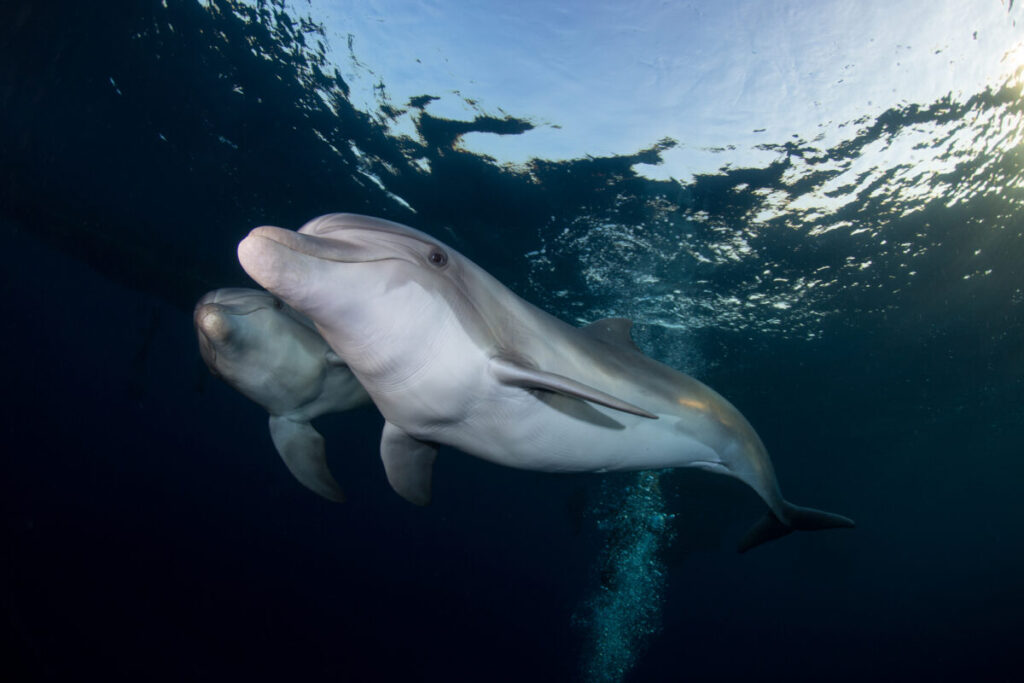
This species thrives in a variety of marine environments, including coastal areas, estuaries, and inshore waters, often favoring shallow coastal regions. The Indian Ocean Bottlenose Dolphin demonstrates a remarkable ability to adapt to different habitats within its range, showcasing its resilience and adaptability in various marine ecosystems. Its preferred habitats provide abundant food sources, social interaction opportunities, and suitable conditions for reproduction and nurturing of offspring, contributing to its overall well-being and survival.

By shedding light on the captivating characteristics, distribution, and habitat preferences of the Indian Ocean Bottlenose Dolphin, it is evident that this species holds a significant ecological and conservation value, emphasizing the importance of safeguarding its natural habitats and ensuring its long-term survival in the world’s oceans.

Facts About Indian Ocean Bottlenose Dolphin

  • The Indian Ocean Bottlenose Dolphin (Tursiops aduncus) can grow up to 2.6 meters (8.5 feet) in length and weigh up to 230 kilograms.
  • They are highly intelligent and graceful marine mammals known for their playful behavior and acrobatic displays.
  • These dolphins tend to live in shallow waters near the shore at depths of less than 300 meters.
  • The Indo-Pacific bottlenose dolphins occur throughout warm temperate and tropical coastal waters.
  • Indian Ocean Bottlenose Dolphins are found in four main regions around Australia: eastern Indian Ocean, Tasman Sea, Coral Sea, and Arafura/Timor Seas.
  • They are known to frequent bays, lagoons, channels, and river mouths.
  • The maximum size of Indian Ocean Bottlenose Dolphins is geographically variable, with lengths of about 2.7 meters and 230 kilograms.
  • They are social animals, often found in groups ranging from a few individuals to hundreds of dolphins.
  • These dolphins are threatened by human recklessness and greed, leading to conservation concerns for their population.
  • Indian Ocean Bottlenose Dolphins are a species of bottlenose dolphin, belonging to the genus Tursiops.


Scientific Provenance & Verified Sources

Biological taxonomy, conservation status, and physical traits are cross-referenced with authoritative global registers:


Peer-reviewed by Wildlife Science Editors โ€ข Updated for 2026

Explore Other Species Profiles