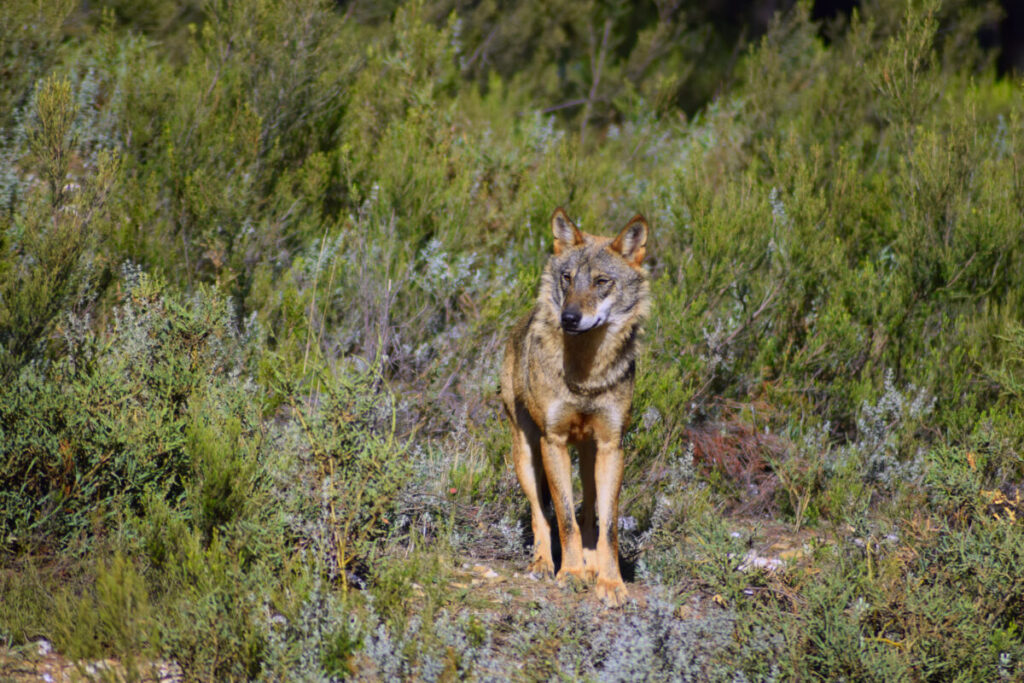
Iberian wolf standing on a narrow path among dense green shrubs

IUCN Red List Conservation Status


Endangered

LC
NT
VU
EN
CR
EW
EX

Official assessment evaluated in accordance with the IUCN Red List of Threatened Species criteria: Endangered.


Species Quick Facts

Scientific Name
Canis lupus signatus

Average Lifespan
6-10 years in wild, 12-14 years in captivity

Average Weight
30-50 kg (66-110 lbs) – Males: 35-50 kg, Females: 30-40 kg

Average Length
105-130 cm (41-51 inches) – head-body length excluding tail

Overview & Identification

The Iberian wolf (Canis lupus signatus) is a subspecies of the gray wolf that inhabits the mountainous and forested regions of the Iberian Peninsula, primarily in northโ€‘western Spain and northern Portugal. Classified within the family Canidae, it shares the typical canid morphology of a robust skull, erect ears, and a dense double coat that varies from grayโ€‘brown to reddishโ€‘black depending on season and locality. Adult wolves form the apex predator of their ecosystems, preying on ungulates such as red deer (Cervus elaphus), roe deer (Capreolus capreolus), and wild boar (Sus scrofa), while also scavenging carrion. Their range is fragmented by humanโ€‘dominated landscapes, but protected areas like the Picos de Europa and the Sierra de Gredos provide critical refuges. Conservation efforts focus on habitat connectivity, livestock compensation schemes, and legal protection under the EU Habitats Directive. The Iberian wolf remains a symbol of wilderness in Spain and Portugal, embodying both ecological importance and cultural significance.

Behavior & Social Structure

Iberian wolves live in cohesive packs of 5โ€‘12 individuals, typically a dominant breeding pair and their offspring from previous years. Packs maintain territories that average 150โ€‘300 kmยฒ, marked by scent rubs, urine, and vocal howls that reinforce boundaries and coordinate movements. They are crepuscular to nocturnal, with peak hunting activity at dusk and dawn, though human disturbance can shift activity to more nocturnal periods. Social cohesion is reinforced through grooming, play, and coordinated hunting, allowing the pack to take down prey larger than any single wolf. Communication includes a repertoire of howls, growls, whines, and body postures that convey rank, alarm, and recruitment. Dispersal of subโ€‘adults occurs at 1โ€‘3 years of age, facilitating gene flow between isolated populations.

Diet & Hunting Patterns

The Iberian wolf is an obligate carnivore, with a diet composed of 85โ€‘95% wild ungulates, primarily red deer, roe deer, and wild boar. Seasonal fluctuations see an increased reliance on smaller mammals such as European hares (Lepus europaeus) and wild rabbits (Oryctolagus cuniculus) during winter when large prey are scarce. Carrion from livestock predation or roadkill supplements their intake, accounting for up to 10% of the diet in heavily anthropogenic landscapes. Wolves hunt in coordinated packs, using endurance to chase prey over long distances and employing ambush tactics in dense cover. An adult wolf consumes roughly 2.5โ€‘3.5 kg of meat per day, but intake can double during the breeding season to support lactating females and growing pups. Their high protein diet supports strong musculature and the stamina required for territorial patrols spanning hundreds of square kilometers.

Reproduction & Life Cycle

Iberian wolves reach sexual maturity at 2โ€‘3 years for females and 2โ€‘4 years for males. Breeding occurs once a year, typically between January and March, with the dominant pair monopolizing reproduction. Gestation lasts 62โ€‘63 days, after which a litter of 4โ€‘6 pups is born in a den dug into a slope, hollow tree, or abandoned burrow. Neonates weigh 500โ€‘700 g and are altricial, relying entirely on the pack for warmth and food. The mother nurses for 6โ€‘8 weeks, while other pack members provide food through successive hunts. Pups are weaned at 8โ€‘10 weeks but remain in the pack for 1โ€‘2 years, learning hunting techniques and social cues. Juveniles disperse to form new packs or join existing ones, a process that reduces inbreeding and expands the population’s genetic diversity.

Threats & Conservation

The IUCN classifies the gray wolf (Canis lupus) as Least Concern, but the Iberian wolf faces regionโ€‘specific pressures that have reduced its numbers to an estimated 2,500โ€‘3,000 individuals. Primary threats include habitat fragmentation from roads, urban expansion, and intensive agriculture, which isolate subpopulations and impede gene flow. Illegal hunting and retaliatory killings related to livestock depredation remain significant, despite compensation schemes that cover 70% of reported losses. Climate change may alter prey availability, especially for ungulates that depend on specific vegetation cycles. Conservation actions focus on expanding protected corridors, enforcing antiโ€‘poaching laws, and promoting coexistence programs that integrate shepherds, ranchers, and wildlife managers. Population monitoring using genetic sampling indicates a modest increase in the last decade, but longโ€‘term viability depends on sustained mitigation of humanโ€‘wolf conflicts.

Interesting Facts

โ€ข The Iberian wolf is the only wolf subspecies native to Western Europe.
โ€ข Packs can travel up to 30 km in a single night while searching for prey.
โ€ข Genetic studies show limited introgression with domestic dogs, preserving its wild genome.
โ€ข Wolves can lower ungulate overโ€‘browsing, promoting forest regeneration.
โ€ข The iconic howl of the Iberian wolf can be heard up to 5 km away in open terrain.

Description

The Iberian wolf, scientifically known as Canis lupus signatus, is a subspecies of the grey wolf, Canis lupus. It has been isolated from mixing with other wolf populations for over a century, leading to distinctive genetic and behavioral traits. The Iberian wolf is an iconic symbol of the Iberian Peninsula and plays a crucial role in the region’s ecosystems.

Appearance

The Iberian wolf shares many physical characteristics with other grey wolf subspecies, but it possesses certain distinguishing features. Typically, it has a robust build, with a thick fur coat that provides insulation in the harsh mountainous terrain where it resides. The coat coloration varies from grey to brown, often with a reddish tint. Notably, the Iberian wolf tends to be smaller in size compared to other grey wolf subspecies, reflecting its adaptation to the rugged landscapes of the Iberian Peninsula.

Distribution

The Iberian wolf primarily inhabits the northwest of the Iberian Peninsula, encompassing regions of northwestern Spain and northern Portugal. This geographical isolation has contributed to the development of unique genetic traits and behaviors specific to the Iberian wolf population. Despite historical persecution and habitat loss, conservation efforts have helped maintain viable populations in these regions, with the potential for expansion into suitable habitats.

Habitat Preferences

The Iberian wolf thrives in diverse habitats, including rugged mountainous terrain, dense forests, and open scrubland. These ecosystems provide ample prey species and cover for denning, contributing to the species’ survival and well-being. The wolf’s presence in these habitats also influences the balance of local wildlife populations, contributing to the overall health of the ecosystem.

By highlighting the unique characteristics, appearance, distribution, and habitat preferences of the Iberian wolf, we can deepen our understanding of this remarkable species and the importance of conserving its natural habitats for future generations.

Facts About Iberian Wolf

  • The Iberian wolf is a subspecies of the gray wolf.
  • It is native to the Iberian Peninsula, including northwestern Spain and northern Portugal.
  • The Iberian wolf forms the largest wolf population in Western Europe.
  • Its coat varies in color from light grey to reddish brown.
  • The typical habitat of the Iberian wolf is the forest.
  • It has a diet that predominantly consists of ungulates.
  • The Iberian wolf lives in small packs and is considered a beneficial habitat species.
  • It has a large and robust head, relatively small ears, and yellowish eyes.
  • The Iberian wolf is smaller than many other subspecies of wolf, not weighing more than 100 lb.
  • Due to population controls and damage to livestock, the Iberian wolf has faced conservation challenges.


Scientific Provenance & Verified Sources

Biological taxonomy, conservation status, and physical traits are cross-referenced with authoritative global registers:


Peer-reviewed by Wildlife Science Editors โ€ข Updated for 2026

Explore Other Species Profiles