
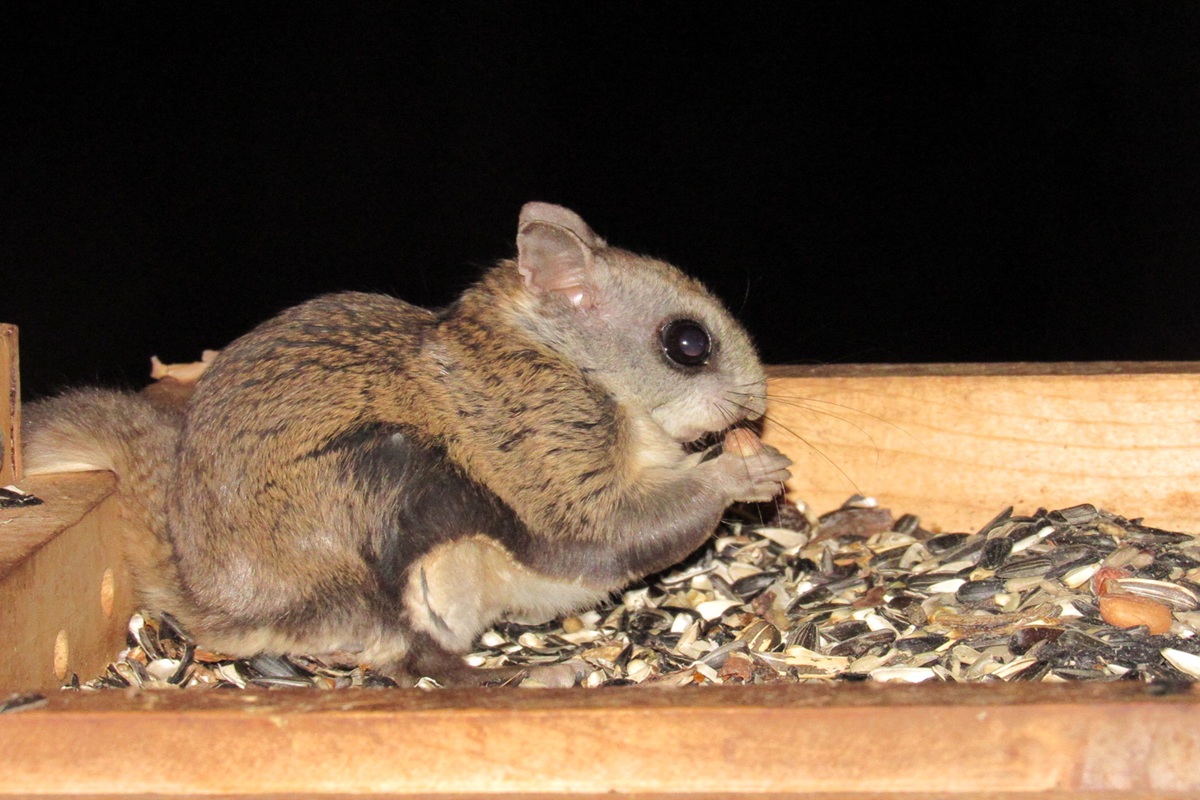
Description

Humboldt’s flying squirrel, scientifically known as Glaucomys oregonensis, is a remarkable species and one of three members of the genus Glaucomys, representing the only flying squirrels found in North America. This elusive mammal is renowned for its unique ability to glide through the air using a specialized membrane between its fore and hind limbs, allowing it to gracefully navigate through its forested habitat.
Appearance

Humboldt’s flying squirrel is characterized by its distinct physical features, including large, expressive eyes and a patagium, or gliding membrane, that extends from its wrists to its ankles. This membrane enables the squirrel to glide from tree to tree with astonishing agility, setting it apart from other species of squirrels. Its fur is soft and dense, typically ranging in color from gray to brown, providing effective camouflage within its wooded environment.
Distribution
The range of Humboldt’s flying squirrel spans the Pacific coast of North America, from southern British Columbia to southern California. This species is primarily found in coniferous and mixed coniferous forests, where it has adapted to thrive in these diverse ecosystems. Notably, its distribution overlaps with the habitat of other species, indicating the need for conservation efforts to ensure the preservation of its unique environment and population.
Habitat Preferences

Humboldt’s flying squirrel exhibits a strong preference for thick coastal forests with ample room for gliding between trees. These habitats provide the essential resources for its survival, including suitable nesting sites and a diverse array of food sources. The squirrel’s reliance on these ecosystems underscores the importance of preserving its forested habitat to maintain healthy population levels and ensure its long-term well-being.
Overall, Humboldt’s flying squirrel is a captivating species that plays a vital role in its forested ecosystem, and its conservation is essential to safeguard the biodiversity of North America’s Pacific coast.
Facts About Humboldt’s flying squirrel
- Humboldt’s flying squirrel (Glaucomys oregonensis) is one of three species of the genus Glaucomys, the only flying squirrels found in North America.
- They are found in coniferous and mixed coniferous forests from southern British Columbia to southern California.
- Humboldt’s flying squirrels have a body length of about 6.7 inches and a tail length of approximately 5.7 inches.
- This species primarily inhabits northern coniferous and mixed forests.
- The scientific name for Humboldt’s flying squirrel is Glaucomys oregonensis.
- They are nocturnal and primarily feed on a diet of lichens, fungi, insects, and seeds.
- Humboldt’s flying squirrels are known for their ability to glide from tree to tree using a patagium, a furry parachute-like membrane.
- Population genetic analysis has been used to characterize the intraspecific genetic structure and diversity of G. oregonensis.
- Humboldt’s flying squirrel was documented as a distinct species in papers published in 2017.
- The new species was named “Humboldt’s flying squirrel” in honor of German scientist and explorer Alexander von Humboldt.


