Hose's Palm Civet

IUCN Red List Conservation Status


Endangered

LC
NT
VU
EN
CR
EW
EX

Official assessment evaluated in accordance with the IUCN Red List of Threatened Species criteria: Endangered.


Species Quick Facts

Scientific Name
Diplogale hosei

Average Lifespan
8-10 years in wild, 12-15 years in captivity

Average Weight
1.5-2.5 kg (3.3-5.5 lbs) – Males: 2.0 kg, Females: 1.5 kg

Average Length
35-45 cm (13.8-17.7 inches) – head-body length excluding tail

Overview & Identification

The Hoseโ€™s palm civet (Diplogale hosei) is a small carnivoran belonging to the family Viverridae, order Carnivora. Endemic to the island of Borneo, it inhabits primary lowland and montane rainforests across Sabah, Sarawak, and Kalimantan, typically up to 1,500โ€ฏm elevation. It prefers dense, undisturbed forest with abundant understory and canopy connectivity, where it can move arboreally. Morphologically, the species displays a sleek, elongated body covered in dark brown dorsal fur, a lighter ventral side, and distinctive facial mask markings that give it a โ€œmaskedโ€ appearance. The tail is long, bushy, and often held upright, aiding balance in the trees. Its small size, keen sense of smell, and nocturnal habits make it an effective nocturnal predator and opportunistic forager. The species is listed as Endangered on the IUCN Red List due to rapid habitat loss and fragmentation, with an estimated population of fewer than 10,000 mature individuals. Conservation efforts focus on protecting remaining forest blocks, establishing corridors, and conducting ecological research to better understand its requirements.

Behavior & Social Structure

Hoseโ€™s palm civet is primarily solitary, with individuals maintaining exclusive home ranges that can span 1โ€“2โ€ฏkmยฒ in undisturbed forest. It is strictly nocturnal, emerging at dusk to forage and retreating to dense foliage or tree hollows before dawn. Territoriality is reinforced through scent marking using anal glands and occasional vocalizations such as low growls or chirps. While generally arboreal, it descends to the forest floor to exploit ground-dwelling prey and fallen fruit. Overlap between male and female ranges is limited, and direct interactions are rare outside the breeding season or motherโ€‘offspring encounters. Activity peaks during the early night hours, coinciding with the activity of many of its prey species, and it exhibits a high degree of stealth, moving silently through the canopy.

Diet & Hunting Patterns

The Hoseโ€™s palm civet is an opportunistic omnivore with a strong carnivorous bias. Its diet comprises small vertebrates such as rodents, shrews, and occasionally birds or amphibians, supplemented by a wide array of invertebrates including beetles, termites, and orthopterans. Fruit forms an important seasonal component, with figs, berries, and drupes consumed when available, providing essential carbohydrates. Foraging occurs both arboreally and on the forest floor; the civet uses its acute sense of smell to locate hidden prey and may employ a sitโ€‘andโ€‘wait strategy in branches or actively search leaf litter. Daily intake is estimated at 5โ€“10โ€ฏ% of body weight, and the species exhibits flexible feeding behavior, shifting its diet in response to prey fluctuations.

Reproduction & Life Cycle

Sexual maturity is reached at about 1.5โ€“2โ€ฏyears for both sexes. Breeding can occur throughout the year but shows a modest peak during the rainy season (Novemberโ€“February), when prey abundance is highest. After a gestation period of roughly 60โ€“70โ€ฏdays, females give birth to litters of one or two highly altricial young. Neonates are blind and weigh less than 50โ€ฏg. The mother provides exclusive care, nursing the kits for up to three months and protecting them within a den in a tree cavity or dense thicket. Weaning occurs at 2โ€“3โ€ฏmonths, after which juveniles begin to accompany the mother on short foraging trips. Dispersal typically happens at 8โ€“10โ€ฏmonths of age, when the young establish their own territories.

Threats & Conservation

The IUCN classifies Diplogale hosei as Endangered, primarily due to extensive deforestation driven by oilโ€‘palm plantation expansion, illegal logging, and mining activities across Borneo. Habitat loss has resulted in severe fragmentation, isolating populations and reducing genetic exchange. Although direct hunting pressure is low, occasional trapping for bushmeat and the pet trade adds localized mortality. Climate change poses an emerging threat by altering forest structure and prey availability. Current population estimates suggest fewer than 10,000 mature individuals, with a continuing decline of at least 30โ€ฏ% over the past three generations. Conservation actions include the protection of key forest reserves such as Kinabalu Park and Danum Valley, the establishment of ecological corridors, and communityโ€‘based monitoring programs aimed at reducing habitat encroachment.

Interesting Facts

โ€ข The species is the sole member of the genus Diplogale, making it phylogenetically distinct among viverrids.
โ€ข Its elongated, prehensile tail aids balance and can be wrapped around branches for stability.
โ€ข Hoseโ€™s palm civet was first described in 1905 by Oldfield Thomas, based on specimens collected by zoologist Charles Hose.
โ€ข It has a highly specialized auditory system, allowing it to detect lowโ€‘frequency sounds produced by nocturnal insects.
โ€ข Despite its small size, it can traverse gaps up to 3โ€ฏmeters by leaping between trees, showcasing remarkable arboreal agility.

Description

Hose's Palm Civet

Hose’s palm civet, scientifically known as Diplogale hosei, is a viverrid species endemic to the island of Borneo. This elusive mammal is listed as Vulnerable on the IUCN Red List due to an ongoing population decline, estimated to be more than 30% over the past three generations. Hose’s palm civet is characterized by its slender body, short legs, and a long, bushy tail. It possesses unique physical features, including long whiskers and partly webbed feet, which hint at its diverse diet and semi-aquatic lifestyle.

Appearance
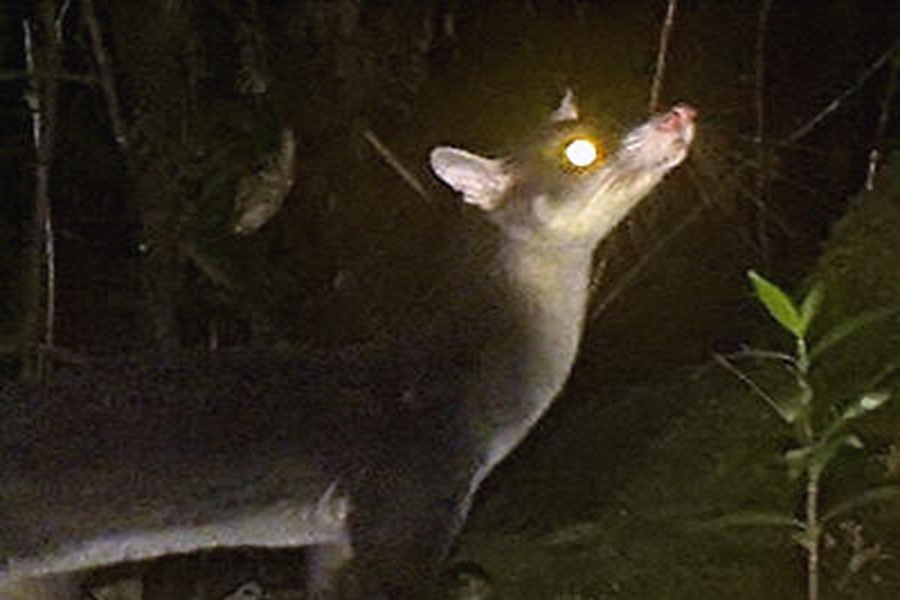
Diplogale hosei

This species is distinguished by its sleek, dark-brown fur with lighter underparts and distinctive markings around the face. The Hose’s palm civet exhibits a remarkable adaptation with partly webbed feet, a feature that sets it apart from other civet species and reflects its semi-aquatic tendencies.

Distribution

Hose’s palm civet is exclusively found on the island of Borneo, which includes the countries of Brunei, Indonesia, and Malaysia. Within this region, it primarily inhabits highly humid environments such as mossy forests, near mossy boulders, and streams. The species’ distribution is limited to specific pockets of suitable habitat within the island, making it vulnerable to habitat loss and fragmentation.

Habitat Preferences

Hose's Palm Civet Appearance

The preferred habitat of Hose’s palm civet includes dense, humid forests with access to water sources. It is known to thrive in mossy forests, near streams, and in areas with mossy boulders. These environments provide the necessary cover and food resources for the species, which is inferred to have a diet comprising a range of small vertebrates, such as frogs, crabs, shrimps, and fish. The semi-aquatic nature of Hose’s palm civet makes it particularly sensitive to changes in its habitat, emphasizing the importance of conservation efforts to safeguard its survival.

This comprehensive species profile aims to provide valuable insights into the unique characteristics, distribution, and habitat preferences of Hose’s palm civet, shedding light on the importance of conservation measures to protect this vulnerable species and its natural habitat.

Facts About Hose’s palm civet

  • Hose’s palm civet (Diplogale hosei) is a viverrid species that is endemic to the island of Borneo.
  • It is primarily observed in the northwestern hills and mountains of Borneo.
  • This species is listed as Vulnerable on the IUCN Red List due to an ongoing population decline of more than 30% over the last three generations.
  • Hose’s palm civet is one of the most elusive and least-understood species of civet in Southeast Asia.
  • It is estimated that Hose’s civet is restricted mainly to the highlands of Borneo, in an area less than 20,000 km2.
  • The species is known for its patchy distribution on Borneo.
  • Hose’s palm civet has a specialized diet, primarily consisting of fruits and small vertebrates.
  • It has a unique mating behavior and social structure within its habitat.
  • The lifespan of Hose’s palm civet in the wild is not well-documented but is estimated to be several years.
  • There are only a few museum specimens and limited data available for this species.


Scientific Provenance & Verified Sources

Biological taxonomy, conservation status, and physical traits are cross-referenced with authoritative global registers:


Peer-reviewed by Wildlife Science Editors โ€ข Updated for 2026

Explore Other Species Profiles