IUCN Red List Conservation Status


Least Concern

LC
NT
VU
EN
CR
EW
EX

Official assessment evaluated in accordance with the IUCN Red List of Threatened Species criteria: Least Concern.


Species Quick Facts

Scientific Name
Arctonyx collaris

Average Lifespan
Up to ~14 years

Average Weight
7-14 kg (15-31 lbs)

Average Length
55-70 cm (22-28 inches) – head-body length

Overview & Identification

The hog badger is a stocky badger of Central and Southeast Asia, named for the pig-like snout it uses to root for food. It has coarse grey fur, a white throat, and dark stripes on its face. Mainly nocturnal, it feeds on earthworms, insects, roots, and small animals.

Behavior & Social Structure

The hog badger (Arctonyx collaris) is primarily nocturnal and crepuscular, emerging from its burrow in the late afternoon or evening to forage and returning before dawn. During daylight hours it rests in self-dug burrows, rock crevices, or dense underbrush, often reusing or expanding burrows over time. This species exhibits a distinctive plantigrade, badger-like gait, and its long, pig-like snout โ€” the source of its common name โ€” is used for digging into soil and leaf litter in search of food.

Hog badgers are largely solitary animals outside of the breeding season and mother-offspring groups, with adults maintaining loosely defined, overlapping home ranges rather than strictly defended territories. They communicate through scent marking using well-developed anal and subcaudal glands, depositing secretions on prominent objects along travel routes to convey information about identity, reproductive status, and possibly territorial occupancy. Vocalizations include grunts, squeals, and growls, particularly during aggressive encounters or mating interactions, while tactile communication is important between mothers and young.

Adaptive behaviors include powerful foreclaws and robust forelimbs suited for digging both burrows and food from compacted soil, an acute sense of smell that compensates for relatively poor eyesight, and a thick hide that offers some protection against bites from prey or competitors. When threatened, hog badgers can emit a strong-smelling secretion from their anal glands, a defensive strategy shared with several other mustelids (source: IUCN Red List).

Diet & Hunting Patterns

As an opportunistic omnivore, the hog badger forages mainly at ground level, using its elongated snout and strong claws to root through soil, leaf litter, and rotting logs. Its diet includes earthworms, insects and their larvae, small vertebrates such as rodents, frogs, and reptiles, bird eggs, and carrion, supplemented substantially by plant matter including tubers, roots, fruits, and fungi. This generalist foraging strategy allows the species to exploit a wide range of forest and forest-edge microhabitats across its Southeast Asian range.

Seasonal shifts in diet are documented, with greater reliance on fruits and tubers during warmer, wetter months when these resources are abundant, and increased consumption of invertebrates and small vertebrates during leaner periods. The hog badger has moderate water dependency, typically foraging near streams, wet forest floors, or moist soil where invertebrate prey and root crops are more plentiful, and it obtains much of its water content directly from food sources such as fruits and prey tissue.

Reproduction & Life Cycle

Hog badgers exhibit a promiscuous or polygynous mating system, with breeding generally occurring between late winter and early spring (approximately February to March), though timing can vary regionally across their range in Southeast Asia. Gestation lasts approximately 6 to 8 weeks, sometimes extended by delayed implantation, a reproductive strategy seen in several mustelid species. Litters typically consist of 2 to 4 young, born in a secluded underground den lined with vegetation.

Maternal care is the primary form of parental investment, with the mother nursing and protecting the altricial young, which are born blind and largely helpless. Weaning occurs at roughly 2 to 3 months of age, after which juveniles gradually begin accompanying the mother on foraging excursions. Sexual maturity is generally reached by around 2 years of age, though specific reproductive parameters for wild populations remain incompletely studied compared to better-researched mustelids (source: Mammalian Species, Oxford Academic).

Threats & Conservation

The hog badger faces significant pressure from habitat loss and fragmentation driven by deforestation, agricultural expansion, and infrastructure development throughout Southeast Asia, particularly in Vietnam, Laos, Cambodia, Thailand, and parts of southern China and northeastern India. Despite its “Least Concern” global IUCN status, regional populations are experiencing notable declines, and the species has been reclassified as threatened in certain national assessments due to intensive snaring and hunting pressure for bushmeat, traditional medicine markets, and the illegal wildlife trade.

Snaring, a widespread and largely indiscriminate hunting method across Indochina, poses one of the most severe direct threats, often incidentally trapping hog badgers alongside targeted game species. Natural predators include large cats, dholes, and raptors targeting juveniles, though human-driven mortality far outweighs natural predation in most range countries. Conservation initiatives include inclusion in CITES Appendix III (in India), protected area management across parts of its range, and ongoing efforts by IUCN Species Survival Commission specialists to improve population monitoring and curb illegal trade (source: IUCN Red List).

Interesting Facts

  • Pig-Nosed Digger: The hog badger’s elongated, mobile, pig-like snout is a specialized adaptation for rooting through soil and leaf litter, functioning much like a miniature plow.
  • Taxonomic Reshuffling: Genetic studies have revealed that what was once considered a single wide-ranging species, Arctonyx collaris, actually comprises multiple distinct species, including Arctonyx albogularis and Arctonyx hoevenii, based on molecular and morphological divergence.
  • Chemical Defense: Like many mustelids, hog badgers possess well-developed anal scent glands capable of releasing a pungent secretion when threatened, serving as both a deterrent and communication tool.
  • Long Claws, Big Payoff: Their robust, elongated foreclaws allow them to excavate burrows and unearth buried food sources far more efficiently than many similarly sized carnivores.
  • Delayed Implantation Possibility: Some evidence suggests hog badgers may exhibit delayed implantation, a reproductive adaptation common among mustelids that allows flexible timing of birth relative to environmental conditions.
  • Snare Vulnerability Indicator: Because hog badgers are frequently caught in snares intended for other species, researchers use their capture rates as an indirect indicator of overall snaring intensity in Southeast Asian forests.
  • Ancient Mustelid Lineage: Arctonyx represents one of the more distinct evolutionary branches within Mustelidae, with fossil records indicating the genus has persisted with recognizable morphology for several million years.

Description

The Hog Badger, scientifically known as Arctonyx collaris, is a remarkable mammal belonging to the mustelid family. It is one of the three species of mustelids in the genus Arctonyx and is part of the subfamily Melinae, alongside the true badgers (genus Meles). This elusive creature possesses a unique set of characteristics that distinguish it from other members of the mustelid family.

Appearance
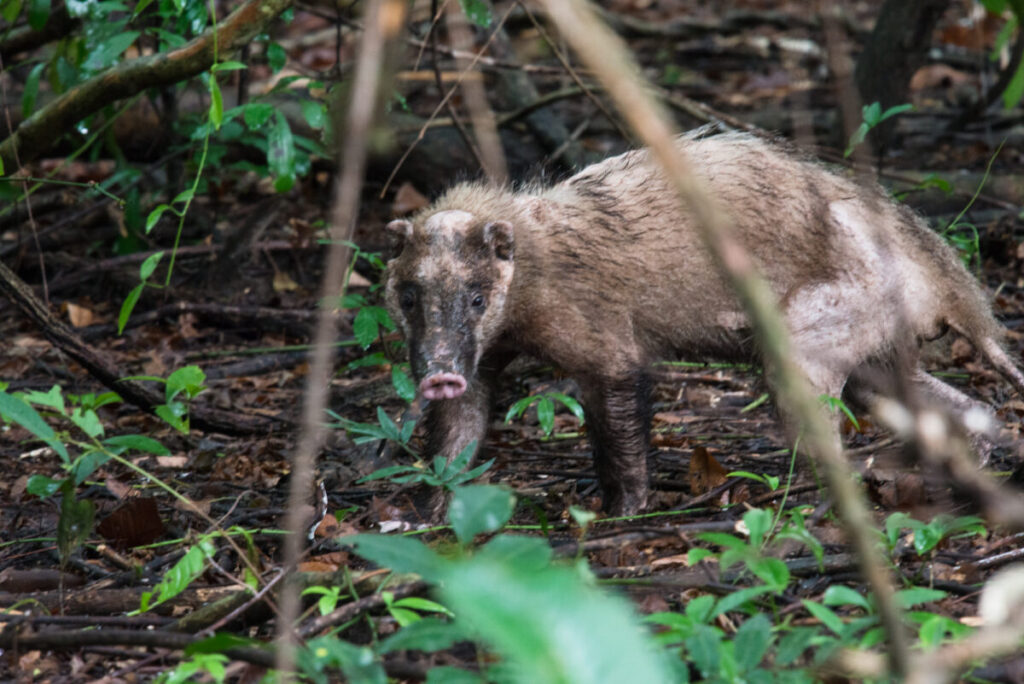
The Hog Badger is recognized for its distinctive appearance, characterized by a robust body, short legs, and a pointed snout. Its fur is predominantly black with a white dorsal stripe running from the head to the base of the tail, enhancing its striking visual appeal. This species is easily differentiated from other badgers due to its larger size and the prominent white stripe on its back.

Distribution

The Hog Badger is native to the lush landscapes of Central and Southeast Asia, where it can be found in countries such as India, Myanmar, Thailand, and other regions within its range. It exhibits notable population densities in tropical evergreen forests, grasslands, and hilly terrains. However, due to various environmental factors and human activities, its population is facing challenges, leading to its classification as a vulnerable species.

Habitat Preferences

This species thrives in a variety of habitats, including grasslands, hills, mountains, and tropical evergreen forests. The Hog Badger’s survival and well-being are intricately linked to these diverse ecosystems, as they provide essential resources for its sustenance and shelter. The species’ adaptability to different habitats underscores its ecological significance and highlights the importance of preserving these environments to ensure its continued existence.

By shedding light on the unique characteristics, distribution, and habitat preferences of the Hog Badger, we gain a deeper understanding of this fascinating species and the critical role it plays in its natural environment. Conservation efforts aimed at safeguarding its habitats and addressing the factors impacting its population are vital to ensuring the long-term survival of the Hog Badger and preserving the biodiversity of its native regions.

Facts About Hog Badger

  • The hog badger (Arctonyx collaris) is a large terrestrial mustelid native to Central and Southeast Asia.
  • It is listed as Vulnerable in the IUCN Red List of Threatened Species.
  • The hog badger is considered fairly common in Thailand and in tropical evergreen forests and grasslands of the Terai in northeastern India and eastern Bangladesh.
  • Adult hog badgers can weigh up to 21 lbs and reach a length of up to 2.3 feet, with an additional 7.9 inch tail.
  • Their lifespan can reach up to 14 years in the wild.
  • Hog badgers primarily feed on insects, small mammals, birds, and fruits.
  • They are known for their distinctive physical appearance, with a stocky body, short legs, and a long, thick tail.
  • Hog badgers are primarily nocturnal and solitary animals.
  • They are skilled diggers and create burrows for shelter and raising their young.
  • The species is distributed primarily in Southeast Asia, ranging from Sikkim and northeastern China to Thailand.


Scientific Provenance & Verified Sources

Biological taxonomy, conservation status, and physical traits are cross-referenced with authoritative global registers:


Peer-reviewed by Wildlife Science Editors โ€ข Updated for 2026

Explore Other Species Profiles