Hainan Black-Crested Gibbon

IUCN Red List Conservation Status


Critically Endangered

LC
NT
VU
EN
CR
EW
EX

Official assessment evaluated in accordance with the IUCN Red List of Threatened Species criteria: Critically Endangered.


Species Quick Facts

Scientific Name
Nomascus hainanus

Average Lifespan
About 30–40 years in the wild, possibly up to ~55.

Average Weight
8-22 kg

Average Length
48-49

Overview & Identification

The Hainan black-crested gibbon is the world’s rarest ape, found only on Hainan Island, China. Males are black while females are golden-buff, and the species lives in small family groups that sing to defend their territory. With only around 40 individuals remaining, it is critically endangered.

Behavior & Social Structure

The Hainan black-crested gibbon (Nomascus hainanus) is strictly diurnal, becoming active shortly after dawn and retreating to sleeping trees before dusk. Its daily activity is dominated by canopy travel via brachiation, foraging bouts, resting, and social interaction, with peak activity typically occurring in the early morning hours when the species also engages in its most conspicuous behavior: loud, coordinated song bouts. These vocal duets, led by the mated pair and often joined by subadults, function to advertise territorial boundaries and reinforce pair bonds, and can carry over a kilometer through the dense forest canopy of Bawangling National Nature Reserve on Hainan Island, the species’ last remaining stronghold.

Social organization is typically multi-male, multi-female or extended family groups, a rarity among gibbons that are usually monogamous pair-living; recent research indicates Hainan gibbon groups often contain one adult male, two to three adult females, and their offspring, likely an adaptation to the extreme population bottleneck and limited availability of unrelated mates. Groups defend well-established but overlapping home ranges (roughly 100–150 hectares), with territoriality maintained largely through vocal signaling rather than direct physical confrontation. Communication also includes tactile grooming, which reinforces social bonds within the tight-knit family unit, alongside subtle postural and facial signaling used in close-range interactions.

Adaptive behaviors include highly specialized brachiating locomotion suited to the disturbed, fragmented forest patches that remain in their range, allowing them to exploit a mosaic of primary and regenerating secondary forest. Because their habitat is now confined to a very small, isolated area, individuals show flexible ranging patterns, adjusting movement to exploit patchily distributed fruiting trees while minimizing overlap with neighboring groups.

Diet & Hunting Patterns

As frugivores, Hainan black-crested gibbons preferentially consume ripe, sugar-rich fruits, which typically make up more than half of their diet when available, supplemented substantially with young leaves, flowers, and occasionally insects or other invertebrates for protein. Foraging occurs in the upper and middle canopy, where gibbons use their long arms and hooked hands to reach and manipulate fruit clusters while maintaining balance via brachiation rather than quadrupedal movement. Preferred food trees include various Ficus (fig) species, which serve as critical keystone resources due to their asynchronous and prolonged fruiting, alongside other native Hainan rainforest trees.

Seasonal shifts are pronounced: during fruit-scarce months, especially in cooler, drier periods, the gibbons increase consumption of leaves and flowers to compensate for reduced fruit availability, demonstrating dietary flexibility crucial to survival in a highly fragmented habitat. Water is obtained primarily through food moisture content and rainwater collected in tree hollows or on leaves, as the species rarely, if ever, descends to the ground to drink, an adaptation that also reduces predation risk and reflects its almost fully arboreal lifestyle.

Reproduction & Life Cycle

Breeding is not strictly seasonal but tends to peak during periods of higher fruit abundance, ensuring sufficient maternal nutrition. Hainan gibbons exhibit an unusual polygynous mating system relative to other gibbon species, with single-male, multi-female groupings documented in the wild population, likely a consequence of severe population decline and skewed sex ratios rather than an ancestral trait. Gestation lasts approximately 7 to 7.5 months (around 200–212 days), typically resulting in a single offspring; twins are exceptionally rare among gibbons generally.

Infants are cared for intensively by the mother, who nurses and carries the offspring continuously for the first several months, with juveniles remaining closely associated with the family group for years afterward. Weaning generally occurs around 18–24 months of age, while sexual maturity is reached at approximately 6–8 years for females and slightly later for males. Given the critically small population, successful reproduction and infant survival are of paramount conservation concern, with each birth representing a meaningful contribution to the species’ long-term viability.

Threats & Conservation

The Hainan black-crested gibbon is one of the rarest mammals on Earth, with a wild population historically estimated at fewer than 40 individuals for decades, though recent monitoring (as of 2024–2025) suggests slow, encouraging growth to around 42–43 individuals across six to seven family groups, still confined almost entirely to Bawangling National Nature Reserve. The overriding historical threat has been catastrophic habitat loss and fragmentation due to logging, agricultural conversion (notably rubber and pulpwood plantations), and infrastructure development across Hainan Island, which reduced the species’ range to a tiny fraction of its former extent and left surviving populations isolated in disconnected forest fragments, limiting genetic exchange and increasing extinction risk from stochastic events.

Historic hunting pressure for traditional medicine and bushmeat contributed heavily to the population crash in the 20th century, though poaching has been largely curtailed through strict protection measures. Ongoing threats include continued habitat degradation at forest edges, limited availability of high-quality contiguous canopy for range expansion, and vulnerability to typhoons and climate-related disturbances given the tiny population size. Conservation initiatives, led by organizations including Fauna & Flora International, the Hainan provincial government, and Chinese Academy of Sciences researchers, include installation of canopy “rope bridges” over habitat gaps caused by a landslide, active reforestation and forest corridor restoration projects, intensive ranger-based monitoring, and long-term ecological research aimed at expanding usable habitat and reducing fragmentation, making this one of the most closely managed primate conservation programs in the world.

Interesting Facts

  • World’s Rarest Ape: The Hainan black-crested gibbon is widely recognized as the rarest primate and rarest ape species on Earth, with a total population numbering only in the low forties.
  • Dramatic Color Change: Infants are born pale yellow, males turn entirely black at sexual maturity, while adult females revert to a golden-buff coloration with a distinctive black cap on the crown.
  • Engineered Canopy Bridges: Conservationists installed artificial rope bridges across a landslide-created canopy gap in Bawangling, successfully enabling gibbons to cross and access previously isolated habitat patches.
  • Unusual Group Structure: Unlike most gibbon species, which are monogamous, Hainan gibbons often live in polygynous groups with one male and multiple breeding females, an adaptation likely linked to their population bottleneck.
  • Singing Duets: Mated pairs perform elaborate, synchronized vocal duets at dawn that can be heard over a kilometer away, used to defend territory and strengthen pair bonds.
  • Extreme Population Bottleneck: The species declined from an estimated population in the thousands in the mid-20th century to as few as 7–9 individuals by the 1970s–1980s, making its slow recovery a landmark conservation success story.
  • Never Touches the Ground: Almost entirely arboreal, this gibbon rarely if ever descends to the forest floor, obtaining all food and water from the canopy throughout its lifetime.

The Hainan black-crested gibbon (Nomascus hainanus) is a Critically Endangered species of gibbon. Formerly considered a subspecies of the Eastern black-crested gibbon, it is now recognized as a distinct species. This remarkable primate is known for its unique characteristics, distribution, and habitat preferences.

Description

Hainan Black-Crested Gibbon

The Hainan black-crested gibbon is characterized by its glossy black fur and a distinctive crest of long, shaggy hair on top of its head. It exhibits sexual dimorphism, with males and females displaying different coloration. The species is renowned for its melodious calls, which are an integral part of their social behavior and communication.

Appearance
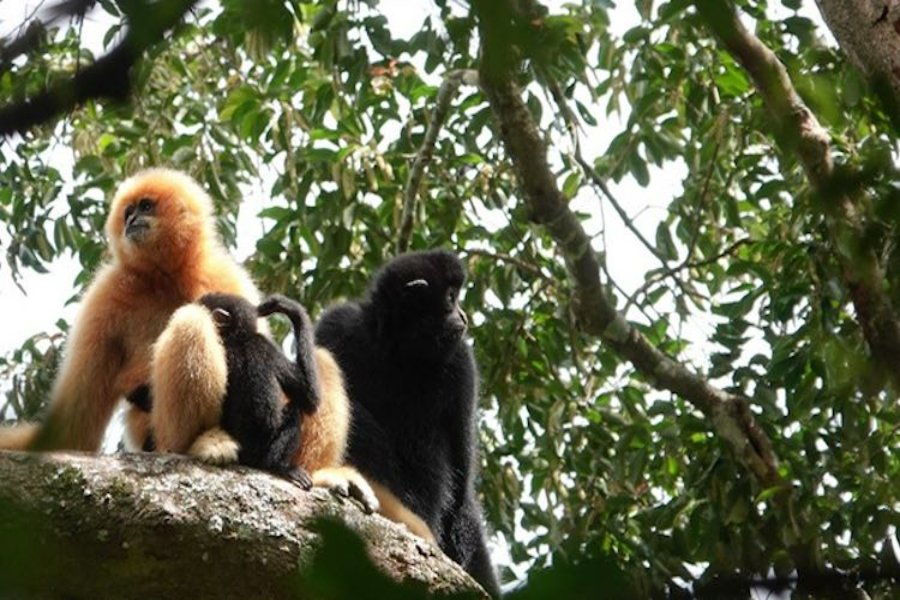
Hainan Black-Crested Gibbon Appearance

These gibbons are distinguished by their glossy black fur and the prominent crest of hair on their heads. Adult males and females exhibit different coloration, with males having a striking white or light-colored throat sac, which they use to amplify their calls. The Hainan black-crested gibbon’s appearance sets it apart from other gibbon species and contributes to its unique identity.

Distribution

The entire population of the Hainan black-crested gibbon is confined to the Hainan Island in China. This limited distribution makes the species particularly vulnerable to habitat loss and fragmentation. The gibbons predominantly inhabit the mountainous tropical rainforests of the island, with their presence concentrated within specific areas, emphasizing the critical need for conservation efforts to protect their remaining habitat.

Habitat Preferences

Hainan Black-Crested Gibbon Habitat

The Hainan black-crested gibbon thrives in mountainous tropical rainforests and semi-deciduous monsoon forests. These arboreal creatures are perfectly adapted to life in the treetops, where they demonstrate remarkable agility and speed. Their survival and well-being are intricately linked to the diverse ecosystems of the rainforests, which provide them with a rich variety of fruits and foliage essential for their diet and sustenance.

“`

Facts About Hainan Black-Crested Gibbon

  • The Hainan black-crested gibbon (Nomascus hainanus) is a critically endangered species found only on Hainan Island, China.
  • It is suggested that they are the rarest mammals in the world.
  • The population size is estimated to be over 25 individuals.
  • Hainan black-crested gibbons weigh between 5.8-10.12.8-22 kg (12.8-22 lbs) and have a length of 48-49 cm (18.9-19.3 inches).
  • They are known to inhabit the dense tropical forests of Hainan Island.
  • Hainan black-crested gibbons live in groups with a fixed home range.
  • The species was once widespread across Hainan, China, but is now found only in the Bawangling National Nature Reserve.
  • Hainan black-crested gibbons are listed as critically endangered by the IUCN.
  • Their diet and habitat are important factors for their survival and conservation.
  • Efforts are being made to protect and conserve the remaining population of Hainan black-crested gibbons.


Scientific Provenance & Verified Sources

Biological taxonomy, conservation status, and physical traits are cross-referenced with authoritative global registers:


Peer-reviewed by Wildlife Science Editors • Updated for 2026

Explore Other Species Profiles