
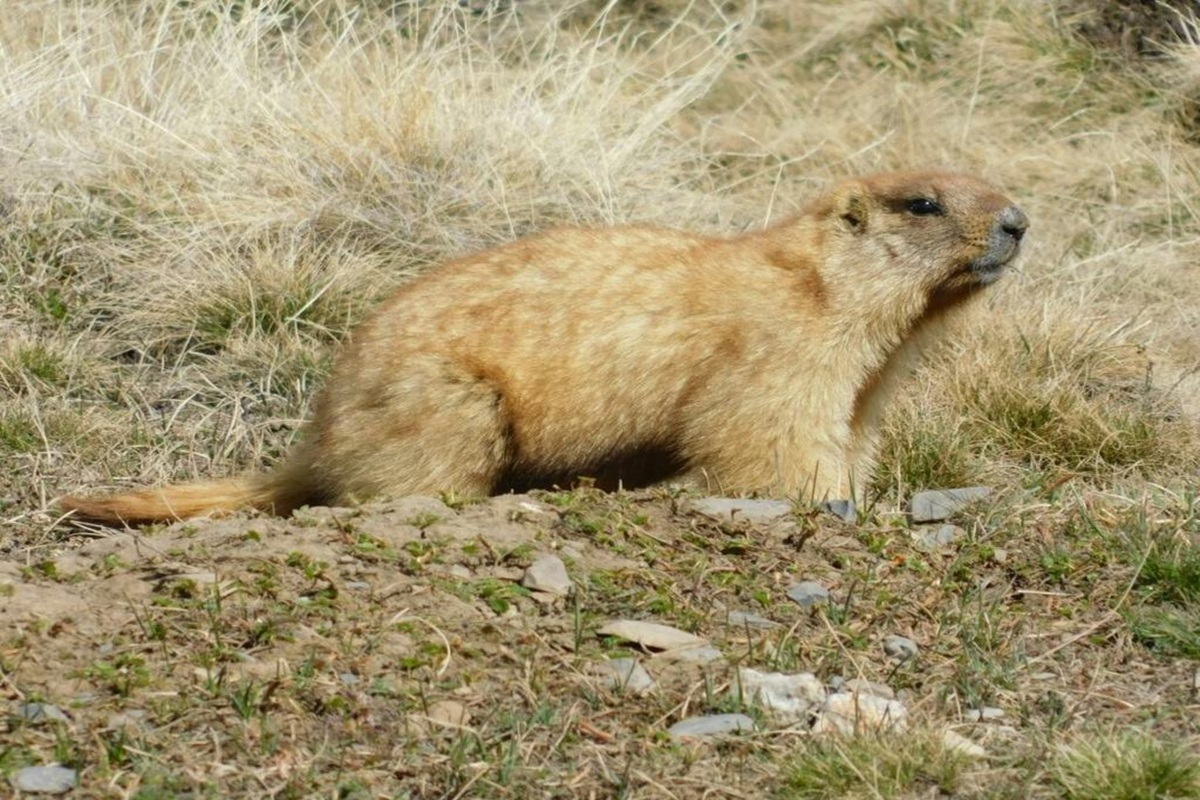
Description

The Gray Marmot, also known as the grey marmot or Altai marmot, is a notable species of rodent belonging to the squirrel family Sciuridae. It is recognized as one of the larger marmot species within the genus Marmota. Gray marmots are renowned for their social behavior and their ability to dig intricate burrow systems in their natural habitats.
Appearance

Gray marmots are characterized by their robust build, short but sturdy legs, and large heads. They possess enlarged claws that are well-adapted for digging, a distinctive feature that sets them apart from other species. Their fur coloration typically ranges from shades of gray to brown, with some variations observed in different populations.
Distribution
The Gray Marmot is primarily found in the mountainous grasslands and shrub lands of central Asia. Its distribution encompasses regions such as the Altai Mountain range in western Siberia (Russia), western Mongolia, and parts of Kazakhstan. This species’ distribution is notable for its association with specific geographic features and ecosystems, which influence its population density and behavior.
Habitat Preferences

Gray marmots thrive in a variety of habitats, including mountain meadows, steppes, and tundra. They exhibit a preference for open country in mountainous and plains regions, often favoring montane meadows, steppes, and forest edges. These environments provide the necessary resources for their survival, including food sources and suitable conditions for burrow construction.
This species’ habitat preferences are closely linked to its ecological role within these ecosystems, contributing to the overall biodiversity and functioning of the natural landscapes it inhabits.
I hope this profile provides a comprehensive overview of the Gray Marmot, highlighting its unique characteristics, distribution, and habitat preferences. If you require any further information, feel free to ask!
Facts About Gray marmot
- The gray marmot, also known as Marmota baibacina, is one of the larger marmot species, weighing between 4 to 6.5 kg (9 to 14.5 pounds).
- These marmots are typically found in the Altai Mountain range in western Siberia (Russia), western Mongolia, and Xinjiang Province in China.
- Gray marmots have a head-body length ranging from 460 to 650 mm and a tail length of 130 to 154 mm.
- They primarily feed on fruits, seeds, and plants, with their diet consisting of 30% fruit, 30% seeds, and 40% plants.
- The average adult weight of a gray marmot is approximately 3.50 kg (7.716 lbs), with a birth weight of around 30 grams.
- These marmots have lightly grizzled brown to charcoal dorsal pelage, with conspicuous suffusion.
- Gray marmots are known for their distinctive appearance, characterized by their grizzled brown to charcoal dorsal pelage.
- They are a species of rodent in the squirrel family Sciuridae, and are closely related to the Tarbagan or Mongolian marmot (Marmota sibirica).
- Gray marmots are well adapted to their mountainous habitats, where they construct burrows for shelter and hibernation.
- These marmots are known for their social behavior, living in colonies and communicating through vocalizations and body language.


